
What happens when two men with absolutely nothing to lose decide they deserve to be kings?
I was walking the lakefront with Denise last Sunday — one of those gray Chicago mornings where the wind off the lake makes you question every life choice — and I figured ninety minutes of Kipling would pair nicely with the misery. What I didn't expect was to finish the whole thing before we even looped back to the car, standing on the path with my earbuds in, telling Denise to hold on because Dravot was about to do something incredibly stupid and I needed to hear how it landed.
Two Scoundrels and the Empire That Made Them
Let's talk about what Kipling is really saying here, because on the surface this is a rollicking adventure tale — two British drifters, Peachey Carnehan and Daniel Dravot, decide to march into Kafiristan (modern-day Afghanistan) and crown themselves rulers. They've got rifles, a half-baked contract they sign with each other swearing off liquor and women, and the kind of delusional confidence that only the British Empire could manufacture.
But underneath that adventure is something darker and more interesting. Kipling wrote this in 1888, and he's already asking whether the whole colonial project is just two con men writ large. Dravot doesn't just want to rule — he starts believing he deserves to rule, that he's some kind of descendant of Alexander the Great. The Masonic symbols the locals recognize, the way the tribal leaders fall in line — it all feeds his delusion until he can't tell the difference between the con and reality. This reminds me of what Hemingway said about how every man's life ends the same way, and it's only the details of how he lived that distinguish one man from another. Dravot's distinction is that he lived — and died — inside his own mythology.
My students would hate this. I love it. They'd call Dravot and Carnehan problematic (they are), but they'd miss the way Kipling is already critiquing the machine he was part of. The narrator of the story — a journalist, Kipling's stand-in — watches these two with a mix of horror and fascination, and there's a moment where you realize he's not sure if they're fundamentally different from the administrators running India. That's the knife twist.
Harrison's Voice Carries the Dust and the Swagger
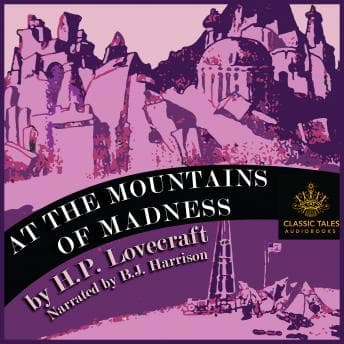
B.J. Harrison does something smart with this material. The story is told in layers — the journalist narrator recounting what Carnehan told him — and Harrison shifts his register just enough that you always know which voice you're hearing. His Carnehan has this rougher, lower-class British energy, a man who's been sunburned and beaten down but still talks with the bravado of someone who once held a kingdom. His Dravot, filtered through Carnehan's retelling, sounds grander, more theatrical — which is exactly right, because Dravot was always performing.
The narrator understands that pause is punctuation. When Carnehan describes the bridge — that awful, inevitable bridge scene — Harrison doesn't rush through it. He lets the silence do work. You can practically feel the rope and the wind. The pacing is deliberate, and at 1h 32m, there's no fat on this thing. Every sentence earns its place.
I will say Harrison captures what one listener perfectly described as the ability to make you "smell, hear, and feel the country this story falls from." Kipling's prose is dense with sensory detail — the heat of the Indian plains, the cold of the mountain passes — and Harrison reads it like a man who's actually uncomfortable, not like someone performing discomfort from a recording booth.
The Prose Deserves to Be Savored (Yes, Even Kipling's)
I know. Kipling is complicated. You can't teach him without the conversation about colonialism, and you shouldn't. But the prose deserves to be savored — the man could write a sentence that cuts. At barely over ninety minutes, this is the kind of listen where you realize how much modern adventure fiction owes to a story written over 130 years ago. If you loved Heart of Darkness, this is its spiritual successor — or maybe its predecessor, since Kipling got there first and with more dark humor.
The contract scene between Carnehan and Dravot alone is worth the listen. Two men sitting in a train car, dead serious, signing a handwritten agreement about how they'll conquer a country. It's absurd. It's also exactly how empires actually worked.
Worth Pausing the Faculty Meeting For
At ninety-two minutes, this is a single walk, a single grading session, a single faculty meeting you're definitely not paying attention to. (Sorry, Principal Martinez.) It's short enough to demand focus and tight enough to reward it. That same tight pacing drives Maze Runner, though Dashner trades colonial hubris for dystopian survival — different genre, same relentless forward momentum. If you're looking for something to remind you why we still read the classics — why Kipling's best work survives despite everything we now understand about his worldview — this is a sharp, brutal little gem. Harrison's performance gives it the weight it deserves without overplaying the drama.
Just don't listen to it on a bridge.