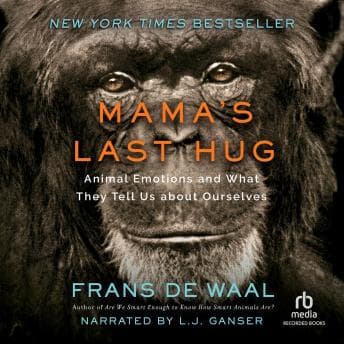

Frans de Waal made me cry on a Tuesday morning jog through Cambridge. There I was, dodging puddles near the Charles River, and this primatologist is describing Mama—a dying chimpanzee matriarch—reaching out to embrace her old friend Jan van Hooff one final time. I had to stop running. Just stood there like an idiot, earbuds in, getting emotional about an ape I never met.
This is what happens when a scientist spends forty years watching primates and finally says, "You know what? They feel things. Real things. And we need to stop pretending otherwise." De Waal isn't some sentimental pet owner projecting human emotions onto animals. He's methodical about it. He builds his case like a prosecutor—here's the evidence for grief, here's the evidence for empathy, here's the evidence for what looks suspiciously like shame. The research shows that rats will help other rats in distress even when there's nothing in it for them. Rats! Those little creatures we've been using as symbols of selfishness for centuries.
Dismantling the Wall Between Species
What makes this book compelling is de Waal's willingness to tear down the artificial barrier we've built between human and animal emotion. As someone who analyzes character motivations for a living, I found myself nodding along constantly. He argues that emotions evolved for a reason—they're not some uniquely human software upgrade that appeared out of nowhere. Talking to Strangers explores a similar theme about misreading emotional cues—though Gladwell focuses on human-to-human failures rather than the cross-species kind. Fear keeps you alive. Attachment keeps your offspring alive. Empathy keeps your social group functioning. The building blocks are ancient.
He's not saying your dog experiences existential dread about mortality (my therapist would have thoughts about that character). But he is saying that when elephants return to the bones of their dead relatives and touch them gently with their trunks, something is happening there. Something real. Something we shouldn't dismiss just because it makes us uncomfortable about the bacon we had for breakfast.
The book weaves between rigorous scientific observation and surprisingly tender storytelling. De Waal writes accessibly without dumbing things down—a skill I wish more academics possessed (looking at you, every colleague who thinks jargon equals intelligence). He'll describe a complex study about facial recognition in chimps, then pivot to a story about a bonobo who adopted an injured bird and tried to help it fly. Invisible Women uses that same technique—hard data punctuated by individual stories—to make you care about statistics you'd normally skip. The mix works.
L.J. Ganser: Steady Hand, Muted Heart
Okay, so. L.J. Ganser. His narration is technically fine. Clear, professional, no weird audio issues. But there's something almost too neutral about it? Like he's reading a particularly interesting textbook rather than a book about love and grief and the deep emotional lives of creatures we share this planet with.
I couldn't find much about Ganser's background online, but based on this performance, he's going for "authoritative science narrator" and mostly hitting it. The problem is that de Waal's writing has genuine warmth and humor, and Ganser's delivery sometimes flattens it. There were moments—especially the more moving passages about Mama—where I wanted more emotional texture in the voice.
Some listeners apparently found it monotonous enough to recommend the print version instead. I get that. I don't fully agree, but I get it. For me, the neutral tone actually worked during the denser scientific sections. It kept things grounded. But during the stories? I wanted him to lean in more.
If you listen to a lot of academic audiobooks, you'll be fine. If you're coming from fiction with dynamic narrators, adjust your expectations.
Who This Is (and Isn't) For
Perfect for anyone interested in animal behavior, cognitive science, or just... thinking about what consciousness means. Also weirdly good for people going through something emotionally. (Don't ask me why hearing about grieving elephants helped me process my own stuff. It just did.) Skip it if you need your narrators to perform, or if you're the type who gets annoyed when scientists anthropomorphize—though de Waal addresses that criticism directly and, I think, effectively.
I listened at 1.25x speed during my morning runs and cooking sessions, and that felt right. The pacing is steady but not slow. Ten hours is a commitment, but it never dragged for me. Though honestly, I paused a lot. Not because it was boring—because I needed to think.
What Mama Taught Me
My mother would probably say I'm spending too much time thinking about chimpanzee emotions when I could be thinking about my own life choices. She's not wrong. But also, Maa, this is basically the same thing.