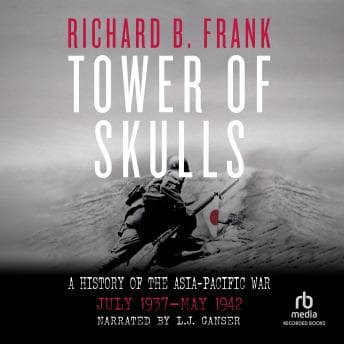

Twenty-six hours. That's a serious commitment, even for someone who spent years on aircraft where entertainment meant staring at cargo straps. But Richard B. Frank's Tower of Skulls earned every minute of my time—and then some.
I started this one during a week of client site visits across Texas. Long stretches of I-35, bad coffee, and a book about a theater of war that most Americans couldn't locate on a map. Perfect combination, actually. By the time I hit San Antonio, I was genuinely angry at how little I'd been taught about the China-Burma-India theater during my own military education.
Where the Pacific War Actually Started
Let me cut to the chase: if you think World War II in the Pacific began at Pearl Harbor, you're missing four years of context. Frank starts in 1937 with Japan's invasion of China, and suddenly everything I thought I knew about the war needed recalibrating. The Rape of Nanking. The Burma Road. The fall of Singapore. These weren't just preludes—they were the main event for millions of people while Americans were still debating isolationism.
What impressed me most was Frank's refusal to treat this as a simple good-versus-evil narrative. Don't get me wrong—the Japanese military committed atrocities that'll make your stomach turn. But Frank also examines the political chaos within China, the colonial arrogance of the British, and the strategic blindness of American planners. I've seen this scenario play out in real life—the fog of war isn't just about visibility, it's about understanding. And in 1941, nobody understood what was coming.
The author clearly did his homework. Frank pulls from Japanese, Chinese, British, and American archives. He's got diaries from junior officers and diplomatic cables from heads of state. The level of detail is staggering—and yeah, some listeners have complained it's too much. I get it. This isn't light listening. But for those of us who want to understand why decisions were made, not just what happened, the depth is exactly right.
L.J. Ganser Behind the Microphone
Here's where I need to be honest—I couldn't find much background on Ganser beyond this performance. But based on what I heard? The guy's solid. His pacing is steady without being monotonous, which matters when you're covering complex military operations across three continents. Some folks have mentioned his Midwestern accent can be distracting. Didn't bother me one bit. (Maybe because I've served with guys from every corner of America and you learn to focus on content, not accent.)
What Ganser does well is maintain that neutral, objective tone that serious history requires. He's not trying to be dramatic. He's not adding theatrical flourishes to battle descriptions. He just delivers the material and lets Frank's writing do the heavy lifting. For 26 hours of dense military history, that's exactly what you want.
I listened at my usual 1.25x, and it worked fine. Ganser's enunciation is clear enough that you don't lose anything at speed. Though I'll admit—during the chapters on Bataan and Corregidor, I slowed it down. Some things deserve your full attention.
The Gut-Punch Moments
This is where the book lost me a few times—not because of quality, but because of weight. Frank doesn't sanitize the civilian casualties. Twenty-five million dead across the region. He puts names and stories to that number whenever possible. Driving through Hill Country at sunset, listening to accounts of the Manila massacre... I had to pull over once. Ranger looked at me like I'd lost my mind.
But that's what good history does. It makes you feel the cost.
Where it genuinely dragged was some of the diplomatic back-and-forth in Washington and Tokyo. Important context, sure. But after the third chapter of bureaucratic maneuvering, I was ready to get back to the operational level. That's a personal preference, though—if you're into political history, you'll probably love those sections.
SITREP
This is volume one of a trilogy, and I'm already committed to the next two. Frank has created something that fills a massive gap in popular understanding of World War II. Most Americans know Midway and Iwo Jima. They don't know the Burma campaign or the Chinese resistance. They should. For a different kind of historical deep-dive—one that's equally dense but focused on nation-building rather than war—Alexander Hamilton offers that same commitment to understanding context most people miss.
Who should skip this: Anyone looking for a quick overview. Anyone who gets bored by operational details. Anyone who wants heroes without complexity.
Who should listen: History buffs who want the real story. Veterans who understand that war is chaos organized by paperwork. Anyone tired of the Eurocentric version of WWII.
Mission accomplished, Mr. Frank. Ranger approved this one—he sat through every mile of it. And if my German Shepherd can handle 26 hours of Pacific War history, so can you.






![Steve Jobs [unabridged audiobook] audiobook cover](/_next/image?url=https%3A%2F%2Fcovers.audiobooks.com%2Fimages%2Fcovers%2Ffull%2F9788499923406.jpg&w=1920&q=75)