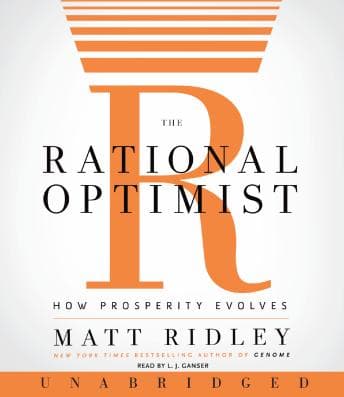

Thirteen hours. Thirteen hours of someone telling me the world isn't on fire. My parents spent 40 years behind a dry cleaning counter, and I've watched three startups implode this year alone—so forgive me if I approached Matt Ridley's aggressive optimism with the enthusiasm of a man being handed a pamphlet about timeshares.
But here's the thing. The man has receipts.
When Data Punches You in the Face
Ridley's core argument isn't "everything is fine, stop worrying." It's that exchange—the simple act of trading stuff and ideas between humans—created a compounding effect that lifted us from caves to iPhones. He traces this from Stone Age obsidian trading routes to container shipping, and the throughline is weirdly convincing. The section on how specialization allows ideas to "have sex" with each other (his phrase, not mine) finally gave me language for something I'd seen at McKinsey but couldn't articulate: why diverse teams outperform homogeneous ones even when the homogeneous team has higher individual talent.
The data is relentless. Child mortality rates, caloric intake per dollar, hours of work required to buy artificial light—Ridley throws chart after chart at you until pessimism starts feeling less like wisdom and more like... laziness? I was on a red-eye to Denver when the section on African mobile banking hit, and I had to pause. My parents couldn't get a small business loan in 1987 LA. Now a farmer in Kenya can access microfinance on a $20 phone. That's not optimism. That's just math.
L.J. Ganser: The Steady Hand You Need (Mostly)
Ganser's narration is... fine. It's competent in the way a reliable sedan is competent. He keeps a steady pace through some genuinely dense material—we're talking quantified economic history, not beach reading—and that consistency matters when you're absorbing 13+ hours of data.
What works: Ganser adds this subtle sarcasm when Ridley takes shots at doomsayers and politicians. There's a section where Ridley dismantles various apocalyptic predictions from the 1970s, and you can hear Ganser almost smirking through the delivery. It matches Ridley's intellectual swagger without becoming annoying.
What doesn't: There's no real dynamism. No moments where the narration elevates the material. Some listeners found it disappointing, and I get it—this is a book that could've benefited from more energy during the genuinely exciting parts (the Industrial Revolution section, the bit about the printing press democratizing knowledge). Ganser treats every chapter with the same measured professionalism. Safe choice. Not a memorable one.
The Blind Spots You Should Know About
Look, I'm not going to pretend Ridley doesn't have an agenda. He's aggressively pro-market, skeptical of regulation, and dismissive of environmental concerns in ways that made me wince. The section on climate change feels dated now (book's from 2010), and his faith in technological solutions to every problem has a whiff of "rich guy who's never had to choose between medicine and rent."
My parents would've called this "yangban thinking"—the kind of optimism available to people who've never had their electricity shut off. That's worth noting.
But here's what I kept coming back to: even if Ridley oversells his case by 30%, the remaining 70% is still a powerful corrective to the doom-scrolling that passes for informed citizenship these days. The key insight—that pessimism is intellectually lazy while optimism requires actual work—that's worth the listen. The other 10 hours? Solid reinforcement, occasionally repetitive.
The Consulting Framework Hidden in Plain Sight
What surprised me most: this is secretly a strategy book. Ridley's argument about "ideas having sex" is basically an innovation framework. His analysis of why some societies stagnate (isolation, protectionism, top-down control) while others flourish (trade, openness, bottom-up experimentation)—I've seen this fail at three different companies. The ones that died were the ones that stopped exchanging ideas with the outside world. Who Moved My Cheese makes a similar point about organizational stagnation, though with significantly less data and significantly more rodents.
Skip to the chapters on specialization and exchange if you're short on time. That's where the actionable insight lives.
Who Gets ROI Here (And Who Doesn't)
Listen if you're a founder, strategist, or anyone tired of treating pessimism as sophistication—the innovation framework alone justifies the credit. Skip if you need current climate science or can't stomach pro-market cheerleading; Ridley's blind spots will drive you crazy.
Park's Final Calculation
At 2.0x speed, this clocks in around 7 hours—which is about right for the amount of actual content. Ridley makes a data-backed case for optimism that doesn't feel naive, even if it occasionally feels convenient. Ganser's narration won't blow you away, but it won't get in the way either.
Jenny would say I'm being harsh about the narrator. Jenny is right. But she'd also agree that this book gave me something I didn't expect: permission to stop treating pessimism as sophistication. My parents never had time for pessimism. They were too busy building something. That builder's mentality is what Diary of a CEO tries to capture, though Steven Bartlett's version feels more like LinkedIn posts than lived experience. Ridley, for all his blind spots, understands that impulse.
Worth a credit if you're tired of being told the sky is falling. Just don't expect the audiobook experience to match the intellectual ambition.