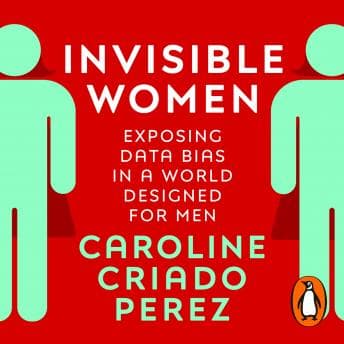

I started this audiobook thinking I knew what I was getting into. Gender bias in data? Sure, I've read the studies, taught the concepts, written about cognitive biases affecting research design. But somewhere around hour three, while jogging through Cambridge and nearly tripping over a curb because I was so absorbed, I realized Caroline Criado Perez wasn't just confirming what I knew. She was systematically dismantling my assumptions about how deep this rabbit hole goes.
And honestly? As someone who studies why humans do what they do, I should have seen it coming.
The Case Study That Keeps Building
What makes this book work—really work—is that Criado Perez approaches gender data bias like a researcher building an airtight case. She doesn't just throw statistics at you. She constructs an argument the way I wish more of my students would: one brick at a time, each example reinforcing the last until you're standing inside a structure you can't unsee.
The New Jim Crow builds its case the same way—each chapter adding another layer until the entire system of mass incarceration becomes impossible to ignore.
The phone thing? That's just the opening. The car crash statistics—women being 47% more likely to be seriously injured because crash test dummies are modeled on male bodies—that's where the psychological weight starts to land. Because this isn't abstract discrimination. This is life and death rendered invisible through the simple act of not collecting the right data.
I found myself doing something I rarely do with nonfiction: taking mental notes for my own research. The way she traces how "male as default" becomes embedded in systems, from medical trials to urban planning to workplace temperature settings (yes, really), mirrors what we see in identity formation studies. The default becomes invisible. And invisible defaults shape behavior in ways people can't articulate.
When the Author Becomes the Narrator
Here's where I have to talk about the audiobook specifically, because Criado Perez narrating her own work changes the experience in ways I didn't expect.
She's not a trained voice actor. You can tell. But that's actually part of what makes this work. There's an indignation in her delivery that a professional narrator might have smoothed over. When she's presenting data about women dying from heart attacks because symptoms were studied primarily in men, you hear the frustration. It's controlled—British, measured—but it's there. And it lands differently than it would on the page.
Her pacing is solid. Clear enunciation, good energy, the kind of wit that keeps nine-plus hours from feeling like a lecture. I listened mostly during morning runs and while cooking (a lot of dal makhani was made during this book), and I never found myself zoning out the way I sometimes do with dense nonfiction.
That said, if you're looking for vocal range or character work, this isn't that. It's one voice, one perspective, delivered with conviction. For this material? It works. The authority comes from the research, and she presents it like she knows exactly what she's talking about. Because she does.
The Criticism Worth Addressing
I can't write this review without acknowledging the elephant in the room. Some listeners—and I've seen this in reviews—take issue with the book's binary approach to gender. And look, as a psychologist, I get it. Gender identity is more complex than the male/female binary, and intersectionality matters.
But here's my read: Criado Perez is writing about data bias, and the data she's examining was collected using binary categories. She's not making a philosophical argument about gender identity. She's exposing how the data we have—flawed as its categories may be—systematically excludes female bodies from consideration. That's a different project than a comprehensive gender theory text.
Does the book have blind spots? Probably. What book doesn't? But criticizing it for not being a different book feels like missing the forest for a very specific tree.
(My therapist would have thoughts about people who can't engage with an argument without demanding it address every adjacent issue. But that's a session for another day.)
Who Should Listen (And Who Should Skip)
If you're interested in how systems perpetuate bias without anyone intending to be biased—this is essential. If you work in research, policy, design, medicine, or basically any field that relies on data, you need to hear this. Not because it will make you comfortable, but because it will make you better at your job.
If you're looking for a light listen or something that won't challenge your assumptions, skip it. This book has an agenda, and it's not subtle about it. Criado Perez is angry, and she wants you to be angry too. Whether that lands as inspiring or exhausting probably depends on where you're starting from.
For me? I finished this while chopping onions for a biryani, and I stood in my kitchen for a good five minutes afterward just... processing. The research actually shows that moments of cognitive disruption—when your existing mental models get challenged—are when real learning happens.
This book disrupted me. In the best way.