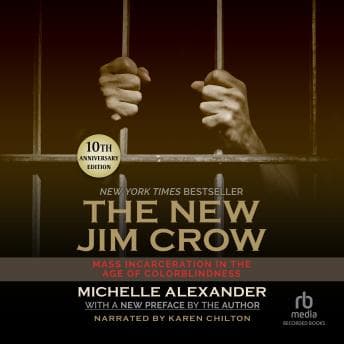

The Book That Rewired My Brain
I started this audiobook on a Monday morning jog through Cambridge, thinking I'd get through maybe an hour before switching to something lighter. Seventeen hours later—spread across two weeks of runs, cooking sessions, and one very long flight delay at Logan—I finished it feeling like I'd just completed an entire graduate seminar on American criminal justice. And honestly? My therapist would have thoughts about why I kept returning to something this heavy. But here's the thing: once Michelle Alexander starts laying out her argument, you can't unhear it.
The protagonist exhibits classic... wait, no. This isn't fiction. This is real life, which makes it so much worse.
Alexander's central thesis—that mass incarceration functions as a racial caste system, a direct descendant of Jim Crow laws, just with better PR—is the kind of argument that sounds hyperbolic until she methodically dismantles every objection you might have. She's not writing polemic. She's building a case. The research actually shows patterns I'd studied in behavioral psychology but never connected to criminal justice policy: how implicit bias operates, how systems perpetuate themselves through seemingly neutral mechanisms, how we construct narratives of personal responsibility to avoid confronting structural failures.
This is a fascinating case study in cognitive dissonance on a national scale. We tell ourselves we're colorblind. The data says otherwise.
Karen Chilton's Steady Hand
Look, I'll be honest—Karen Chilton's narration isn't going to win awards for dramatic range. She reads like a law professor giving a particularly important lecture, which is... exactly what this material needs? The professorial tone that some listeners find dry actually works here. Alexander is presenting evidence. Statistics. Legal precedents. Supreme Court decisions that will make your blood pressure spike. Chilton delivers all of it with the kind of measured clarity that lets the facts speak for themselves.
That said, there are moments—particularly in the middle sections when Alexander is walking through the legal mechanics of how the War on Drugs was designed and implemented—where the energy dips. I found myself rewinding a few times during my kitchen experiments (I was making dal makhani, a three-hour process, don't ask). The narration is clean and professional, but it doesn't quite capture the moral urgency that pulses beneath Alexander's prose.
What makes this performance compelling is Chilton's consistency. Seventeen hours is a marathon, and she never loses focus. By chapter eight, when Alexander starts connecting the dots between Reagan-era drug policy and the systematic disenfranchisement of Black voters, Chilton's steady delivery feels almost necessary. Like a doctor explaining a serious diagnosis. You need someone calm when the news is this devastating.
That same measured approach to difficult truths shows up in Being Mortal: Medicine and What Matters in the End, where Atul Gawande walks you through mortality with the kind of clarity that makes you grateful even when the subject matter hurts.
Where Alexander Gets It Right (And Where I Wanted More)
Psychologically, this tracks. Every single bit of it.
Alexander understands human nature—specifically, how humans construct justifications for systems that benefit them. She traces how "tough on crime" rhetoric exploited implicit racial biases while maintaining plausible deniability. She shows how the language of colorblindness became a shield against accusations of racism while enabling racist outcomes. I found myself asking: why does a nation that elected a Black president simultaneously incarcerate Black men at rates that would shock apartheid-era South Africa?
The answer, Alexander argues, is that we never actually dismantled the racial caste system. We just made it invisible to those who benefit from it.
(My mother would say I'm being too political. Maa, facts aren't political. They're just facts.)
The book's weaker moments come toward the end, when Alexander pivots from diagnosis to prescription. Her call for a broad-based social movement feels less developed than her historical analysis. But honestly, after spending fifteen hours documenting how thoroughly the system is rigged, I'm not sure what solution would feel adequate. Alexander has mapped a problem bigger than any single policy fix.
The Listening Experience
At nearly seventeen hours, this is not a casual listen. I wouldn't recommend it for a single commute or a light workout. This is a commitment—the audiobook equivalent of a serious relationship.
But the length works. Alexander needs time to build her argument, to address counterpoints, to trace the historical through-lines from slavery to convict leasing to Jim Crow to mass incarceration. By the time she reaches the present day, you've internalized enough context to understand why the system operates the way it does. It's not a bug. It's a feature.
I listened at 1x speed, which I almost never do for nonfiction. The material is dense enough that speeding up felt disrespectful—both to Alexander's scholarship and to my own comprehension. Your mileage may vary, but I'd suggest starting at normal speed and adjusting only if you're already familiar with the subject matter.
Who Should Listen (And Who Should Skip)
Here's my honest assessment: if you care about understanding how America actually works—not the mythology, but the machinery—this is essential. If you've ever wondered why the criminal justice reform movement exists, or why conversations about race in America feel so fraught, or why certain communities distrust police and courts, this book will give you the historical and psychological framework to understand.
Skip if: you're looking for something light, you're not in a headspace to confront heavy material about systemic racism, or you need dynamic narration to stay engaged with nonfiction. This is not beach reading. This is not background noise.
But if you're ready to have your assumptions challenged—really challenged, with receipts—this is the audiobook to do it.
I finished it three days ago. I'm still thinking about it. That's the mark of something that matters.










