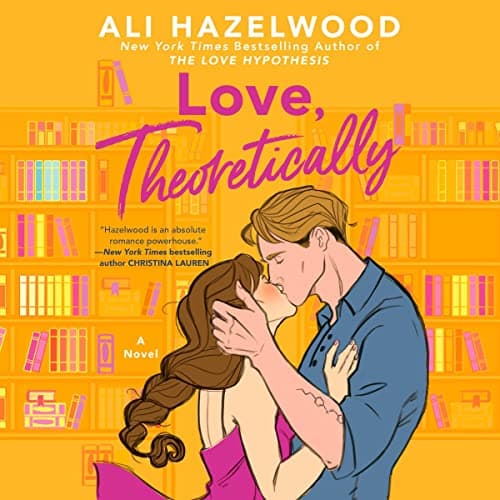

When's the last time you let yourself be a mess for someone?
I was three hours into this book, hunched over my desk at 2 AM finishing a rebrand for a coffee roaster in East Austin, and Elsie Hannaway was describing the bone-deep exhaustion of being a different version of herself for every person she meets — and I had to pause the audio because Frida was kneading my chest like she knew. She knew.
The Girl Who Was Everyone and No One
Here's the thing about Elsie that got under my skin in a way Hazelwood's other protagonists haven't quite managed: the fake girlfriend gig isn't just a cute premise. It's a survival mechanism built on years of people-pleasing so intense she literally doesn't know what food she likes. There's this moment early on where she orders something at a restaurant and realizes she picked it because it's what the person across from her would want her to pick, and I just — my heart. MY HEART. As a first-gen kid who spent years code-switching between abuela's kitchen and art school critiques, that hit different.
Thérèse Plummer gets this. She reads Elsie with this slightly breathless, performative brightness that cracks at exactly the right moments — like when Elsie's alone and the cheerfulness drops out of her voice and you hear this tired, scared woman underneath. The student emails? Plummer delivers them with this deadpan academic absurdity that made me snort-laugh while color-correcting at 1 AM. Jack's one-liners land with this dry, understated weight because Plummer doesn't oversell them.
But I'll be honest — there are stretches in the middle, especially during the department politics sections, where Plummer's pacing flattens out and everything starts to sound the same temperature. Not monotone exactly, but like she's coasting. I'd catch myself drifting and rewinding thirty seconds. For a 12-and-a-half-hour listen, that's a problem in the midsection.
Theoretical Physics and the Thermodynamics of Catching Feelings
The academic rivalry framework is where Hazelwood's actual neuroscience PhD flexes hardest. The theorists-vs-experimentalists beef isn't just window dressing — it's baked into how Elsie and Jack see the world, how they argue, how they flirt. Jack doesn't just like Elsie; he likes that she builds models of the universe in her head while he's busy smashing particles together. The tension between their disciplines becomes this metaphor for the tension between who Elsie pretends to be and who she actually is, and the vibes are immaculate when Hazelwood leans into that.
The chemistry is chef's kiss — specifically because Jack is the first person who doesn't want a version of Elsie. He wants the prickly, overthinking, thermodynamics-obsessed disaster. There's a scene where he basically tells her to stop performing and she short-circuits, and Plummer reads that moment with this trembling hesitation that wrecked me. I ugly-cried at that scene. Not the big romantic declaration — the quiet one where someone just says "stop pretending."
Abuela would have loved this one. She always said the best novelas were about women who forgot they were allowed to want things and then remembered. That's this book.
Where the Equations Don't Balance
Look, I've listened to all three Hazelwood-Plummer collaborations now, and this one's the weakest audio experience of the three. Not because the story is bad — it's actually my favorite of her premises — but because the pacing sags in Act Two when the academic politics take over and the romance goes on hold. The fake dating setup resolves earlier than you'd expect, and then there's this stretch where Elsie's career anxiety dominates and the banter disappears. This book felt like a romcom that forgot it was a romcom for about two hours.
The CeCe friendship is wonderful and funny but occasionally veers into "quirky best friend exists only to deliver exposition" territory. Plummer differentiates CeCe's voice well — sharper, louder energy — but the writing gives her less to do than she deserves.
The spicy scenes? They're there, they're explicit, and Plummer handles them with enough warmth that they don't feel clinical. But they also don't feel as essential as the quiet vulnerability moments. This is a rainy Sunday book, not a steamy Saturday night book. I had a similar cozy-but-not-scorching experience with Wrong Highlander — another romance where the emotional undercurrent quietly does more work than any of the explicit scenes.
Who Gets an A, Who Should Drop the Course
Pick this up if you've ever been the person who shapeshifts to make everyone comfortable and need to feel seen for ninety seconds. Skip it if you found The Love Hypothesis's pacing perfect and want more of that tight structure — this one wanders more. And if you mostly listen while multitasking, this requires more attention than you'd think for a romcom. The emotional payoffs are in the quiet beats, not the loud ones.
Save As: Heart_Wrecked_Final_V3.psd
Three crying sessions. Not four — Beach Read still holds the record. But the "stop pretending" scene alone earns this book permanent residence on my phone. Hazelwood writes STEM women like she knows what it costs to be smart and accommodating and exhausted all at once, and Plummer — when she's locked in — makes you feel every crack in Elsie's armor. Imperfect listen, but the imperfections are in the pacing, not the heart. And I will always, always choose heart.