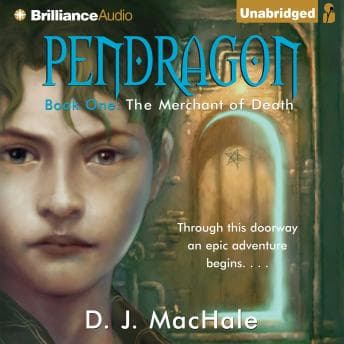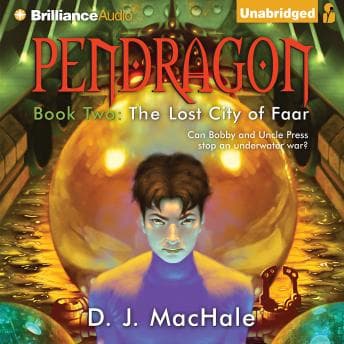

The Pendragon series is middle school fantasy comfort food, and I mean that with genuine affection.
I picked this one up during a particularly brutal debugging session at 2 AM - my procedural terrain generation was spitting out nothing but flat planes (ironic, given Cloral is literally a flat water world), and I needed something to keep me awake without demanding too much brainpower. Lost City of Faar fit that slot perfectly. Almost too perfectly.
Bobby Pendragon Is the Party's Fighter Who Dumped INT
Look, Bobby is a fourteen-year-old suburban basketball star who keeps getting dropped into interdimensional conflicts, and his primary character trait is being a nice guy. That's... that's it. He's the human equivalent of a D&D character sheet where someone put all their points into Charisma and Athletics and forgot they needed a backstory beyond "my uncle is cool." The Cloral setting - a world entirely covered by ocean with floating cities - is genuinely interesting conceptual territory, but MacHale doesn't dig into the world-building the way I wish he would. How do these floating cities handle agriculture? What's their political structure beyond "people are mad"? The book gestures at these questions when it introduces the agricultural crisis driving the conflict, but it's more interested in getting Bobby from action setpiece to action setpiece.
And honestly? For the target audience, that's probably the right call. This isn't Sanderson-level world-building. It's not trying to be. The magic system here - the Traveler mechanics, the flumes, the way territories work - operates on vibes more than hard rules, and if you're a twelve-year-old discovering fantasy for the first time, that's exciting stuff. I just kept wanting MacHale to slow down and let me live in Cloral for a while instead of rushing through the "marauders are poisoning the food supply" plot.
The lost city of Faar itself, when Bobby finally reaches it, has this cool underwater civilization thing going on that reminded me of a homebrew D&D setting one of my library crew built back in Georgia. Kyle spent three weeks mapping an underwater dwarven city and then we TPK'd in session two. Good times. Faar deserved that same level of obsessive detail, but it arrives late and resolves fast.
William Dufris Doing the Heavy Lifting
Here's where it gets interesting. William Dufris - the guy has over twenty AudioFile Earphones Awards and an Audie, so he's not messing around - basically carries this book on enthusiasm alone. His Bobby voice has this youthful, slightly breathless energy that makes the journal entries (Bobby narrates via journals he sends home to his friends) feel like a kid who's genuinely excited and terrified in equal measure. It works. When the story gets predictable, and it does get predictable, Dufris's delivery keeps things moving with enough momentum that you don't mind.
But I'll be straight with you - the character differentiation isn't strong. Bobby sounds distinct, sure. Everyone else kind of blends into "adult voice" or "other teen voice." Compare that to Steven Pacey, who - okay, unfair comparison, Steven Pacey walked so other narrators could run, but even by YA audiobook standards, I wanted more vocal distinction between the supporting cast. When Bobby's interacting with multiple Clorans in quick dialogue exchanges, I occasionally lost track of who was speaking. Not a dealbreaker for a 12-hour listen, but noticeable.
The pacing of the narration itself is solid. Dufris doesn't drag through the exposition-heavy journal sections, and he picks up nicely during the underwater action sequences. No weird audio artifacts, no production issues. Clean, professional, standard single-narrator work.
Who's Rolling Initiative on This One
If you're an adult fantasy listener expecting depth, pump the brakes. This is a YA series from the mid-2000s, and it reads like one. The junior-high melodrama is real - there are moments where Bobby's internal monologue sounds like a particularly dramatic Instagram caption, and MacHale's prose isn't going to win any literary awards.
But if you've got a kid who's into fantasy and needs a gateway series? Or if you're looking for something light and undemanding for chores or commuting? This does the job. My D&D group would love this - well, my D&D group circa 2007 would have loved this. Current me wants more from the world-building and less from Bobby's feelings about being a reluctant hero.
The progression is satisfying in the series-arc sense - Bobby's slightly more competent here than in book one, the Traveler mythology gets a few new wrinkles, and the ending sets up the next territory. It's doing what book two in a ten-book series should do. Chosen by Grace: Divine Fate Trilogy scratches a similar itch if you want that slow-burn chosen-hero arc with a bit more meat on the world-building bones.
Save Your Spell Slot
Dufris elevates what would otherwise be a pretty standard YA adventure into something listenable, but I can't pretend this is worth a full credit when there are stronger options out there. Grab it from the library, throw it on during a long drive, let it wash over you like, well, like the endless ocean that covers Cloral. It's fine. It's fun. It's not going to change your life. And sometimes at 2 AM when your code won't compile, that's exactly enough.