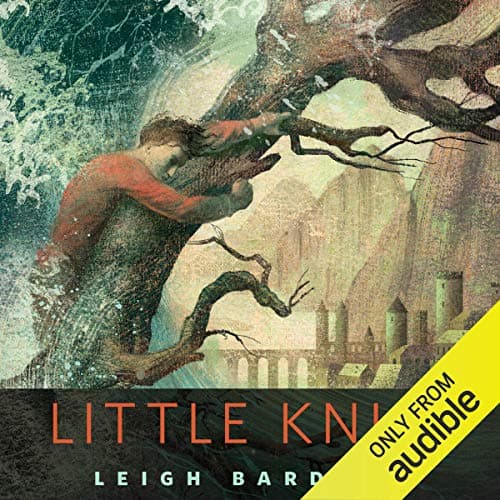

Thirty-six minutes. That's shorter than my Caltrain ride from 4th & King to Mountain View. I queued this up at 11PM on a Tuesday after a particularly brutal day of chasing down a memory leak in prod, and I finished it before I'd even gotten through my post-mortem notes. So let's talk about whether those 36 minutes are worth your time.
A Fairy Tale That Knows Teeth Are Part of the Smile
Bottom Line: Worth your commute - well, a fraction of it. "Little Knife" is Leigh Bardugo writing a Grishaverse folk tale the way the Brothers Grimm would if they'd grown up in Ravka. A girl named Yeva is so beautiful that her village basically tears itself apart over her, and her father's "fix" - sealing her beauty away with a series of magical bargains - goes about as well as deploying untested code to production on a Friday.
The structure here is classic fairy tale: repetition with escalation. Yeva's father visits a river spirit three times, each time trading away more of his daughter's humanity to contain her beauty. Her laugh, her voice, her warmth - all stripped away in exchange for peace. And Bardugo doesn't soften the edges. By the end, Yeva's been reduced to something sharp and cold and dangerous, and the story doesn't pretend that's a happy ending or a tragic one. It just... is. The folk tale format lets Bardugo do something she doesn't always get to do in her novels: be ambiguous. There's no Alina or Kaz here to root for. Just a pattern of men making decisions about a girl's body, and the girl becoming something they can't control.
The ROI on this audiobook is weird because it's so short. You're basically paying for a single short story. But the density is there - Bardugo packs more world-texture into 36 minutes than some fantasy authors manage in 36 chapters.
Lauren Fortgang and the Art of Bedtime-Story Menace
Fortgang narrates this with a cadence that splits the difference between reading to a child and telling a ghost story around a campfire. She doesn't go for big dramatic swings - this isn't the kind of performance where you need twelve distinct character voices. It's more about tone modulation, and she's good at it. The river spirit's dialogue has this cool, measured quality that contrasts with the father's increasingly desperate pitch. And when Yeva speaks near the end - after she's been changed - Fortgang drops into something flat and blade-like that genuinely gave me a little chill sitting alone in my apartment at midnight.
Is it a Ray Porter-level performance? No (but what is, honestly). The narrator on Mystery Guest: A Maid Novel brought a similar kind of controlled tension to a very different story, and I kept thinking about how much the right voice can accomplish without ever overplaying its hand. It's well-matched to the material: restrained, deliberate, and slightly unsettling.
The Engineering of a Folk Tale
Here's what I appreciate as someone who thinks about systems all day: this story is really about unintended consequences in a feedback loop. Father identifies problem (daughter's beauty causes conflict). Father implements fix (remove the beauty-adjacent traits). Fix creates new problem (daughter becomes something inhuman). Each iteration of the "fix" makes the system more unstable, not less. It's basically the distributed systems version of "every hotfix introduces two new bugs."
Bardugo's doing something clever with the folk tale format too - she's using the genre's built-in misogyny (beautiful girl as problem to be solved by men) and letting it run to its logical, ugly conclusion. The story doesn't editorialize. It doesn't need to. The pattern speaks for itself.
Who Should Listen (And Who Should Skip)
Perfect for: bedtime, short break, waiting in line at Philz. If you're already in the Grishaverse and want the folklore texture that underpins Bardugo's world-building, this is a nice companion piece. If you've never read Bardugo, this actually works as a standalone fairy tale - you don't need any context. Skip if you need a full narrative experience with character arcs and plot development - 36 minutes isn't going to give you that, and this story isn't trying to.
The real question is format economics. At 36 minutes, spending a credit on this would be like paying full price for a single unit test. If your library or streaming service has it, that's the move. The story itself is sharp and well-crafted and does exactly what it sets out to do. The value proposition just doesn't scale to credit-pricing.
Ship It, But Watch the Invoice
Bardugo writes fairy tales the way they should be written: short, patterned, and carrying a knife behind their back. Fortgang delivers it clean. I finished it, sat with it for a minute, then went back to my post-mortem doc and realized I was thinking about fathers and rivers instead of heap allocations. For 36 minutes, that's not bad at all.