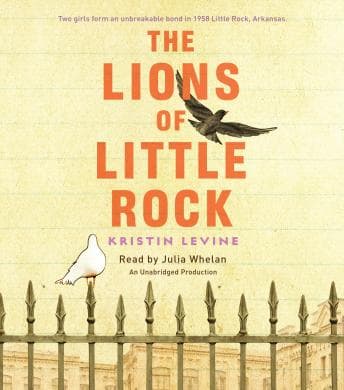

My complaint about this book is simple: it made me feel things I didn't budget time for. I was doing dishes on a Sunday evening - Jenny had commandeered the living room for her book club, I had a sink full of pots from her elaborate hosting spread, and I figured 8.5 hours of middle-grade historical fiction would be background noise. Efficient multitasking. Wrong. By the time Marlee and Liz are standing near the lions' cage at the Little Rock Zoo, I'd stopped scrubbing entirely. Just standing there, soapy sponge in hand, not moving.
So. That's the kind of book this is.
The Business Case for a 12-Year-Old's Courage
Bottom line: this is a book about the 1958-1959 Little Rock school crisis, told through a twelve-year-old girl who doesn't talk. Selective mutism as a plot device sounds gimmicky. It isn't. Marlee's silence is the whole point - because the adults around her are also choosing silence, choosing to look away, choosing not to say the thing that needs saying. And then this kid decides her friendship with Liz is worth more than the comfortable quiet her whole community is hiding inside.
This is what my parents did instinctively. Now it has a TED talk. Except in this case it's a children's novel, and it's better than the TED talk.
What Levine gets exactly right: the cost-benefit analysis of courage is different when you're twelve and your family's safety is the collateral. Marlee isn't naive about what she's risking. The segregationists in this book aren't cartoon villains - they're neighbors, church members, people with real leverage over real families. The way Levine maps that social pressure onto a child's moral reckoning reminded me of the conversion process Dr. Shefali Tsabary traces in Radical Awakening - the idea that real courage isn't the absence of a cost-benefit analysis, it's running the analysis honestly and choosing anyway. When the threats start arriving and Marlee has to weigh her friendship against her family's livelihood, I thought about my parents' dry cleaning shop in Koreatown. The calculus of keeping your head down versus standing for something. They understood that math better than any business school case study I've read.
The lions of the title - both literal and metaphorical - earn their place by the end. Don't skip the zoo scenes thinking they're filler.
Julia Whelan Does the Work
Whelan's narration here is doing something specific and smart: she's playing Marlee's interiority, not performing it. Because Marlee doesn't speak much in the story, Whelan has to carry the character's entire emotional life in the narration itself - the observations, the internal arguments, the moments where Marlee notices things adults have stopped seeing. She nails it. The voice is young without being cartoonish, uncertain without being passive. When Marlee finally speaks up - and I mean out loud, to people who can hurt her - Whelan's delivery earns that moment without overselling it.
The male character voices are limited, which the research flagged as a potential weakness. Honestly? Given that this story lives almost entirely inside Marlee's head and her friendships with other girls, it barely registers. This isn't an ensemble cast situation. It's an intimate story, and Whelan keeps it intimate.
I ran this at 1.5x, not my usual 2.0x. Make of that what you will.
Who Gets the Invoice
If you have a kid between 10 and 14: this is the listen. Not because it's educational (though it is - the detail about Arkansas closing its public schools entirely rather than integrate is the kind of historical fact that hits harder in audio than in a textbook). Because Marlee's friendship with Liz models something genuinely useful: how to decide what you actually believe when it costs you something.
If you're an adult listening solo: also yes, but recalibrate your expectations. This isn't a prestige historical drama. It's a middle-grade novel that happens to be doing serious work. The emotional beats are clean and direct. That's not a bug.
If you're looking for moral complexity where nobody's clearly right or wrong: wrong book. Levine is not interested in both-sidesing segregation. Good.
I've seen companies fail because the adults in the room chose comfortable silence over the hard conversation. Marlee's twelve and she figured out what those executives couldn't. The key takeaway is worth the listen. The other 7 hours? Also worth the listen, actually. Which almost never happens.
Jenny walked in during the zoo scene and asked why I'd stopped doing the dishes. I told her I was processing a business insight. She looked at the soapy sponge still in my hand and walked back out. We don't talk about that.