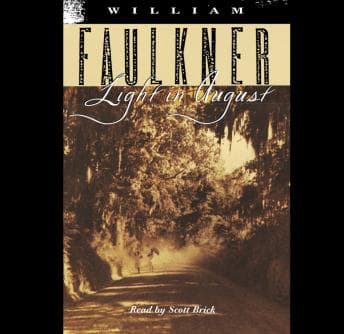

I tackled this one during a stretch of three twelve-hour shifts, listening in the quiet hours of the morning when I'm too wired to sleep but too exhausted to move. Faulkner isn't exactly light reading—the title is ironic that way—but I figured if I can handle a Level 1 trauma center on a full moon, I can handle Yoknapatawpha County.
The "Brick" Wall
Let's address the elephant in the trauma bay: Scott Brick. You either love him, or you want to sedate him. I've listened to him narrate enough thrillers to know his style—that breathy, lilting cadence where every sentence ends like he's imparting the secrets of the universe. In a medical thriller, it works. It adds tension. But here? I had the same issue with his narration of Aladdin—too polished for the raw material. In the gritty, dusty, sweat-stained American South?
It's... complicated. Faulkner's prose is jagged. It bleeds. It's messy and confusing and loops back on itself like a patient with a concussion telling you how they fell. Brick, on the other hand, is smooth. He polishes the jagged edges. On one hand, this makes a notoriously difficult book actually digestible. He acts as a stabilizer, keeping the rhythm steady when the stream-of-consciousness threatens to flatline your attention span. On the other hand, it feels like watching a gritty documentary that's been filtered through Instagram. The dirt is there, but it looks too pretty.
Diagnosing the Characters
Joe Christmas is the heart of this thing—a man at war with his own blood, consumed by his mixed ancestry in a time and place where that's a death sentence. As a nurse, I see guys like Joe. The anger, the self-destruction, the refusal to accept help until it's too late. That same destructive spiral shows up in Doll's House, though the setting couldn't be more different. Brick does a decent job with Joe's melancholy. He leans into the tragedy of it. But I wanted more grit. I wanted to hear the desperation in his throat, not just the theatrical sadness.
Then you have Lena Grove, walking across states pregnant and barefoot, looking for a man who clearly doesn't want to be found. She's the calm in the center of the storm. Brick gives her a gentleness that works, contrasting her with the violence swirling around Joe and the disgraced Reverend Hightower.
Who This Is For (And Who Should Skip It)
This is a seventeen-hour commitment. It requires focus. If you try to listen while grocery shopping, you will lose the thread. Faulkner switches perspectives without warning, and while Brick changes his tone slightly, he doesn't do distinct character voices or heavy accents. It's all delivered in that same serious, melodramatic narrator voice. If you've always wanted to read Faulkner but found the text too dense to get through visually, this audio version is the IV drip you need. It forces the story into your veins at a steady rate. Skip it if you need something you can half-listen to during chores—this one demands your full attention.
Shift Change
Just be prepared for the narration to feel a little more "Hollywood" than "Deep South."