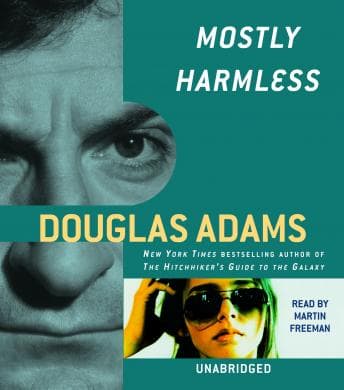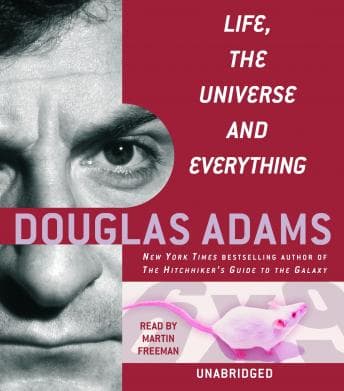

I'll admit something that might get my literature credentials revoked: I came to Douglas Adams late. Embarrassingly late. My students quote Hitchhiker's Guide at me and I'd just nod along for years, pretending I understood why the number 42 was supposed to be funny. So when I finally decided to work through the series via audiobook, I had decades of cultural hype working against it.
Here's the thing—by book three, I expected the magic to wear thin. That's what usually happens with comedy series, right? The jokes get recycled, the formula gets stale, the author starts coasting on goodwill. But Adams? Adams is doing something different here. He's not just telling jokes. He's building a philosophy of absurdism that would make Camus proud—if Camus had a sense of humor about the whole meaninglessness thing.
Martin Freeman Was Born for This
I couldn't find much about Freeman's approach to recording these, but honestly? It doesn't matter. The performance speaks for itself. There's this restraint to his delivery that absolutely nails Adams's comedy. He doesn't oversell the jokes. He doesn't wink at the audience. He just... presents the absurdity with the same matter-of-fact tone you'd use to read a weather report.
This is harder than it sounds. (Trust me, I've watched enough students butcher Shakespeare to know the difference between someone who understands comic timing and someone who's just reading words.) Freeman gets that the humor in Adams isn't in the punchlines—it's in the deadpan observation of universal chaos. When he describes Arthur Dent trying to learn to fly by "throwing himself at the ground and missing," there's no comedic emphasis. It's just stated as fact. Which makes it ten times funnier.
His character voices are distinct without being cartoonish. Zaphod sounds appropriately insufferable. Slartibartfast has this weary dignity. And Arthur—poor, perpetually confused Arthur—sounds exactly like someone who's been dragged across the universe against his will and has simply stopped being surprised by any of it.
The Krikkit Problem (Don't Tell My Students I'm Doing Literary Analysis)
Okay, so the Krikkit plot. On the surface: aliens want to destroy the universe because they're sick of looking at stars. Ridiculous, right? Except—and this is where my English teacher brain kicks in—it's actually a pretty brutal satire of xenophobia and isolationism. These beings can't comprehend anything beyond their own experience, so they decide everything else must be eliminated.
I was grading sophomore essays on "The Stranger" while listening to this, and the thematic parallels hit me hard. Adams is doing what Camus did, just with cricket bats and killer robots instead of beach murders. Guild Master: A LitRPG Adventure tackles similar existential questions about purpose and meaning—just wrapped in game mechanics instead of intergalactic cricket. He's asking what happens when beings refuse to engage with the incomprehensible vastness of existence. The Krikkiters choose destruction. Arthur Dent chooses tea and mild bewilderment. Both are coping mechanisms, honestly.
(My wife walked in during the flying sequence and asked why I was laughing at my red pen. I tried to explain Adams's theory of flight as a metaphor for achieving the impossible through distraction. She went back to watching her cooking show.)
On the "Repetitive" Complaints
Some listeners apparently find parts repetitive. I get it. Adams does circle back to certain bits—the running gags, the Guide entries, the asides about improbability. But here's my take: that's the point. Comedy works through repetition and variation. The callbacks aren't lazy writing; they're building a comic vocabulary.
At 5 hours and 49 minutes, this is a quick listen. I got through it in three lakefront walks and one faculty meeting. (Sorry, Principal Martinez. The budget projections were very interesting. So was the part about the Somebody Else's Problem field.) The pacing never dragged for me, though I can see how someone expecting non-stop hilarity might find the philosophical tangents slower.
Freeman's delivery helps here. He keeps things moving without rushing. You can hear him savoring certain phrases—and honestly, Adams's prose deserves to be savored. The man could construct a sentence.
Who Should Listen (And Who Should Skip)
If you're already invested in the Hitchhiker's series, this is absolutely worth your time. Fans of British absurdist humor and anyone who appreciates comedy that's actually saying something will find plenty here. Skip it if you need non-stop jokes without philosophical tangents, or if—like my students—you'd call it "random" and "trying too hard."
This isn't the strongest entry in the series—the first book has that lightning-in-a-bottle energy that's hard to recapture. But it's smarter than it gets credit for, and Freeman's narration elevates every page. I listened at 1.0x because rushing through Adams feels like a crime. The rhythm matters. The pauses matter.
Class Dismissed
If you've never read Adams, start with the first book. But if you're already in, don't skip this one. Just maybe save it for somewhere other than faculty meetings. The laughing gives you away.