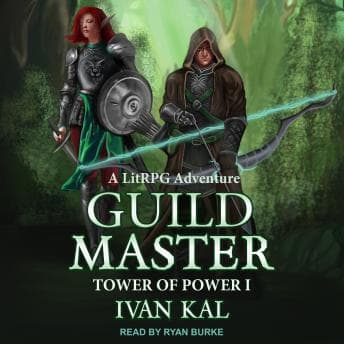

"There's a crazy-looking dude saying that he is technically not a god on one end of the tunnel, and a blinding light on the other end-and he was really not digging the light."
Okay, that line from the description sold me. A surfer god-not-god in a wetsuit offering isekai deals to dying gamers? That's the kind of absurd premise I live for. And look, I should've been working on my thesis when I started this, but my D&D group had been pestering me about LitRPG recommendations and I figured - research, right? Totally counts as research.
The Tower Has Stat Blocks and I'm Here For It
Ivan Kal knows what he's doing with the genre. This is gateway LitRPG, the kind of book you hand to your skeptical friend who doesn't understand why you want numbers in your fantasy. Morgan gets dropped into a game-world with actual progression mechanics, guild management systems, and city-building elements that scratched an itch I didn't know I had. The pacing is solid - we're not drowning in exposition dumps before anything happens, and the world-building unfolds naturally as Morgan stumbles through it.
The half-elf twins showing up to basically tutorial him through the early game? Classic. It works. It's not reinventing the wheel here, and honestly, it doesn't need to. Sometimes you just want competent execution of familiar tropes, and Kal delivers that.
But here's where I gotta be honest - Morgan himself is... a lot. The dude drops f-bombs like he's getting paid per profanity, and while I'm not exactly clutching pearls over here, even I noticed it felt excessive. Like, we get it, you're edgy. The immaturity works for the first hour or so (he just died and got isekai'd, some panic is warranted), but it doesn't evolve as much as I wanted. My D&D group's chaotic neutral rogue has more character development, and that's saying something.
Ryan Burke: The Narrator Situation
Okay. So. The narration.
Ryan Burke has a soft-spoken style that's... polarizing. I'm being diplomatic. His character differentiation is actually pretty good - there's an edge to different voices that helps you track who's talking, which is crucial when you're listening while pretending to code. The clarity is there. Production is clean.
But man, the volume thing. I had to crank my headphones way up during some sections, and then Burke's voice has this quality where it can tip into almost... whiny? Not always. Not even most of the time. But enough that I noticed, especially during Morgan's more petulant moments. It's like the narration style accidentally amplified the character's worst traits.
I didn't quit - some folks apparently did, and I get it. If you're coming from Steven Pacey's Logen Ninefingers or Tim Gerard Reynolds' Jorg Ancrath, Burke's energy is going to feel like someone turned the dial way down. But once I adjusted my expectations (and my volume), it worked well enough. The soft-spoken thing actually helped during my late-night listening sessions when I didn't want something too intense.
The Guild Management Payoff
Where this book really clicked for me was the city and guild development stuff. I'm a sucker for base-building in games, and watching Morgan slowly accumulate resources, recruit people, and establish something in this world hit that same dopamine button. It's not Sanderson-level world-building - let's be real, what is - but Kal clearly understands what makes progression fantasy satisfying. Speaking of towers, Towers of Midnight proves Sanderson can make even tower-based progression feel epic.
The Tower of Power (yes, stupid name, the book acknowledges this) gives the whole thing a clear goal structure. You always know what Morgan's working toward, even when he's getting sidetracked by things trying to eat his face. The magic system isn't super complex, but it's consistent, and the stat progression feels earned rather than arbitrary.
At 8 hours and change, it doesn't overstay its welcome. This isn't one of those 40-hour epics where you forget what happened in the first act. It's tight, focused, and knows what it's trying to be.
Who Should Listen (And Who Should Skip)
If you're new to LitRPG and want to see what all the fuss is about, this is a solid entry point. Not the best the genre has to offer, but accessible enough that you won't bounce off the gaming elements.
If you need your narrators to have big, dramatic energy - maybe sample first. Burke's style is divisive for a reason, and you'll know within the first chapter whether it's going to work for you or drive you up the wall.
Skip this one if excessive profanity bugs you, or if you need your protagonist to be immediately likeable. Morgan grows on you eventually, but it takes a minute.
Me? I finished it instead of my thesis, so take that for what it's worth. Dr. Patel's disappointment is a small price to pay for a decent LitRPG with guild mechanics. Would I listen to the sequel? Probably. Would I recommend it to my D&D group? Already did - with the caveat about the narrator. They can make their own choices.