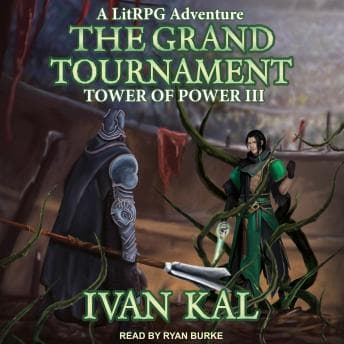

What happens when you take a tournament arc — the single best arc type in shonen anime, LitRPG, and honestly most fiction — and build an entire book around it?
I was supposed to be debugging my procedural dungeon generator. It's 11 PM, my thesis document is open in another tab (untouched for three days, Dr. Patel, if you're reading this, I'm sorry), and I'm nine and a half hours deep into Grand Tournament instead. Because Ivan Kal dangled a tournament arc in front of me like a treat in front of a golden retriever, and I am, apparently, that golden retriever.
Stat Blocks, Energy Swords, and the Beautiful Mess of Isekai LitRPG
Look, I will defend LitRPG with my dying breath. Yes, stat blocks in fiction are good, actually. And Grand Tournament leans into exactly what makes this genre fun — Morgan's got an energy sword, he's got a guild, he's been through the isekai wringer of betrayal and goblin hordes, and now he's entering a multi-event tournament with dungeon diving, monster hunting, and single combat. The progression is satisfying. You feel the team leveling up across events, strategizing, getting beaten down and adapting.
The tournament structure itself is smart. Instead of just arena fights (which, fine, those are here too), Kal throws in varied challenges — the dungeon diving segments especially scratched that D&D itch for me. My old library D&D group would've eaten this up. It felt like watching a party run through a gauntlet of encounters where composition and tactics matter as much as individual power. I got a similar kick from Fields of Fire, which leans just as hard into the tactical team-composition angle — though in a very different setting. Morgan's team dynamics have that "adventuring party" energy where everyone's got a role and the fun is watching them click (or not click) under pressure.
But here's where my enthusiasm has to pump the brakes a little. The characters — and this is the thing that kept nagging at me — sometimes feel more like character sheets than characters. Morgan's relationships, including the romantic subplot, get development time on paper, but they read flat in places. His love interest exists, they have moments together, but I couldn't tell you what makes her laugh or what she's afraid of beyond the plot-relevant stuff. The old enemies who show up during the tournament? They're functional antagonists. They serve the story. But they don't haunt you. There's a difference between a villain you hate and a villain who's just... in your way.
For a book that's the fifth entry in a series (Tower of Power, for the uninitiated), some of that thinness might be less noticeable if you've been with these characters from jump. But as a listening experience on its own, there were stretches where I felt more connected to the game mechanics than the people using them.
Ryan Burke Does the Job (But Not the Magic Trick)
Ryan Burke narrates this clean and smooth — and I mean that genuinely, not as a backhanded compliment. His pacing is solid. Action scenes hit with good energy; he doesn't rush the combat choreography, which in LitRPG is critical because you need to track abilities and cooldowns and positioning. He's clearly comfortable with Kal's world after narrating multiple books in the series.
But — and this is the Steven Pacey standard talking, so maybe it's unfair — Burke doesn't do the thing where you forget there's one person reading. His character voices are distinguishable but not inhabited. When Morgan's talking to his guildmates, I can tell who's speaking, but I don't hear distinct personalities in the voices themselves. Compare that to Pacey's Logen Ninefingers, where the voice IS the character. Burke's approach is more utility than artistry. For a 9.5-hour listen, that's fine. It gets the job done. But it doesn't elevate.
The production is straightforward — no music, no sound effects, just narration. Which honestly? For LitRPG I don't mind. I don't need a dramatic score when someone's reading stat upgrades. Clean audio, no weird artifacts or volume issues. Professional work.
Who's Rolling Initiative on This One
If you're already deep in the Tower of Power series, this is obviously a must-grab — it's your next chapter, and the tournament format is a blast. If you're a LitRPG fan who gets genuine dopamine from team-based competition arcs, progression systems, and varied combat challenges, you'll have a good time. Think of it like a well-run D&D tournament module: the encounters are creative, the stakes escalate nicely, and there's enough variety to keep the 9.5 hours moving.
Skip it if you need deep emotional character work to stay engaged. If "2D characters" is a dealbreaker for you rather than a genre tradeoff you're willing to make, this won't convert you. And if you're new to the series — maybe start at book one? There's enough context here to follow along, but you'll care more about the team dynamics if you've watched them form.
I read this instead of writing my thesis. Was it worth it? Mostly. The tournament arc delivered exactly what I wanted from a tournament arc. The characters just didn't level up as much as their stats did.
The Loot Was Good, the Party Was Just Okay
At 9.5 hours, it's a mid-length commitment that flies by during the action sequences and occasionally drags during the interpersonal stuff. It's a solid LitRPG audiobook — not the genre's best, but a reliable good time if you know what you're signing up for. I'd grab it on sale or through a subscription service rather than burn a full credit, but I don't regret the listen. Now if you'll excuse me, I have a thesis to pretend to work on.