
What happens when the funniest writer in science fiction gets genuinely depressed?
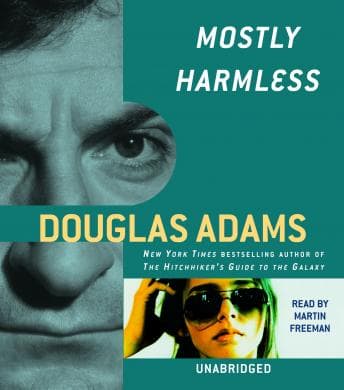
I was supposed to be running regression analysis on my procedural terrain generation code. Instead, I spent six and a half hours listening to Douglas Adams work through what I can only describe as an existential crisis wrapped in British absurdism. And look—I knew going in that Mostly Harmless had a reputation. The "dark one." The "bummer ending." But knowing that and actually experiencing Martin Freeman guide you through it are two very different things.
The Galaxy's Saddest Sandwich Maker
Here's the thing about Mostly Harmless that nobody prepared me for: it's not just darker than the other Hitchhiker's books, it's mean. Adams seems genuinely angry at his own characters. Arthur Dent finds something resembling contentment making sandwiches on a primitive planet, and the universe immediately punishes him for it. Ford Prefect discovers the Guide has been taken over by corporate interests, and his attempts to fight back feel futile in a way that's less "funny futile" and more "capitalism will consume everything you love" futile.
The worldbuilding still has flashes of that classic Adams brilliance. The concept of probability axes and the Guide Mk II manipulating reality across dimensions? That's the kind of high-concept sci-fi nonsense I live for. But it never quite lands the way the Improbability Drive or the Total Perspective Vortex did. It feels like Adams had the ideas but not the joy.
Freeman's Arthur, For Better and Worse
Martin Freeman playing Arthur Dent in audio form after playing him in the film feels like cheating in the best way. He is Arthur—that perpetually bewildered, fundamentally decent Englishman who just wants a proper cup of tea and for the universe to leave him alone. His comedic timing is exceptional, especially in the early chapters when Arthur's sandwich-making expertise becomes village legend.
But here's where it gets interesting. Some listeners apparently hate his Zaphod voice—apparently it comes across as "very Brooklyn"—and I can see that. It's jarring. Zaphod should sound like the galaxy's most confident idiot, not like he's about to offer you a deal on a used spaceship in Queens. The delivery man fighting the Boghog scene, though? Freeman absolutely nails that. You can hear the exhaustion and absurdity in equal measure.
The first couple hours, Freeman does seem to be finding his footing as narrator versus actor. It's subtle, but there's a warmth that develops as he settles into the storytelling rhythm. By the time Random—Arthur's surprise teenage daughter—shows up, Freeman's bringing genuine emotional weight to scenes that could have been played purely for laughs.
When Adams Stopped Laughing
I need to talk about the ending. (No spoilers, but also—it's been out since 1992, and if you're reading this review, you probably know.)
This isn't the gentle absurdism of the first three books. This is Douglas Adams writing through depression, and you can feel it. Beyond Good and Evil gave me that same sense of a brilliant mind wrestling with darkness, though Nietzsche at least seemed energized by his despair. The humor is still there—it's still funny—but there's a nihilism underneath that the earlier books never had. My D&D group would probably love the multiverse mechanics, but they'd be bummed out by the destination.
Compared to Restaurant at the End of the Universe or even So Long and Thanks for All the Fish, Mostly Harmless feels like Adams lost faith in his own creation. The jokes land, but they leave bruises. Arthur's journey from bewildered everyman to... where he ends up... isn't satisfying in the way good fantasy progressions are satisfying. It's the opposite of that Sanderson-level payoff where everything clicks into place.
Who Should Brave This Particular Probability Axis
If you're a completionist who needs to finish the series: yes, obviously, Freeman's narration makes it worth your time. If you're looking for the zany, quotable brilliance of the original Hitchhiker's Guide: temper your expectations significantly. Skip this if you want comfort reading—this isn't that.
This is for focused listening. Don't put this on while coding or doing housework—you'll miss the subtleties of Adams' language, and honestly, the dark ending hits harder if you've been paying attention. I listened during what was supposed to be a thesis work session, and I ended up just... sitting there. Staring at my procedural generation code. Thinking about entropy and corporate takeovers and whether any of our sandwiches really matter.
Roll for Existential Damage
Mostly Harmless is a weird artifact. It's the work of a genius who was clearly struggling, performed by the perfect actor for the material, telling a story that refuses to give you what you want. Freeman's narration elevates it from "disappointing conclusion" to "fascinating failure." The six and a half hours flew by, even when I wished they wouldn't.
Do I recommend it? Yeah. But not because it's fun. Because it's interesting. And sometimes that's enough.