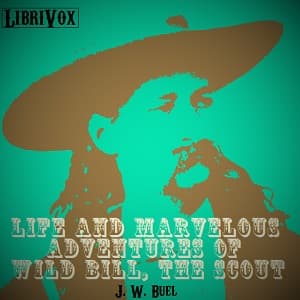

Most people hear "Wild Bill Hickok" and think of a Hollywood gunslinger with a six-shooter in each hand and perfect hair. J.W. Buel's 1880 biography wants you to think that too - and that's both the charm and the problem with this one.
I was up late rebuilding a proposal for a client's executive protection plan, Ranger snoring at my feet, and figured a short listen about one of America's original security professionals might be fitting background. At two hours and thirty-six minutes, this barely qualifies as a commitment. Finished it before midnight.
Frontier Propaganda Done in Earnest
Let me cut to the chase: this isn't a modern biography. This is an 1880s hagiography written by a journalist who clearly idolized his subject. Buel treats Wild Bill the way a staff officer treats a four-star general - every action is justified, every kill was righteous, every close call proves divine favor. The book reads like an after-action report written by Bill's biggest fan.
And honestly? That's what makes it interesting. Not as a reliable historical document - historians have picked apart Buel's claims for over a century - but as a window into how the American frontier manufactured its own legends in real time. Buel was essentially doing PR for the Old West. The "Rock Creek Station fight" where Bill supposedly killed ten men single-handedly? Modern historians say the actual number was probably one, maybe two, under pretty questionable circumstances. But Buel presents it like the Alamo compressed into a single afternoon.
I've seen this scenario play out in real life, by the way. Every unit has that operator whose stories get bigger with each retelling. The difference is Wild Bill's inflated stories got published and became gospel. I kept thinking about how Battle Scars handles a similar tension - the gap between the story a man becomes and the life he actually lived.
The LibriVox Gamble
Here's where I need to be straight with you. LibriVox is a volunteer operation - free audiobooks read by people donating their time, and God bless them for it. But you're getting what you pay for. Multiple volunteers read different sections, which means the voice, recording quality, and pacing shift chapter to chapter. One reader might sound like they're in a closet (because they probably are), the next sounds like they're narrating from a cathedral. There's no consistent character voice work, no dramatic tension in the delivery. It's people reading aloud competently, and some sections are better than others.
For a 19th-century text full of Victorian prose and dramatic frontier language, a strong single narrator could've made this thing sing. Instead it's a patchwork. Not terrible - I've endured worse briefings from majors who couldn't find their own slides - but don't expect a polished Audible production.
I bumped the speed to 1.25x as usual, and some of the slower readers benefited enormously from the push. Others were already at a decent clip and the acceleration made them sound slightly breathless during action sequences. Your mileage will vary by chapter.
Where History Meets Tall Tale
The most valuable thing about this book is Buel's descriptions of frontier life - the mundane logistics of scouting, the casual violence of Kansas cow towns, the weird social hierarchy where lawmen and outlaws swapped roles depending on the day. When he stops worshipping Bill long enough to describe Abilene or Deadwood, you get genuine period texture. The section on Bill's service as a Union scout and spy during the Civil War is probably the most grounded part, and the descriptions of intelligence gathering behind Confederate lines felt oddly familiar. Different war, same principles - you move quiet, you watch patterns, you trust nobody.
But Buel's a 19th-century journalist, and the prose shows it. Sentences that run forty words when ten would do. Adjectives stacked three deep. "Sanguinary combats" and "hair-breadth escapes" - the man never met a dramatic phrase he didn't want to marry.
The author clearly did their homework for 1880 - Buel interviewed people who knew Bill, visited the locations, and gathered contemporary accounts. The problem is he didn't have a fact-checker, and he didn't want one. This is myth-making in progress, captured on the page.
Who Should Saddle Up (And Who Should Ride On)
If you're a frontier history buff who wants to understand how Wild Bill became WILD BILL - the legend, not the man - this is a fascinating primary source. Short enough to knock out on a single drive. If you want accurate history about James Butler Hickok, read Joseph Rosa's biography instead. If you need polished audio production, this ain't it.
Worth your time? Here's the debrief: it's free, it's short, and it's a genuine artifact of American myth-building. Just don't mistake it for the truth. Ranger slept through most of it, which tells you something about the audio quality, but I'm glad I listened. Sometimes the most honest thing about a piece of propaganda is how shamelessly it commits to the bit.






![Steve Jobs [unabridged audiobook] audiobook cover](/_next/image?url=https%3A%2F%2Fcovers.audiobooks.com%2Fimages%2Fcovers%2Ffull%2F9788499923406.jpg&w=1920&q=75)