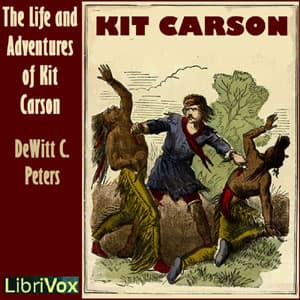

What happens when you pick up a book that's so far outside your wheelhouse it might as well be on another planet?
I'll tell you what happens. You learn something. Not just about Kit Carson or the nineteenth-century American West, but about yourself - about what you can sit with, what makes you uncomfortable, and what stories you've been fed your whole life without questioning them.
Let me back up. I grabbed this one on a whim during a marathon branding project - twelve hours of logo iterations for a craft brewery, two cats asleep on my keyboard, and I needed something that wasn't going to wreck me emotionally because I could NOT afford mascara streaks on a Zoom call. A fifteen-hour biography of a mountain man seemed safe. Neutral. Historical.
Reader, it was not neutral.
The Ghost of "Manifest Destiny" Is Louder Than You Think
This book was published around 1858, and it reads like it. DeWitt C. Peters was an Army surgeon who compiled Kit Carson's life story largely from Carson's own accounts, and the language is steeped in the ideology of its era. Indigenous peoples are referred to with terms that made me physically flinch. The framing of westward expansion as noble, inevitable, righteous - it's baked into every chapter like sugar in pan dulce. You can't separate it out.
And honestly? That's exactly why I think it's worth hearing. Not because it's comfortable, but because it's a primary document of how a nation told itself stories to justify what it was doing. As a first-gen Mexican-American whose family's own history got steamrolled by some of these same forces, listening to Peters describe Carson's encounters with Native tribes and Mexican communities felt like reading someone else's version of your family's nightmare written as a hero's journey.
Abuela would have had WORDS. Many of them in Spanish. Most of them unprintable.
Fifteen Hours With a Rotating Cast of Strangers
Okay, the LibriVox situation. Here's the thing about volunteer-narrated audiobooks: they are free, they are a gift, and they are wildly inconsistent. Different chapters are read by different volunteers, which means you'll go from someone with a steady, measured delivery to someone who sounds like they're reading aloud for the first time in a college seminar. The tonal shifts between narrators are jarring - one section feels like a fireside storytelling session, the next feels like a public library recording booth at 2 PM on a Tuesday.
Nobody here is Julia Whelan. Nobody is even trying to be. There are no character voices to speak of, no emotional coloring in the delivery. The nineteenth-century prose is already dense and formal - long paragraphs describing trapping expeditions, trade routes, military campaigns - and a flat reading makes those sections feel twice as long. I caught myself drifting during hour seven, somewhere in the middle of yet another beaver-trapping expedition described in excruciating geographic detail.
But some of the volunteers genuinely try, and you can hear it. There's warmth in certain chapters, a sense that the reader cared about the material. It's uneven, but it's human. And free is free.
Where It Actually Got Me
I didn't cry. (I know. Shocking. Mark your calendars.) But there were moments that hit differently than I expected. Carson's early life - orphaned young, apprenticed to a saddler, running away to join a trading caravan at fourteen - has this raw, lonely quality that Peters can't quite smother with his hero-worship prose. There's a passage about Carson's first wife, an Arapaho woman named Waanibe, that is heartbreakingly brief. She dies. Peters gives it maybe two paragraphs. And that absence - the emotional crater where a fuller story should be - said more to me than any of his flowery descriptions of Carson's bravery.
The book is at its most alive when Carson's own voice breaks through Peters' formal style. Short, blunt observations about survival, weather, danger. You can almost hear a different man than the myth. That gap between the myth and the actual human underneath it - I ran into something similar reading Babe Ruth, where the legend keeps crowding out the person and you find yourself grieving the real story you'll never fully get.
Who This Is Actually For
If you're a history nerd who wants primary-source material about the fur trade era and early American expansion, and you can hold the deeply problematic racial framing at arm's length while still engaging critically - this is genuinely fascinating. If you want a polished audiobook experience with a skilled narrator who makes you feel things through vocal performance alone, this is absolutely not that. If you're like me and you occasionally need to step outside your comfort zone and sit with discomfort, it's worth the free download.
Skip if you need emotional warmth from your narrator. Skip if colonial-era language about Indigenous peoples is something you can't or don't want to sit with right now. Both are valid.
Closing the Tab on This One
I'm not going to pretend this changed my life. But it stuck with me in ways I didn't expect - not because of what Peters intended, but because of everything he left out, glossed over, or couldn't see. Sometimes the most revealing thing about a biography is what the biographer thinks doesn't need explaining. And sometimes two cats and a fifteen-hour window into someone else's mythology is exactly the creative reset you didn't know you needed.








![Steve Jobs [unabridged audiobook] audiobook cover](/_next/image?url=https%3A%2F%2Fcovers.audiobooks.com%2Fimages%2Fcovers%2Ffull%2F9788499923406.jpg&w=1920&q=75)