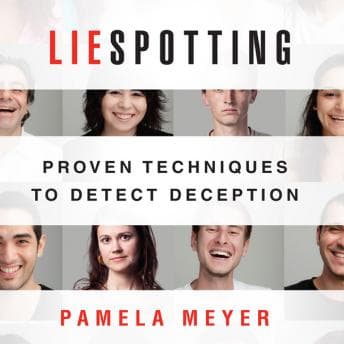

So here's the thing about Liespotting: I went in expecting a blog post stretched to book length (the curse of most business books), and came out genuinely surprised. Pamela Meyer's TED talk has 17 million views for a reason—the woman knows her stuff. But does that translate to six hours of audio? Mostly yes, with some significant asterisks.
I finished this across four commutes, and by day two I was doing something dangerous: trying to apply micro-expression analysis to my fellow Caltrain zombies at 6:47 AM. (Spoiler: everyone just looks tired. Or possibly lying about being tired. Hard to tell.)
The Content Is Actually Solid—Like, Surprisingly So
Bottom Line: This is basically interrogation training for people who negotiate deals instead of solve crimes.
Meyer pulls from three disciplines—facial recognition, interrogation techniques, and academic research on deception—and synthesizes them into something actually usable. The BASIC method she outlines (Baseline behavior, Ask open-ended questions, Study clusters, Intuit, Confirm) gave me a framework I've already used in two vendor negotiations. The ROI on this audiobook is real.
What I appreciated: she doesn't just tell you that liars avoid eye contact (which is actually a myth she debunks). She explains that deception leaks through micro-expressions—those split-second facial movements that happen before someone can mask their real emotion. The section on "duping delight"—that little smile liars get when they think they're pulling one over on you—was genuinely useful. I've seen that exact expression in meetings. Now I know what I'm looking at.
The interrogation techniques section reads like a cheat code for difficult conversations. How to ask questions that make lying cognitively expensive. How to spot the difference between someone who's nervous and someone who's deceptive. This is the kind of thing that probably should've been in my CS degree somewhere between algorithms and distributed systems.
Karen Saltus: Competent Until She Isn't
Okay, here's where my rating takes a hit. Karen Saltus is... fine? For straightforward exposition, she's perfectly competent. But there are moments—particularly when she's reading excerpts from other sources or trying to voice different characters—where it sounds like a mom reading a bedtime story. Not in a charming way. In a "this is supposed to be a high-stakes interrogation scenario and I'm getting Goodnight Moon vibes" way.
Worse: pronunciation errors. "Irrevelant" instead of "irrelevant" caught me so off-guard I rewound to make sure I heard it right. In a book about detecting lies and paying attention to details, this kind of sloppiness is... ironic? Frustrating? Both.
I bumped up to 1.5x speed and the pacing issues smoothed out somewhat. The content is dense enough that you want to absorb it, but her delivery doesn't always match the material's energy.
The Inevitable Business Book Bloat
Look, this could've been 4 hours. There's repetition. There are case studies that make the same point three different ways. Classic business book padding. Meyer clearly has the expertise—her background in interviewing and interrogation techniques is legit—but the book occasionally feels like it's justifying its page count.
The section on detecting deception in written communication felt tacked on, honestly. Email analysis techniques from 2010 haven't aged particularly well. (Though I did appreciate the bit about how liars use fewer first-person pronouns—that's still relevant.) For a business book that actually stays relevant, Outliers holds up way better—the research on success patterns doesn't expire like tech-specific advice does.
Who Gets Value Here (And Who Should Skip)
This is commute-worthy, but barely. The concepts are practical enough that you can follow along while half-asleep, but some of the facial expression descriptions really want visual aids. Meyer references her TED talk multiple times, and honestly? Watch that first. It's 18 minutes and covers the highlights. If you want the deep dive—the interrogation frameworks, the detailed case studies, the science behind why we're all terrible at detecting lies (spoiler: we're barely better than chance)—then the audiobook delivers.
Listen if: You negotiate, interview, or manage people and want practical frameworks for reading deception cues. Skip if: You need visual learner support for facial expressions, or you're looking for something more about building than reading people—Crush It! takes that completely different angle. Just know the narrator won't blow your mind, and you might want to speed it up.
Debug Complete: Worth the Install, Needs Patches
The science actually holds up. The delivery? Could've used an interrogation of its own.