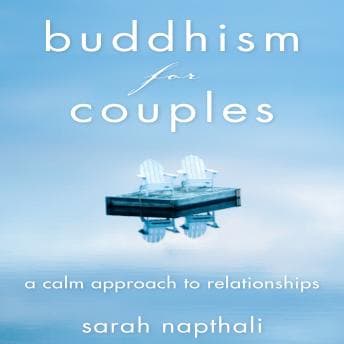

Look, I'm going to be honest about something that's been bugging me: the subtitle says "A Calm Approach to Relationships" and I wanted to throw my phone into the Caltrain bathroom sink approximately forty minutes in. Not because it's bad. Because Sarah Napthali has this very specific, very Buddhist way of holding up a mirror and going "hey, you know that thing you do where you keep score of who emptied the dishwasher last? That's suffering you're choosing." And I'm sitting there at 6:47 AM, half a cold brew in, thinking about the passive-aggressive text I sent Kevin last night about the laundry. Cool. Thanks, Sarah.
The Self-Help Book That's Actually About You (Not Your Partner)
Here's what separates this from the graveyard of relationship books I've 1.75x'd through: Napthali isn't giving you a communication framework or a five-step conflict resolution protocol. She's basically saying the biggest upgrade to your relationship is debugging yourself. And as someone who spends eight hours a day tracing problems through distributed systems, the metaphor landed hard - sometimes the bug isn't in the service you're yelling at, it's in the caller.
The book covers the usual relationship territory - housework division, anger, sex, even infidelity - but through Buddhist concepts like attachment, impermanence, and self-compassion. What surprised me is how grounded it is in actual communication theory. One reviewer nailed it: there's "practical wisdom rooted in rigorous communication theory" buried under the Buddhist framing. Napthali isn't just saying "meditate and be nice." She's dissecting why we catastrophize, why we build narratives about our partner's intentions that have zero basis in reality, why we cling to being right instead of being happy. Battlefield of the Mind goes after the same wiring - the stories we tell ourselves that have nothing to do with what's actually happening - though it comes at it from a completely different theological direction.
The housework chapter genuinely made me laugh - and then made me uncomfortable, which is probably the point. She doesn't take sides in the "who does more" war. Instead she interrogates why we're keeping score at all, what need that scorekeeping serves, and whether the resentment is actually about dishes or about something much deeper. (It's never about the dishes. Kevin, if you're reading this, it was never about the dishes.)
Karen Saltus and the 6:44 Problem
At 6 hours 44 minutes, this is a lean listen - three commutes for me. Karen Saltus narrates with a calm, clear delivery that matches the book's energy. She's not doing vocal gymnastics or character work because she doesn't need to - this is a single-voice self-help book and she treats it like a measured conversation. Which is fine. It's appropriate.
But here's my issue: "fine" and "appropriate" don't always survive the 6 AM commute test. There were stretches - especially in the more philosophical middle sections about attachment theory and Buddhist doctrine - where Saltus's even tone made my brain start to drift. I caught myself re-winding twice during one morning ride when someone's backpack kept hitting my shoulder and the narration didn't have enough variation to compete. For a book about paying attention, I was not paying attention.
She's not bad. I want to be clear about that. But she's the kind of narrator where you need to meet her halfway with your focus, and some mornings I just don't have that in me.
Could've Been a Blog Post? Actually, No.
I keep a running mental category for self-help books that pad a single insight to fill 200 pages. This isn't one of them. Napthali earns her runtime because she's applying Buddhist principles across genuinely different relationship scenarios, not just restating the same thesis in twelve chapters. The section on dealing with anger - specifically, sitting with anger instead of either suppressing it or weaponizing it - was worth the credit alone. She frames it not as "don't be angry" (useless advice) but as "observe the anger before you act on it" (actually doable).
The book also doesn't require any Buddhism background, which I appreciated. I've read a few Buddhist-adjacent self-help books and some of them assume you already know what the Eightfold Path is. Napthali explains concepts as she introduces them, and Napthali's own experience - over a decade of practice - keeps it from feeling like a Wikipedia summary.
What it's NOT: a couples workbook. Don't go in expecting exercises or scripts. This is more like recalibrating your own internal defaults so you show up differently in the relationship. Think of it as refactoring your emotional codebase rather than adding new features. Rising Strong is the book I'd hand someone who wants that same internal reckoning but needs more of a structured framework to work through - Brené Brown gives you the scaffolding where Napthali gives you the philosophy.
Who Gets the Most ROI Here
Perfect for: anyone in a long-term relationship who's tired of having the same three arguments on rotation. Also good if you're Buddhism-curious but don't want to commit to a pure dharma text. Skip for: anyone wanting actionable couples exercises, conversation prompts, or anything resembling therapy homework. Also skip if you need high-energy narration to stay locked in during early commutes.
I texted Kevin a summary of the attachment chapter and he replied "so you're saying I was right about the laundry thing?" He was not right about the laundry thing. But I didn't send a passive-aggressive text about it, so. Progress.
The ROI on This Audiobook Is... Quietly High
TL;DR: Worth your commute. Not flashy, not life-changing in a fireworks way, but the kind of book that shifts something small in how you think - and small shifts compound. I'd bump it to 1.25x to add a little energy to the narration without losing the content. Three commutes, one slightly better relationship. Not bad math.