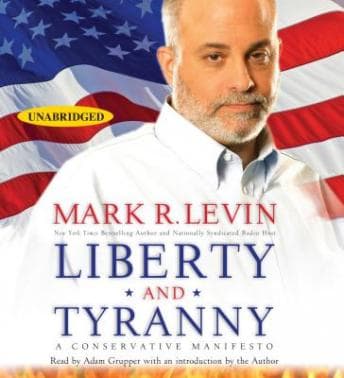

Finished this one on a Tuesday night drive back from a client site in San Antonio. Two hours of I-35, Ranger snoring in the back seat, and Mark Levin laying out his philosophical framework for conservatism through my truck speakers. Pretty fitting setting, actually - nothing like Texas highway darkness to make you think about the state of the republic.
Let me cut to the chase: this is a political philosophy book dressed up as a manifesto, and whether that works for you depends entirely on what you're looking for.
The Intellectual Ammo Dump
Levin's background as a constitutional lawyer and Reagan-era adviser shows here. This isn't talk radio bluster put to paper - it's structured as a series of essays covering the economy, environmentalism, immigration, the judiciary, and the welfare state, all filtered through what Levin calls the "Conservative" versus "Statist" framework. He leans hard on Locke, Montesquieu, de Tocqueville, and the Founders themselves. Ron Chernow does something similar in Alexander Hamilton - anchoring the philosophical arguments of the founding era in the specific, contested decisions of real men under pressure, which makes the abstract feel consequential in a way Levin sometimes struggles to achieve. The chapter on environmental policy - where he dissects the regulatory apparatus built around climate science - is probably the most data-dense section. He throws statistics and policy citations at you like brass at a range.
Here's what I appreciate: Levin doesn't just complain. He actually traces the philosophical lineage of American conservatism back to natural law and individual liberty, then maps how specific policies have eroded those principles. The chapter on the judiciary and activist courts reads like a legal brief - because that's basically what it is, coming from a guy who's argued before the Supreme Court through his work at Landmark Legal Foundation.
But - and this is where I have to be honest - the book was published in 2009, early Obama era, and some of the specific policy arguments feel dated. The healthcare debate has evolved. The economic landscape has shifted. The philosophical underpinnings still hold up, but if you're looking for a tactical manual for 2024 politics, this ain't it. It's more like reading the Army's doctrinal publications - the principles are enduring, but the field manuals need updating.
Grupper Keeps His Cool When Levin Doesn't
Adam Grupper is an interesting choice for this material. Levin on his radio show is... passionate. Let's leave it there. But Grupper reads with this calm, almost academic steadiness that actually elevates the text. When Levin's prose gets its most pointed - calling out what he sees as liberal overreach in pretty blunt terms - Grupper doesn't match that energy. He pulls it back, keeps it measured. It's like having a college professor read you a strongly worded op-ed. The material lands differently that way. Harder to dismiss, actually.
At seven hours, this is a tight listen. No fat on it. I bumped it to 1.25x as usual and it tracked perfectly - Grupper's pacing is deliberate enough that the speed increase just brings it to normal conversational cadence. The production is clean, no audio artifacts, just a solo narrator doing solid professional work.
Where This Lost Me
Levin has a habit of framing everything as binary. You're either a Conservative (capital C, his definition) or a Statist. No middle ground. Now, I spent 25 years in an organization that runs on clear orders and defined objectives, so I understand the appeal of binary thinking. But governing a country of 330 million people is messier than a convoy through Sadr City, and pretending otherwise weakens some of his arguments. When he gets into immigration policy, for instance, the framework gets strained because the real-world solutions don't fit neatly into philosophical boxes.
Also - and this bugged me - he occasionally attributes motives to "the Statist" that feel more like rhetorical strawmen than honest engagement with opposing arguments. I've sat across the table from people I deeply disagree with in rooms where the stakes were a lot higher than a policy debate. You learn pretty quick that assuming your opponent's motives gets you killed. Or at least gets you bad intelligence.
Who Should Form Up
If you're already conservative and want a philosophical foundation for positions you hold intuitively, this is solid ammunition. If you're genuinely curious about the intellectual roots of modern American conservatism - Levin does that work better than most talk radio figures would. If you're on the left and willing to engage honestly with opposing ideas, Grupper's measured delivery actually makes this more accessible than Levin's radio persona might suggest.
Skip it if you want current policy analysis. This is 2009 thinking applied to 2009 problems, even if the principles predate both.
Mission Debrief
Worth your time? Here's the debrief: it's a well-constructed argument for a specific worldview, delivered by a narrator who smartly plays against the material's intensity. Not every argument lands, and the binary framing gets tiresome, but there's genuine intellectual rigor underneath the manifesto packaging. Ranger slept through most of it, but he's more of a Federalist Papers dog anyway.







![Steve Jobs [unabridged audiobook] audiobook cover](/_next/image?url=https%3A%2F%2Fcovers.audiobooks.com%2Fimages%2Fcovers%2Ffull%2F9788499923406.jpg&w=1920&q=75)