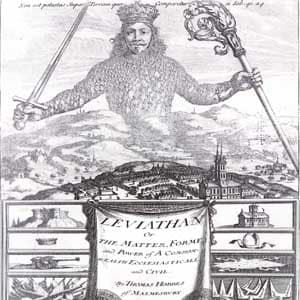

I was on a red-eye to Boston, couldn't sleep, and figured - you know what, let me finally tackle the back half of Leviathan. I'd done Books I and II years ago at McKinsey when a partner told me Hobbes was "the original management consultant." He wasn't wrong. But Books III and IV? This is a different animal entirely.
Bottom line: This is Hobbes going full corporate restructuring on the Catholic Church. And it's kind of magnificent in a 370-year-old way.
Hobbes Was the First Guy to CC: Everyone on the Takedown Email
Here's what nobody tells you about the second half of Leviathan: it's basically an 11-hour argument that the Church has no authority independent of the state. Hobbes does this by becoming, of all things, a biblical scholar. The man reads Scripture like a contract lawyer looking for loopholes. He cross-references passages, dismantles claims to prophetic authority, and essentially argues that if you can't verify someone's divine revelation, you shouldn't let them override civil law. This is what my parents did instinctively - they didn't trust the church elder's business advice over their own judgment running that dry cleaning shop. Now it has a TED talk. Actually, it had a 1651 treatise first.
Book III spends a LOT of time on biblical exegesis. And I mean a lot. Hobbes walks through the Old Testament prophets, the nature of miracles, the authority of Moses versus later prophets, and builds this meticulous case that sovereign power trumps ecclesiastical authority. If you've ever sat through a strategy presentation where someone spends 47 slides building to a conclusion you already agree with - that's this. But the reasoning is genuinely sharp. Hobbes distinguishes between "the Kingdom of God" as a real political entity (ancient Israel) versus a metaphorical concept, and uses that distinction to demolish theocratic claims. Pretty bold for a guy who could've been burned for it.
Book IV - "Of the Kingdom of Darkness" - is where it gets spicy. Hobbes essentially accuses the institutional church of importing pagan philosophy (looking at you, Aristotle) into Christian doctrine and using it to consolidate power. He goes after transubstantiation, purgatory, exorcism, and a dozen other doctrines as essentially political tools dressed up in theological language. The consulting parallel writes itself: I've seen this fail at three different companies - organizations that let internal politics masquerade as strategy. Hobbes saw it in 1651. We're still seeing it.
The LibriVox Factor - You Get What You Pay For
Let's talk about the elephant in the room. This is a LibriVox recording, which means volunteer narrators reading public domain text. No production budget. No sound design. No Audible polish. The audio quality shifts between chapters because different volunteers recorded in different environments - one chapter sounds like a proper studio, the next like someone's living room with a ceiling fan. There's no consistent vocal characterization because there's no single narrator making interpretive choices.
Is it listenable? Yes. Is it good? It's... adequate. The text itself is dense 17th-century English, and without a skilled narrator to guide you through Hobbes's serpentine sentences, you're doing a lot of heavy lifting as a listener. My 2.0x speed couldn't save this one - I actually had to drop to 1.5x in places because the sentence structures are genuinely complex and the volunteer readers don't always handle the phrasing in ways that clarify meaning. When Hobbes builds a paragraph-long argument with three subordinate clauses, you need a narrator who knows where the emphasis falls. You don't always get that here.
That said - it's free. And for a text this old and this important, free is a perfectly reasonable price of admission.
Who Should Bother (and Who Definitely Shouldn't)
If you're a political philosophy nerd, a history-of-ideas person, or someone who wants to understand the intellectual roots of church-state separation, this is essential reading. The arguments Hobbes makes in Book III about the relationship between civil and religious authority are still live debates. You hear echoes of this in every conversation about religious exemptions, about whether faith leaders should dictate policy, about the limits of institutional authority. Ben-Hur actually puts flesh on these same tensions - the collision between imperial authority and religious conviction plays out there not in footnotes but in chariot dust and prison cells, and I found the contrast instructive.
If you're coming to this hoping for the greatest hits - the state of nature, the social contract, the war of all against all - skip it. That's Books I and II. Skip to chapter 5. Thank me later. Actually, skip to a different audiobook entirely.
And if you're not already somewhat familiar with Hobbes and with biblical scholarship, this will be genuinely impenetrable. Hobbes assumes you know your Deuteronomy from your Ecclesiastes, and he doesn't slow down.
The Dry Cleaner's Son's Take
Jenny would say I'm being harsh. Jenny is right. But here's the thing - there's real intellectual firepower in these pages. Hobbes was doing something genuinely dangerous: telling the most powerful institution in Europe that its authority was borrowed, not inherent. That the sovereign, not the pope, held final say. He did it with footnotes and Scripture citations instead of a sword. That's a move I respect.
The audiobook version? It's a functional delivery vehicle for a brilliant text. Nothing more, nothing less. If you want the prestige narration experience, wait for a proper production. If you want the ideas and you want them free, this does the job.