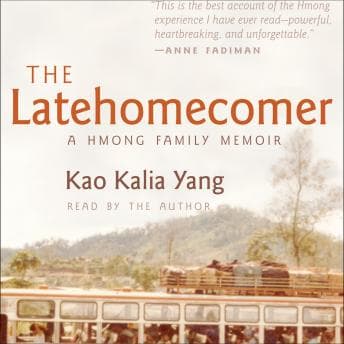

I'm writing this with puffy eyes and a cat (Diego, the judgmental one) sitting directly on my keyboard because I haven't moved in two hours.
There's a line in this book about how the grandmother's spirit had to travel back through the jungles, across the river, all the way back to the beginning just to rest. That image? It broke me. Completely. I was sitting at my desk trying to vector a logo for a coffee shop, and I just had to put the stylus down and let the tears happen.
This isn't a polished, high-production performance. It's an open wound. And honestly, it's beautiful.
Why the "Bad" Reviews Are Wrong
Okay, let's address the elephant in the room because I saw the reviews before I hit play. People are saying Kao Kalia Yang's narration is "flat" or "whiny." Some people even said they couldn't understand her.
Here's my take: You're wrong. (Sorry, not sorry.)
Is she a professional voice actor with perfect breath control and distinct character voices for every cousin? No. She's a granddaughter reading a eulogy for the woman who saved her life. That "whiny" quality people are complaining about? That's the sound of a voice thick with grief. That's the sound of someone trying to keep it together while reading about their family starving in the jungles of Laos.
If you want a performance, go listen to a celebrity memoir. If you want to feel like you're sitting on the floor in St. Paul, Minnesota, listening to a friend tell you the hardest thing they've ever lived through, you listen to this. There were moments where her voice cracked or she sounded like she was holding back a sob, and it made the hair on my arms stand up. It felt private. Intrusive, almost.
The Matriarch Energy is Real
I lost my Abuela two years ago, and this book hit me right in that soft, bruised spot. The way Yang writes about her grandmother—the shaman, the protector, the woman who literally carried them to safety—is so visceral.
It's not just a refugee story (though the history part is heavy and necessary). It's a love letter to the women who carry culture in their bones. That same weight of lived history—the kind that shapes identity across generations—is what made Narrative of the Life of Frederick Douglass so devastating to listen to. When Yang describes the Hmong concept of the soul and the journey home, it didn't feel like folklore. It felt like truth.
There's a slowness to the pacing—I'll admit that. It's not a thriller. It meanders a bit, like a long conversation over tea that's gone cold. But I listen at 1.0x speed because I want to sit in that feeling. I want to hear the silence between the words.
Who This Is (and Isn't) For
If you need dynamic, theatrical narration to stay engaged, you might bounce off this. It's quiet. It's sad. It's incredibly specific to the Hmong experience while being universally heartbreaking. But if you've ever lost a grandmother who felt like the center of your universe, or if you want to understand what it means to carry your family's survival in your memory—this one will wreck you in the best way.
Now I Need to Call My Mom
This is exactly why I listen to audiobooks. To hear a person tell their own truth, in their own voice, without a filter. I'm going to be thinking about that grandmother for a long, long time. Now, if you'll excuse me, I need to go hug my cat and make that call.






![Steve Jobs [unabridged audiobook] audiobook cover](/_next/image?url=https%3A%2F%2Fcovers.audiobooks.com%2Fimages%2Fcovers%2Ffull%2F9788499923406.jpg&w=1920&q=75)