🎧
AudiobookSoul
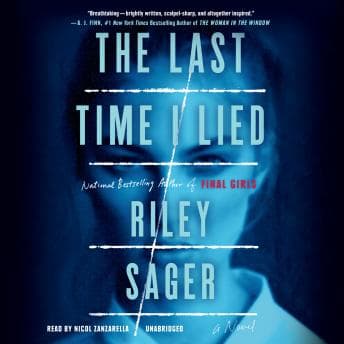
Last Time I Lied: A Novel audiobook cover

Last Time I Lied: A NovelWhen Memory Becomes the Monster

by Riley Sager🎤Narrated by Nicol Zanzarella
🔵 Worth Credit
✍️ 3.8 Editorial
🎤 4.2 Narration
12h 13m
📋

Case Abstract

When Memory Becomes the Monster

  • Narrator Assessment: Zanzarella's slow, eerie delivery perfectly mirrors the protagonist's traumatized processing without overselling the suspense.
  • Psychological Profile: Gothic summer camp setting functions as externalized psychology - dark lake, unchanged cabins, and surveillance anxiety.
  • Narrative Tempo: Deliberate past-present switching demands focused listening but accurately depicts how traumatic memory bleeds across time.
  • Clinical Verdict: Worth a Credit

Is this for you?

Pick this if: you enjoy psychological unreliable narrators and don't mind demanding timeline shifts · you want gothic atmosphere with restrained narration over flashy thriller performance · you love excavating traumatic memory puzzles and accept imperfect plot mechanics
Skip if: you need airtight mysteries with tidy resolutions and clean timelines · you mostly listen while commuting or distracted and can't give full attention · you prefer fast-paced whodunits over slow psychological character excavation
📚Best for fans of: Pretty Baby by Mary Kubica, The Last House Guest by Megan Miranda, The Girl on the Train by Paula Hawkins
Read Time4 min read
Duration12h 13m
Your rating?
Priya Sharma, audiobook curator
Reviewed byPriya Sharma

Psychology enthusiast. Analyzes characters like case studies. Not sorry about it.

🎧 Prefers listening while cooking elaborate meals, appreciates psychological architecture of unreliable narrators, disengages quickly from unrealistic character motivations.

Last updated:

Share:

"Two truths and a lie." Somewhere around hour three, while I was chopping onions for a dal that would take far too long for a Tuesday night, that phrase lodged itself in my brain like a splinter. Because here's the thing about Riley Sager's setup—it's not just a camp game. It's the entire psychological architecture of how we construct memory, identity, and the stories we tell ourselves to survive. My therapist would have thoughts about this character. ## The Unreliable Mind as Protagonist Emma Davis is a fascinating case study in what we call "narrative identity theory"—the idea that we become the stories we tell about ourselves. She's built an entire art career on massive canvases of dark leaves and ghostly white dresses, essentially painting her trauma on repeat. The research actually shows this kind of compulsive re-creation can be either therapeutic or pathological, depending on whether you're processing or just reliving. Emma? She's definitely reliving. What makes this character compelling is how Sager doesn't let her off the hook. She's not a reliable narrator, and the book doesn't pretend she is. The constant switching between past and present—fifteen-year-old Emma versus adult Emma—could have been disorienting (and honestly, some listeners found it was), but psychologically it tracks. That's exactly how traumatic memory works. It doesn't stay neatly in the past. It bleeds. Nicol Zanzarella's narration captures this bleeding beautifully. Her delivery is slow, almost eerie, and I found myself asking: why does this pacing work so well? Because it mirrors Emma's own processing speed. She's not racing through revelations. She's circling them, afraid to land. ## Camp Nightingale and the Gothic Tradition Let me be honest—the summer camp thriller is a crowded genre. But Sager understands something fundamental about gothic settings: they're externalized psychology. The dark lake, the unchanged cabins, that single security camera pointed at Emma's door—these aren't just atmospheric details. They're manifestations of surveillance anxiety, of being watched and judged for something you can't quite remember doing. Emma exhibits classic survivor's guilt patterns, complicated by genuine gaps in her memory. Did she see something that night? Did she *do* something? The book keeps you uncertain, which is frustrating if you want a clean mystery but brilliant if you're interested in how the mind protects itself from unbearable truths. (I will say—and this is where my academic brain gets picky—some of the plot mechanics strain credibility. The wealthy camp owner inviting Emma back specifically? The convenient clues Vivian left behind? Psychologically, this doesn't track as neatly as the character work does. But I was chopping ginger by hour seven and still listening, so clearly it worked well enough.) ## Where the Audio Earns Its Keep Zanzarella does something subtle that I appreciated: she doesn't oversell the suspense. In lesser thriller narrations, you get that breathless "something terrible is about to happen" voice that makes you roll your eyes. Here, the eeriness comes from restraint. She renders Emma's confused thoughts gently, almost tenderly, which makes the dark revelations hit harder. No sound effects, no music, no full cast—just one voice carrying twelve hours of psychological tension. It's a commitment. I wouldn't recommend this for background listening or your morning commute unless you want to miss your exit because you're too busy analyzing whether Emma's memory of that final night is constructed or genuine. ## The Right Listener for This Particular Excavation If you need your mysteries to be airtight and your timelines to behave themselves, this might frustrate you. The past-present switching is intentional but demanding. Skip it if you're looking for a fast-paced whodunit with a tidy bow. [Pretty Baby](/reviews/pretty-baby) plays with that same unreliable memory structure, though it approaches maternal psychology from a completely different angle. But if you're here for the psychology—for watching a woman excavate her own buried memories while the narrative keeps you guessing which version of events is true—this is your book. I found myself taking notes. Not for a review. For a potential paper on unreliable narration and traumatic memory. (My dissertation committee would be thrilled to know I'm still finding research material in thriller audiobooks at 10 PM on weeknights.) ## Diagnosis: Compelling, If Imperfect Riley Sager—or rather, Todd Ritter behind the pen name—understands human nature in the specific way that thriller writers must: he knows we lie to ourselves first and most convincingly. Emma's journey back to Camp Nightingale isn't really about finding out what happened to three missing girls. It's about whether she can survive knowing the truth about herself. The ending will divide people. I won't spoil it, but I'll say this: it's psychologically honest in a way that might not feel satisfying. Real closure rarely does. [Four Blind Mice](/reviews/four-blind-mice) gave me that same psychologically honest but emotionally unsatisfying ending—the kind that respects the messiness of human motivation. My dal burned, by the way. Worth it.

Clinical Observations 🧠

Audio production quality notes that may affect your listening experience

🎙️

Read by a single narrator throughout the entire audiobook.

Quick Info

Release Date:July 3, 2018
Duration:12h 13m
Language:English
Audio Code:58694736

About the Narrator

Nicol Zanzarella

Nicol Zanzarella is an award-winning audiobook narrator and actor with a background in classical and contemporary theater as well as film. She has narrated over 350 audiobooks across multiple genres and is known for her engaging and versatile narration style.

4 books
3.7 rating

Enjoyed this review? Rate it!

📬

Get Weekly Audiobook Picks

Join listeners getting honest reviews from our curators every Monday. No spam. Unsubscribe anytime.

Subscribe on Substack