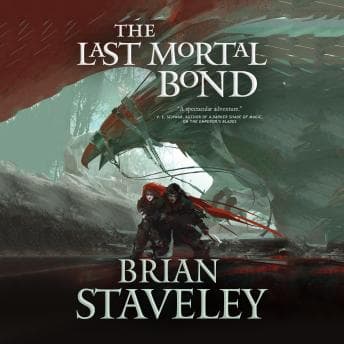

Nearly thirty hours. This book is nearly thirty hours long and I still wasn't ready for it to end. That's not a flex, that's a problem. I finished the last chapter at 2 AM on a Tuesday, sitting in my desk chair where I was supposed to be writing my thesis lit review, and I just... sat there. Staring at nothing. Processing. My advisor would be disappointed. I am not.
Brian Staveley really said "I'm going to take three imperial siblings, throw them into completely different worldviews shaped by their training, and then force them to try to save an empire together when they can't even agree on what 'saving' means." And then he delivered on that premise so hard I forgot to eat dinner.
The Csestriim Problem (Or: What If Elves Were Terrifying)
Let me explain something to my D&D group: the csestriim are what happens when you take the concept of ancient, immortal beings and strip out everything romantic about them. No tragic beauty. No melancholy wisdom. Just cold, calculating entities who view human emotion as a design flaw to be corrected through extinction. They're not evil in the mustache-twirling sense—they're evil in the "your feelings are a bug, not a feature" sense, and that's so much worse.
The magic system here? Chef's kiss. Leaches drawing power from specific sources—one needs fire, another needs pain, another needs... well, I won't spoil it, but there's a reveal about one character's source that made me actually say "oh no" out loud. Second Foundation had me doing the same mental math with its psychohistory limitations—different magic system, same satisfying crunch. In my apartment. Alone. At midnight. The specificity of the limitations creates genuine tension because you're always calculating what resources are available.
Simon Vance Walked So Other Narrators Could Run
I've been listening to Simon Vance since I discovered audiobooks could be more than just someone reading words at me. The man has range. His Kaden—the monk-trained emperor who learned to empty himself of emotion—sounds genuinely different from his Valyn, the elite soldier whose rage burns so hot it's practically a fourth character. And Adare, caught between faith and pragmatism, gets this edge of exhaustion that builds over the course of the book.
What really works is how Vance handles the Kettral—Valyn's special forces unit. Each member gets distinct vocal treatment without becoming cartoonish. Long Fist, the Urghul chieftain who may or may not be hosting a god, has this weight to his voice that made me genuinely uncomfortable every time he spoke. (In a good way. The best fantasy villains should make you uncomfortable.)
When Siblings Become Enemies Become... Something Else
Here's where Staveley does something I didn't expect. The three siblings don't reconcile. Not really. They don't have a big tearful reunion where they realize the power of family was inside them all along. They've been shaped by forces so different—monastic emptiness, military brutality, political necessity—that they can barely recognize each other anymore. And the book asks: what if that's okay? What if saving the world doesn't require you to be a happy family?
The emotional weight of mortality hangs over everything. The csestriim live forever. Humans don't. And that gap—that fundamental difference in how you experience time and loss and love—becomes the central conflict. It's not just about winning a war. It's about whether human emotion is worth preserving at all.
(My thesis is about procedural generation in games. Why can't I write about this stuff instead? Dr. Patel wouldn't understand.)
Sanderson-Level Worldbuilding With a Bleaker Edge
The Annurian Empire feels lived-in, with its bureaucracies and religious factions and military structures all grinding against each other. That same institutional complexity shows up in Into the Forest, though it strips away the empire entirely to ask what happens when all those structures collapse. The gods walking around in human bodies have their own agendas that don't align with anyone's survival. And the ending—look, I can't spoil it, but it's the kind of ending that earns its weight. Not happy, exactly. But right.
Yes, it's 30 hours. Yes, it's worth it.
Roll for Initiative (Or Don't)
If you bounced off the first two books, this won't save you. If you need your fantasy heroes to be heroic in uncomplicated ways, look elsewhere. But if you want a trilogy finale that respects your intelligence, that treats its characters as genuinely different people rather than variations on a theme, that asks hard questions about what we're willing to sacrifice for survival—this is it. This is the payoff.
My D&D group would love this. I'm already planning a csestriim-inspired villain for our next campaign.
Now if you'll excuse me, I have a thesis to pretend to work on.