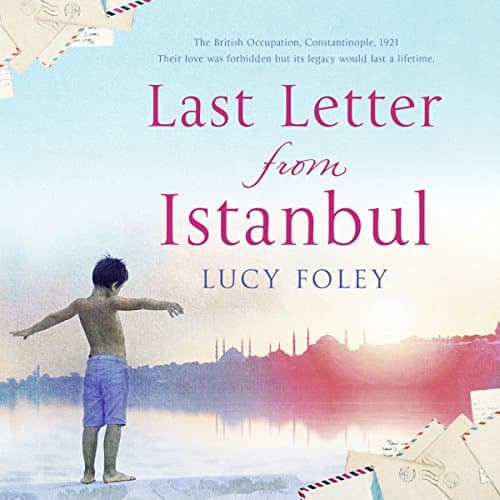

Okay so everyone's out here telling me Lucy Foley only does murder mystery thrillers now - The Guest List this, The Paris Apartment that - and I genuinely forgot she wrote historical fiction before she became the queen of whodunits. So when I pulled up Last Letter from Istanbul at like 2:47 AM while re-organizing my shelves by vibe (yes I have a "devastating but beautiful" section, don't judge me), I was NOT expecting what hit me.
This is not a thriller. This is not fast. This is the literary equivalent of watching fog roll across water at golden hour, and somehow I didn't DNF it.
Constantinople Hits Different When You're Not Expecting It
Let me set the scene: 1921, post-WWI Istanbul (still called Constantinople), and our girl Nur is literally watching her childhood home - this gorgeous white house across the Bosphorus - get used as a British army hospital. She's out here selling embroideries to survive. She's got this orphan boy she's protecting who's carrying a secret that had me pausing the audio and staring at my ceiling for a solid minute. And then the boy gets sick, and she has to go back to her own house and beg the British medical officer, George, for help.
The tension between Nur and George is not your typical enemies-to-lovers where they're bickering over coffee. It's wrapped in actual geopolitical weight - she literally lost her home, her status, her entire world to his side. And Foley doesn't let you forget that. Every interaction between them carries this undercurrent of "we shouldn't" that's rooted in real consequences, not just vibes. That same push-pull where the stakes are bigger than the two people in the room is exactly what made me spiral over Trouble with Honor — different era, same gut-punch of wanting two people to just figure it out already. Spice level? Low. But the emotional tension? The tension is chef's kiss.
I'll be honest though - the pacing tested me. Around hour 3 I almost bumped to 2.5x because the descriptions of Constantinople, while genuinely gorgeous, can go on. Foley writes these long sensory passages about saffron sunsets and fig tree fragrance and the salt air off the Bosphorus, and they're beautiful on the page probably, but in audio form they can feel like the narrator is reading you a very fancy weather report. I settled on 1.5x which is unheard of for me - but going faster actually made me miss the atmosphere, which is wild because I normally have zero patience for atmosphere.
Emma Gregory Carried This on Her Back
This narration slaps different. Emma Gregory is doing the WORK here - she's handling Turkish characters, British officers, different ages, different genders, and she's making real choices with each voice. The way she shifts between Nur's quieter, more guarded delivery and George's more clipped British military cadence creates this constant audio reminder that these two people come from completely different worlds. That contrast does more storytelling than some of the actual dialogue.
One listener said Gregory captures "the human predicament" and honestly that's the most accurate way to describe it. There's this quality in her voice during Nur's internal moments - especially around the orphan boy and his secret - where you can hear the character holding herself together. Not dramatic, not overwrought. Just... controlled grief. It got me.
I do wish the research had more specifics on particular scenes because I want to shout about specific moments, but I'll say this: the sections where Nur returns to her family home and has to navigate it as a stranger in her own space? Gregory's delivery there made my chest physically tight. POV: you're obsessed with a narrator you'd never heard of before.
The Slow Burn That Actually Has a Reason
Here's where I'll be real - this book asks a LOT of patience. The romance between Nur and George builds at an almost glacial pace, and the war backdrop means the stakes feel more political than personal for long stretches. If you need your romance to be the engine of the plot, you'll be frustrated. The romance here is more like... a consequence of proximity and shared humanity during wartime. Which is beautiful but also means you're waiting. A lot.
But the payoff IS there. Unlike some slow burns that string you along for nothing (my villain origin story), Foley earns the emotional moments. The forbidden nature of Nur and George's connection isn't manufactured drama - it's the actual historical reality of occupied Constantinople, and that makes every small gesture between them feel enormous.
My algorithm is screaming because this isn't my usual romantasy chaos, but sometimes a book catches you sideways. This one did. Wild Orchids caught me the same way — not what I came for, not what I expected, and somehow still living in my chest weeks later.
Who Should Listen (And Who Should Skip)
If you love slow-burn historical romance with real weight behind the "forbidden" part, atmospheric writing that actually earns its runtime, and a narrator who'll wreck you quietly — this is your listen. Skip it if you need fast pacing, high spice, or a romance that drives the plot instead of hovering at its edges. This book moves like fog, not fire.
The 2 AM Verdict - Would I Lose Sleep Again?
Yeah. I would. This isn't a book that makes you forget you're listening - it's a book that makes you hyper-aware of every word, every pause, every shift in Gregory's voice. It's quiet and heavy and slow and earned. I finished it at 4 AM with my ring light still on and my shelving project completely abandoned, which tells you everything you need to know.