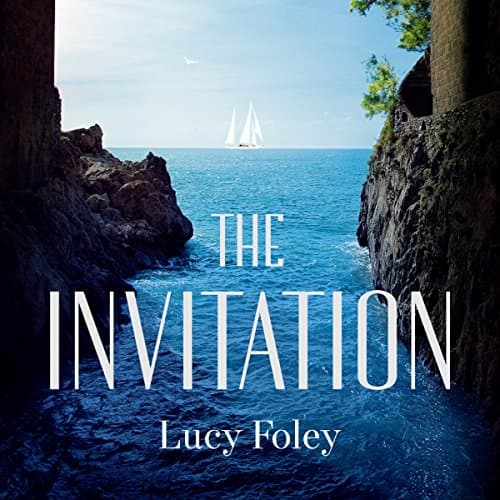

I started this one on a rainy Tuesday evening when I had nowhere to be, and that turned out to be exactly the right call. I was curled up, half a glass of wine in, and within twenty minutes I was standing in a Roman piazza with Hal Jacobs, watching him meet a woman who would ruin his ability to think straight for the next year of his life. That opening night between Hal and Stella — him adrift in post-war Rome with more guilt than purpose, her glittering and somehow broken at the same time — hooks you with a specific kind of quiet electricity that has nothing to do with plot twists and everything to do with Foley's ability to make you feel the temperature of a room.
This is Lucy Foley before she became the locked-room thriller queen. No murdered guests, no suspects with alibis. Her later work — I reviewed The Paris Apartment a few months back and spent the whole time white-knuckling my steering wheel — is a completely different animal. The Invitation is literary historical fiction wearing silk and carrying war wounds. Hal is a journalist going through the motions in 1950s Rome when he meets Stella, a luminous American socialite who vanishes after one charged evening. A year later, an invitation from an Italian Contessa pulls them both onto a yacht bound for Cannes, surrounded by film people and socialites who look polished from ten feet away and start cracking up close.
Emma Gregory's narration is the reason this audiobook works as well as it does. Her default voice — a refined English register that fits the 1950s European setting like a tailored jacket — anchors the story in place and period. But the standout moment is when she becomes Stella. The American accent she uses isn't the nasal caricature you sometimes get from British narrators tackling American characters. It's warm, a little breathy, with a quality that sounds like someone carefully holding themselves together. When Stella deflects a personal question at dinner on the yacht, Gregory's delivery carries both the charm of the deflection and the panic underneath it. You hear the performance within the performance — Stella performing ease while Gregory performs Stella. That layering is what makes the audiobook version worth choosing over the print.
Foley's writing earns its comparisons to Kate Morton and Victoria Hislop. The Italian Riviera sections practically have a color temperature — warm gold, salt-tinged, the deck of the yacht shifting under your feet. When the narrative drops into flashbacks of war-torn Spain, the shift hits like stepping from sunlight into a cellar. Gregory handles this tonal whiplash with real control, slowing her pace for the wartime passages, letting the weight of what happened sit in the silence between sentences. She's quietly one of my favorite narrators working right now — her performance in Hide Her Name showed the same ability to carry emotional weight in the quiet moments, and it holds up just as well here.
Here's where I have to level with you: the middle third of this book slows down considerably. The yacht-bound social dynamics — the repressed glances, the cocktail party maneuvering, the secondary characters orbiting Hal and Stella — start repeating without advancing the story. The Contessa's collection of luminaries (a film director, various socialites with curated public faces) never develop beyond their function as scenic backdrop for the central romance. I caught myself checking how much time was left during a stretch where two consecutive scenes involved characters staring meaningfully at each other across a deck. Beautiful staring, yes. But staring.
The ending will frustrate some listeners. It's deliberately ambiguous — fitting for characters defined by what they've buried — but after eleven and a half hours of slow-building tension, the lack of clean resolution can feel like the story simply decided to stop rather than conclude. If you've read Foley's later thrillers and expect that kind of satisfying click at the end, you'll need to adjust your expectations entirely.
What keeps the slower passages from becoming actual boredom is Gregory's voice holding you in place. During the dual timeline sections — shimmering present-tense Riviera against dark wartime flashbacks — her shifts in register give the audiobook a rhythm the text alone might not achieve. She turns good-not-great prose into something you want to keep listening to even when the plot isn't pulling its weight.
This is not a book you put on while folding laundry. The prose asks for your focus, and the emotional payoff comes from accumulation — small revelations stacking until the weight of Stella's past becomes something you feel physically. Save it for a quiet evening, a long solo drive, or any stretch where you can give it real attention. It rewards patience with beauty, but it moves at the pace of a Mediterranean afternoon, not a thriller's midnight sprint.
Who Should Listen (And Who Should Skip): Buy this if you want lush Riviera atmosphere, wartime secrets, and a love story built on longing rather than action — and you can handle a slow middle without a thriller payoff. Skip it if you need The Guest List-style momentum or a cleanly resolved ending. This is Foley in a completely different mode — less puzzle, more painting — and Gregory's narration is what makes it worth the frame.