
Okay so I need to rant for a second because WHY did nobody warn me that this book would make me physically unwell. I'm talking gut-punch after gut-punch, and the last four hours had me sitting on my gym mat - not working out, just sitting there with my headphones on, staring at the wall like a war survivor myself. The leg press was RIGHT THERE and I could not move.
Let me back up.
Rin Didn't Come to Play and Neither Did Kuang
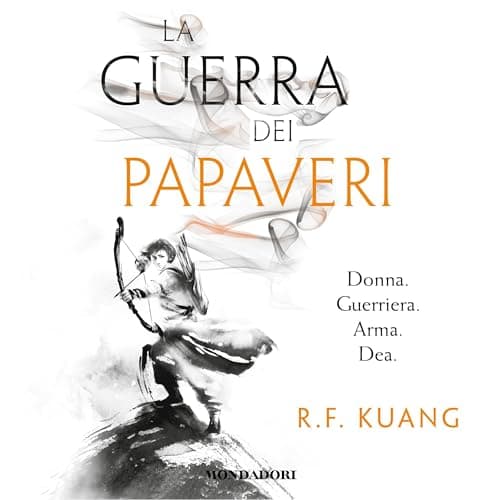
So La guerra dei papaveri is the Italian audio version of The Poppy War, and if you've been sleeping on R.F. Kuang's debut trilogy - baby, wake UP. Rin is a war orphan from the southern provinces who claws her way into Sinegard, the empire's elite military academy, basically through sheer stubbornness and a willingness to set herself on literal fire. And I mean that almost literally. The first third is giving dark academia meets magical boot camp, where Rin discovers she has shamanic powers connected to ancient gods. The middle shifts into full military strategy mode. And then the final act? It goes to a place so dark I had to pause and just... breathe.
What gets me is how Kuang structures the tonal shift. You think you're reading a fantasy school story - rivals, mentors, training arcs - and then the Mugen Federation invades and suddenly you're processing genocide through the lens of a nineteen-year-old girl channeling a fire god. The Nanjing Massacre parallels hit DIFFERENT in audio because you can't skim. You have to sit in it. Every single second.
Barbara Villa Carries 19 Hours on Her Back
Here's the thing - I have basically zero context on Barbara Villa as a narrator because this is an Italian production and the English-language audiobook discourse doesn't really cover her. So I'm being real with y'all: I can't compare her to the English narrators or give you the deep vocal analysis I usually do. What I CAN tell you is that 19 hours and 12 minutes is a COMMITMENT, and a single narrator handling Rin's arc from scrappy orphan to someone bargaining with gods requires range.
The Italian language actually adds something wild to the shamanic chanting and the martial terminology - there's a rhythm to it that feels almost operatic during the battle sequences. If you're an Italian speaker or studying Italian, this is genuinely a cool way to experience the story because Kuang's prose already has this relentless forward momentum that pairs well with Romance language cadence.
I bumped to 1.75x for the academy chapters (the pacing in that first third drags a little - Kuang herself has said the school section is the weakest part) and then dropped back to 1.25x once the war started because you do NOT want to miss a single beat of the Golyn Niis sequence. That scene - when Rin walks through what's left of the city and sees what the Federation did - I literally stopped my TikTok edit mid-frame. Couldn't focus on anything else.
The Spice Question (There Isn't One, and That's the Point)
Look. I'm a romantasy girlie at heart, and I went into this knowing it wasn't going to feed that particular hunger. There's no real romance arc here - Rin's relationship with Nezha is complicated but it's more about class tension and political allegiance than butterflies. And honestly? That's correct for this story. Kuang isn't interested in giving you comfort. She's interested in making you understand what happens when a traumatized girl gets access to unlimited destructive power and a government that sees her as a weapon. That same slow unraveling of a young person being weaponized by the system that made them — I felt it in a completely different genre with Ballad of Songbirds and Snakes, and it wrecked me just as hard.
The tension is chef's kiss but it's not romantic tension. It's the tension of watching someone you're rooting for make increasingly horrifying choices and understanding exactly why she makes them. By the final hour, Rin does something that made my jaw literally drop - and I KNEW it was coming because BookTok spoiled it for me two years ago and it STILL hit. The only other time I've been spoiled on an ending and had it wreck me anyway was Una corte de alas y ruina — different vibes entirely, but that final act? Same wall-staring energy.
Who Gets This and Who Bounces
If you need romance or light escapism, skip this one - it will not deliver what you want and the content warnings are real: graphic war violence, abuse, references to sexual assault during wartime. This book doesn't flinch. But if you're looking for a fantasy that treats its Asian-inspired setting with actual historical weight instead of aesthetic vibes, and you want a protagonist who's angry and messy and powerful and wrong - POV: you're obsessed. At 19+ hours this is not background listening. Save it for a long road trip or a weekend where you can just lock in.
The Algorithm Brought Me Here and I'm Not Mad About It
BookTok made me buy this. No regrets. Kuang wrote this at 19 years old which is genuinely unhinged talent. The Italian audiobook is a solid way to experience it if that's your language, though I wish I had more data on Villa's specific performance choices to give you a proper narration breakdown. What I know is: I finished all 19 hours in three days, I immediately added the next two books to my wishlist (which is now at 849, someone intervene), and I haven't stopped thinking about Rin's final choice since.