
I was hauling firewood back to the cabin in late February — snow up to my knees, breath crystallizing before it left my mouth — when Rin made a decision so devastating I stopped mid-step and just stood there in the pines, holding a split log like an idiot, staring at nothing.
That's the thing about La repubblica del drago. It doesn't let you multitask. Not even when the temperature's dropping and you should be stacking wood before dark.
War Doesn't End When the Fighting Stops
Kuang understands something most fantasy authors don't: the aftermath is the real battlefield. Rin comes out of the third Poppy War a walking wound — addicted to opium, haunted by genocide she committed with her own hands, trying to outrun a god that lives inside her skull. The Phoenix isn't some cool magical power-up. It's a parasite. An addiction layered on top of an addiction.
And this is where Kuang's academic background in Chinese studies actually shows up on the page. The political architecture of the Nikan — the fractured warlord territories, the Empress playing factions against each other, the Dragon Republic's promise of democracy as a weapon of conquest — none of this is window dressing. It's drawn from the real collapse and reformation periods of Chinese history. The Mugenese occupation maps onto Japanese imperialism with uncomfortable precision. Kuang isn't romanticizing war. She's dissecting it, and then making you hold the organs.
Rin's arc in this second book is essentially this: she allies with Vaisra, the Dragon Warlord who wants to overthrow the Empress and establish a republic. Sounds noble. Except "republic" here means the same thing it's always meant when powerful men say it — power reshuffled, not redistributed. The slow reveal of Vaisra's actual agenda, the way Rin keeps swallowing red flags because she needs the alliance, because vengeance is the only thing keeping her alive — it's brutal to watch. Not because it's shocking, but because it's familiar. I've watched people make the same calculations in much smaller stakes.
The Sinusoidal Problem
Here's where I have to be honest. Some Italian listeners noted that the narrative arc feels more like a sine wave than a proper arc, and... yeah. There are stretches — particularly in the middle third, around the naval campaigns — where the pattern becomes visible. Rin gains power, loses control, faces consequences, pulls back, and then the cycle repeats. The war sequences are described with genuine tactical intelligence (the siege strategies, the river blockades, the way Kuang handles fleet positioning — she clearly did the research). But the emotional rhythm underneath starts to feel repetitive by hour fourteen or so.
The opium dependency subplot carries real weight early on. The physical descriptions of withdrawal, the way Rin's perception warps and sharpens and collapses — that's visceral, accurate-feeling stuff. But it also contributes to the stop-start pacing. Every time the story builds momentum, Rin craters, and we reset.
Barbara Villa Carrying 21 Hours
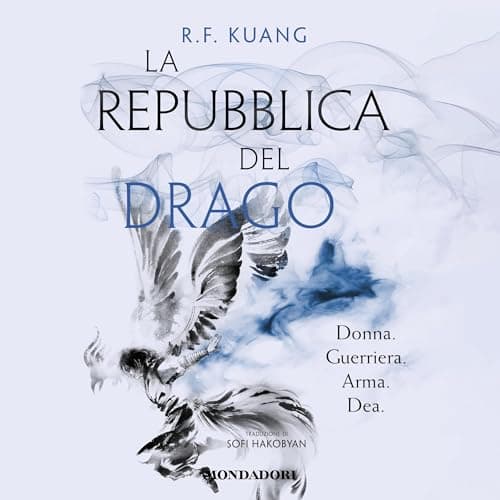
I should say — I listened to this in Italian, the Sofi Hakobyan translation read by Barbara Villa. Twenty-one hours and fifty-one minutes is a serious commitment for a single narrator, and Villa holds steady through it. I don't have enough data to speak to every vocal choice she makes, but I can say this: across nearly twenty-two hours, I never lost track of who was speaking, and that's not nothing in a book with this many political players. The Italian translation itself reads naturally — it doesn't feel like translated English the way some fantasy translations do.
What I can't tell you is whether Villa's performance elevates the material in the way a great narrator can. She's competent and consistent. Whether she captures the specific rawness Rin requires — the girl who burned 500,000 people alive and has to keep living with that — I'd need to hear the English version to compare. She didn't pull me out of the story. She didn't make me forget I was listening to a performance, either. For contrast, Brave is a case where the narrator actively transforms the material — I kept thinking about that gap while Villa was doing her steady, capable work here.
The Ecology of Empire (Or: Why Kuang Gets It)
Here's what earns my respect. Kuang treats the Nikan like an actual landmass with actual consequences. When armies cross rivers, those rivers flood. When shamanic powers are unleashed, the land scars. The Cike — Rin's squad of god-bonded soldiers — aren't superheroes. They're ecological disasters waiting to happen. Every use of shamanic power has a cost, and that cost gets paid by the land and the people standing on it.
Nature doesn't forgive mistakes. Neither do I. And Kuang doesn't either. She makes Rin pay for every fire she lights.
Who Should Listen (And Who Should Skip)
If you want grimdark fantasy that's actually about something — about imperialism, about what happens when you let anger become identity, about the real cost of divine power — this delivers. If you need tight pacing and can't tolerate a protagonist spiraling through the same destructive patterns for twenty-two hours, you'll lose patience somewhere around the naval campaigns.
The content warnings are serious. Genocide, rape, torture, suicide, substance abuse — Kuang doesn't flinch, and neither does the book.
Stacking Wood Before Dark
I finished the last chapter hauling that same load of firewood, three hours later than I should've. The ending lands hard — Rin makes a choice that redefines what this trilogy is actually about, and it's not redemption. It's not even survival. It's the terrible clarity of someone who has finally stopped pretending they're anything other than what war made them.
Not a perfect book. But an honest one. And out here, that counts for something.