
Three AM, warehouse floor empty except for me and the hum of the conveyor belts, and Rin is making the kind of choices that had me standing still next to a loaded pallet jack just shaking my head. I'm talking out loud to nobody, saying "Girl, don't do it." She does it anyway. Every single time.
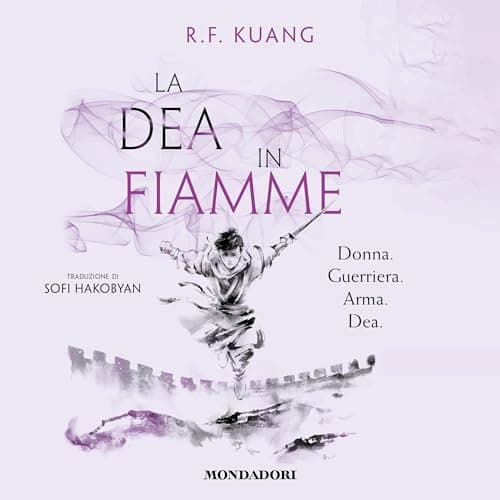
This is the Italian audiobook version of R.F. Kuang's The Burning God — the final book in the Poppy War trilogy — and I came into it already knowing Rin from the first two books. Let me give you the verdict up front: this is a war story about power eating a person alive, and it hits different when you're a guy who's watched ambition chew up good people on the warehouse floor for fourteen years.
Rin Burns Everything She Touches And You Can't Look Away
What Kuang does with Fang Runin in this final volume is brutal. She starts out betrayed, beaten, left for dead by allies she bled for. And instead of some triumphant comeback arc where the hero learns to be better — nah. Rin doubles down. She builds an army from the southern provinces, from people who've been ground under the boot of empire their whole lives, and she uses their loyalty like fuel. The parallels to real-world revolutionary movements aren't subtle, and they shouldn't be. Kuang pulled from the Chinese Civil War, Mao's rise, the cost of liberation when the liberator starts believing their own myth. That's heavy stuff, and it lands because Kuang doesn't flinch.
Here's what got me though — there's a stretch in the middle where Rin is running Tikany, her home village, trying to be a leader in peacetime, and she's terrible at it. She can call down the Phoenix's fire and burn entire fleets, but she can't sit through a meeting about rice allocation without wanting to destroy something. That felt real to me. I've seen guys who can run a crew of twenty during a holiday rush but can't handle a parent-teacher conference. (I might be one of those guys. Jamal's teacher and I have had words.)
The addiction thread — Rin's dependence on opium to suppress or channel the Phoenix god — that's the spine of the whole series, and in this book it gets ugly. Not glamorous-ugly. Desperate-ugly. The kind where you watch someone convince themselves they're in control while everyone around them can see they're not. Kuang wrote a war god who's basically a functioning addict running a revolution, and if that doesn't make you uncomfortable, you're not paying attention.
Barbara Villa Behind The Mic
So here's the thing — this is narrated in Italian by Barbara Villa, and I'll be straight with you: my Italian is nonexistent. I listened to this one because my buddy Marco at the warehouse wouldn't shut up about it, and he played me chunks during breaks. What I can tell you is that Villa carries the weight of 22 hours and 45 minutes without ever sounding like she's phoning it in. Her Rin sounds angry and young and increasingly unhinged as the book goes on, which is exactly right. The battle sequences — and there are a LOT of them — come through with real urgency even when I was catching maybe 60% of the words. Marco filled in gaps. That's how we spent most of January, him translating the political scheming parts, me picking up the action on my own. That obsessive, piece-by-piece way of chasing a story down reminds me of how I got through I'll Be Gone in the Dark — McNamara working her sources the same way Marco and I were working each other, filling gaps until the whole picture snapped into focus.
I can't give Villa a full technical rating the way I would an English narrator because that wouldn't be fair. But the emotional range? I could hear it. The moments where Rin breaks — and she breaks hard in this book — Villa doesn't oversell it. She lets the silence do work. That takes discipline.
Who This Hits Hardest (And Who Should Walk Away)
Look, this isn't a feel-good fantasy. The content warnings on this thing read like a police blotter — genocide, torture, child death, addiction, cannibalism. Kuang isn't messing around. If you came here for a hero's journey with a neat bow at the end, wrong door. Skip this if you want clean endings or if dark content is a dealbreaker — no judgment, but this ain't it.
But if you want a story about what happens when someone from the bottom — truly from the bottom, from a village that the empire treats like dirt — gets power and has to decide what they're willing to destroy to keep it? Real blue-collar stuff right here. Not the sanitized version. The version where the warehouse taught me more than college, where you learn that the people who fight hardest for their crew sometimes burn their crew down in the process.
At 1.6x this thing still runs around 14 hours, and even in a language I barely speak, I was gripping the wheel on the drive home more than once. Kuang was 24 when she finished this trilogy. Twenty-four. I was still figuring out how to parallel park a forklift at 24.
Punching Out
This book doesn't let Rin off the hook, and it doesn't let you off either. The ending is earned — painful and earned. Jamal and Malik would call this fake as hell if it was some Hollywood ending where everybody hugs. It's not. It's the ending a story about fire and empire and addiction deserves. From the warehouse floor straight to you: if you've followed Rin this far, finish the job.