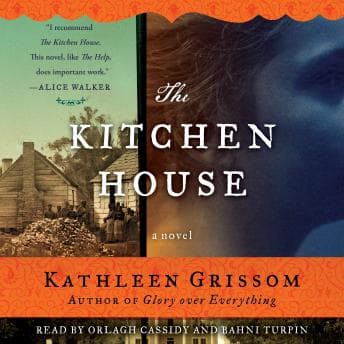

Everyone kept telling me this was a beautiful, heartbreaking story about the antebellum South. They weren't wrong. But what nobody prepared me for was how much the dual narration would fundamentally change the way I understood the material.
I've taught American literature for two decades. I've read slave narratives, plantation fiction, the whole painful canon. And I'll admit—I approached The Kitchen House with a certain wariness. Another white-authored story set on a Virginia plantation? I've seen this go wrong so many times. But Kathleen Grissom does something structurally interesting here, and the audiobook production makes it impossible to ignore: she gives us two narrators, two perspectives, and forces us to sit with the dissonance between them.
Two Voices, One Impossible History
Bahni Turpin is a Golden Voice for AudioFile Magazine, and honestly? She earns that title in the first five minutes. Her Belle is everything—strong without being a stereotype, wise without being a magical figure existing only to educate white characters. There's a weariness in Turpin's delivery that feels earned, historical, real. When Belle speaks about the kitchen house, about her position as the master's illegitimate daughter, about the impossible calculations she makes every day to survive—Turpin makes you feel the weight of every word.
Orlagh Cassidy handles Lavinia, the Irish orphan who arrives as an indentured servant and eventually moves into the big house. Some listeners have complained about Cassidy's Irish accent, and I'll be honest—it's not perfect. But here's the thing: Cassidy does something more important than accent work. She captures the genuine confusion of a child who doesn't understand the racial hierarchy she's been dropped into. Lavinia's innocence isn't played for sympathy; it's played as what it is—a kind of ignorance that has consequences.
The way these two voices trade off chapters creates something I rarely experience in audiobooks: genuine dramatic irony. We hear Belle's perspective on an event, and then we hear Lavinia's, and the gap between them—what Lavinia doesn't see, can't see, refuses to see—becomes the real story.
The Slow Burn and the Gut Punches
Look, this isn't a fast-paced book. I listened while grading final papers (don't tell my students), and there were moments—particularly in the middle section—where I had to rewind because I'd drifted. The pacing does slow toward the end, and some of the plot developments feel more melodramatic than the careful character work deserves.
But the gut-punch moments? They land. Hard.
Grissom isn't interested in making slavery palatable or in creating easy villains. The master's opium-addicted wife, his dangerous son, the complex web of relationships in the kitchen house—nothing here is simple. And that's what makes it valuable. This is the kind of book I wish I could teach in my classroom, if only the content warnings weren't so significant. (Violence, abuse, sexual content—this is not a gentle read.)
What struck me most was how the book handles Lavinia's skin color as both protection and barrier. She can never fully belong to the kitchen house family, no matter how much she loves them. And the narration makes this visceral—Cassidy's voice literally sounds different from Turpin's, and that difference is the point.
Who This Is For (And Who Should Skip It)
Would I assign this to my high schoolers? No—too much content. But anyone teaching or studying this period? Absolutely. If you need your historical fiction fast-paced and plot-driven, you'll struggle with the middle sections. But if you're willing to sit with discomfort and complexity, this rewards that patience.
The audiobook runs nearly thirteen hours, which is substantial. I'd say it's perfect for commutes or long walks—I finished the last three hours on the lakefront with Denise, and we ended up talking about it for another hour after. That's the mark of something that matters.
The production quality is clean. No weird audio artifacts, no volume inconsistencies between narrators. Whoever engineered this understood the assignment.
If you loved Toni Morrison's Beloved or Edward P. Jones's The Known World, this is a different animal—more accessible, more traditionally plotted—but it's asking similar questions. I'd also throw Les Miserables into that conversation—different setting, same fundamental questions about love and survival under oppressive systems. What do we owe each other across impossible divides? How do we love people we're not supposed to love? What does it cost to survive in a system designed to destroy you?
Grissom doesn't have Morrison's prose style (who does?), but she has something else: a genuine curiosity about how people navigate impossible situations. And Turpin and Cassidy make that curiosity vivid in a way that reading on the page simply cannot replicate.
Class Dismissed
My students would probably hate the pacing. I loved it anyway.