
When Arthur, Guinevere, and Lancelot start circling that doomed little emotional bonfire, you know exactly where this is headed. And because this version clocks in at just under two hours, it gets there fast.
I listened to King Arthur while folding scrubs at my kitchen table after a stretch of night shifts - house quiet, coffee reheating for the third time, brain somewhere between tired and nosy. This turned out to be a pretty decent slot for it, because this audiobook feels less like a big sweeping fantasy production and more like catching a public-domain stage play performed by an earnest local troupe. Sometimes that works. Sometimes... less so.
Camelot, but make it a stage drama
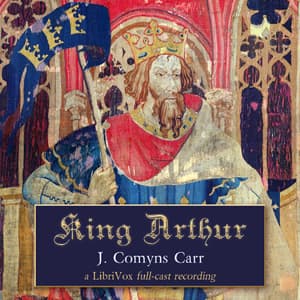
The first thing to know: this is Joseph Comyns Carr doing Arthur as drama, not a giant immersive retelling with battlefield thunder and cinematic world-building. No long scenic detours. No attempt to turn Camelot into a fully textured fantasy universe. This is much more interested in the emotional machinery of the legend - Arthur, Guinevere, Sir Lancelot, betrayal, loyalty, fate, the whole sad royal mess.
And honestly, that compactness helped me.
At 1 hour 51 minutes, there isn't time for bloat. If you've read or heard a lot of Arthuriana, that may actually be the selling point here. You already know the bones of the legend, so the appeal becomes hearing how this playwright trims it down into dialogue and confrontation. It's dialogue-heavy by design. Pretty much a chamber version of Camelot. Less "questing across Britain," more "everyone in this castle needs therapy."
That dramatic structure also means the love triangle is front and center. Not subtle. Not especially fresh if you're an Arthur regular. But direct. If what you want is Merlin doing cryptic wizard business for six hours, this isn't that book. If you want the tragic interpersonal core served up quickly, this gets the job done.
The volunteer-cast gamble
This is a LibriVox full-cast recording, edited by Libby Gohn, and you need to go in with the right expectations or you're going to be annoyed by minute ten.
Because yes - this is one of those "your mileage may vary" productions.
I didn't hear major technical disaster stuff. No wild sound effects, no weird music drops, no overproduced nonsense. The audio itself is listenable enough, and the editing keeps the whole thing from falling apart. So on a basic functional level, fine. Borrowable. Background-friendly.
But the performances are uneven. That's the real issue.
And I get why some listeners had the exact complaint that Arthur's reader sounds like he should've been Merlin and Merlin's reader should've been Arthur. Once you hear that idea, it's hard to un-hear it. Character fit matters a lot in a dramatic piece this short, because there isn't much runway for a voice to win you over. You meet a character, your brain tags the voice, and that's pretty much the relationship. If the match feels off, it keeps feeling off.
A couple of the volunteer performances have that community-theater energy - sincere, committed, but not always emotionally precise. Which sounds meaner than I intend. I've heard way worse from free classics recordings. But if you're used to polished commercial full-cast productions where every role is carefully cast and every pause feels intentional, this will feel rough around the edges.
The same LibriVox quality lottery showed up when I listened to Story of Mankind — that one landed a little better overall, so it might be a gentler entry point if you're new to the format.That's why I wouldn't recommend this as your first Arthur audiobook, or your first LibriVox listen. Start stronger elsewhere.
What worked better than I expected
Here's the thing. I didn't hate it.
Actually, I kind of admired what it was trying to do.
There is something charming about hearing an old-fashioned dramatic retelling handled by multiple volunteers instead of one narrator trying to muscle through every role. In a story built on confrontations and declarations, having different voices does create a little theatrical spark, even when the casting isn't ideal. You can hear the bones of the play. You can feel that this was written by a playwright and critic from another era, not by someone chasing modern fantasy pacing.
Also, because it is so short, the weak spots don't have endless time to wear you down. That's a real advantage. A mismatched performance over 14 hours? I would've started bargaining with the universe. Under two hours, I can live with it.
This is why I landed in the middle on it. The story itself holds up because the legend holds up. Arthur, Guinevere, Lancelot - those dynamics still have bite. Honor versus desire still works. Tragic inevitability still works. The audiobook presentation just doesn't elevate the material much beyond "serviceable free listen."
If I'm being practical - and I usually am - this is a stream or borrow title, not something I'd point people toward as a must-own performance. Good enough for a curious afternoon. Not the definitive trip to Camelot.
Who should ride to Camelot (and who should skip this one)
Pick this up if:
- you like Arthur retellings and want a very short public-domain variation
- you enjoy hearing older plays in audio form
- you're already comfortable with LibriVox's volunteer-performance quality swings
- you want something you can finish in one cleaning session
Skip this version if:
- narrator performance is your make-or-break factor
- you want lush fantasy atmosphere or big cinematic production
- voice casting mismatch drives you up the wall
- you're looking for a deep Merlin-centered take
My charting note and sign-off
This one's fine. Not glorious, not a disaster, just fine in that very specific free-audiobook way.
I wouldn't spend money on this version. But if you're in the mood for a quick, dialogue-heavy Arthur/Guinevere/Lancelot tragedy and can tolerate some volunteer-cast wobble, it's a reasonable stream. Think of it like break-room coffee on night shift: not amazing, but sometimes it gets you where you need to go.