
Okay, I have a complaint. Twenty-five minutes. TWENTY-FIVE MINUTES. I sat down at my desk at 1 AM - thesis document open, cursor blinking accusatorially at me - and figured hey, I'll knock out this short Bradbury piece before I pretend to work on my procedural generation chapter. And now I'm just... sitting here. Staring at my monitor. Feeling existentially wrecked by a story shorter than my average D&D combat encounter.
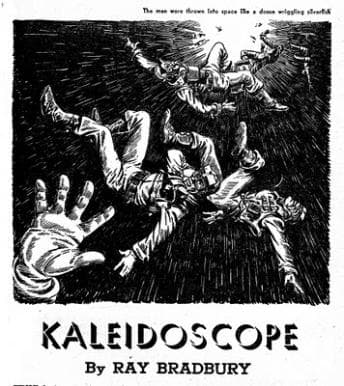
Here's the thing about Bradbury that drives me crazy in the best way: the man wrote science fiction like a poet who accidentally wandered into a spaceship. Kaleidoscope isn't about the tech. There's no magic system to diagram, no world-building wiki to maintain. A meteor hits a ship, the crew gets scattered into the void, and they're all just... drifting apart. Literally. Talking to each other over their suit radios while the distance between them grows and the oxygen doesn't replenish. That's it. That's the whole premise. And it absolutely destroyed me.
Dying Men Don't Monologue - They Argue, Confess, and Go Quiet
What Bradbury gets right - and what makes this so different from, say, a Sanderson character confronting death with some heroic cosmere-level revelation - is how petty and human these astronauts are in their final moments. The captain doesn't give a rousing speech. He's angry. He's reflecting on a life that feels wasted, cycling through regret and bitterness. The crew members snipe at each other, confess jealousies, settle old grudges. One guy is furious at another for sleeping with his wife. They're dying in the most spectacular way imaginable and they're still just... people. Messy, small, resentful people. It's devastating precisely because there's no grand catharsis. Just the slow realization that the void doesn't care about your unfinished business.
The ending - and I won't spoil it fully - reframes everything. There's this image that Bradbury paints of what happens to one of the crew members as he enters Earth's atmosphere, and it's the kind of thing that makes you set down whatever you're holding and just breathe for a second. A child looks up at the sky and sees something beautiful and has no idea what it cost. I read this instead of writing my thesis, and I regret nothing.
The Narrator Situation (It's Complicated)
So here's where I have to be honest: this version lists "Various Readers" with no specific names, and at 25 minutes, we're talking about a very slim production. The narration I heard leans into a single voice - slow, deep, heavy with weight. It works for the material. When you're conveying men who know they're dead and are just running out the clock on consciousness, you don't need vocal fireworks. You need someone who can sit in the silence between sentences and let the dread build.
But - and this is real - there's no meaningful character differentiation. Everyone sounds roughly the same, which means you're tracking the astronauts by context clues rather than distinct vocal identities. For a story with multiple crew members having separate conversations as they drift apart, that's a problem. Steven Pacey walked so other narrators could run, and this narrator is... standing still. Competently. The emotional delivery of the anguish lands, but I kept wanting the voices to fracture and separate the way the characters physically do. A full-cast production of this story would be absolutely transcendent. This version is good. It could be great.
Who Gets the Most Out of This
If you're a Bradbury fan, you probably already know Kaleidoscope from The Illustrated Man, and this is a fine way to experience it aurally. If you're new to Bradbury - honestly, this isn't a bad entry point. It's concentrated. No sprawl, no info-dumps (and look, I love info-dumps, but Bradbury doesn't need them). The info-dump-as-worldbuilding approach gets a much fuller workout in Well of Ascension, which I genuinely love, but sitting with Bradbury's total absence of it makes you realize how much weight a story can carry when it just trusts the void. It's 25 minutes of existential free-fall.
This is NOT for you if you want plot mechanics, progression systems, or anything resembling a conventional narrative arc. My D&D group would love this as a tone-setter before a particularly grim session, but it's not the kind of thing you throw on during a workout. You need to be still for this one. Focused. Maybe a little bit fragile.
The duration is the elephant in the room for value. At 25 minutes, spending a full credit on this would be like paying cover charge for a bar that closes in ten minutes. Phenomenal drinks, but still.
The Kid Who Looked Up and Saw a Shooting Star
Twenty-five minutes. I've spent longer arguing about whether monks are overpowered in 5e. But this little story crawled into my chest and sat there. Bradbury didn't need 40 hours or a hard magic system or Sanderson-level world-building. He just needed dying men, empty space, and one child who doesn't know what they're seeing. Sometimes the shortest fall hits hardest.