
"Now this is the Law of the Jungle — as old and as true as the sky."
That line hit me somewhere around the twenty-minute mark, and I actually stopped walking. Just stood there on the lakefront like a weirdo while joggers swerved around me. Because here's the thing — I've taught Kipling. I've assigned Kipling. I've graded half-hearted five-paragraph essays about Kipling. But I hadn't really listened to Kipling in years, and hearing that line spoken aloud reminded me why we still read the classics. The rhythm of it. The authority. Kipling wrote in a register that sits halfway between myth and bedtime story, and when you hear it rather than scan it while marking papers, you feel the weight of it differently.
The Jungle Is Smaller Than You Remember
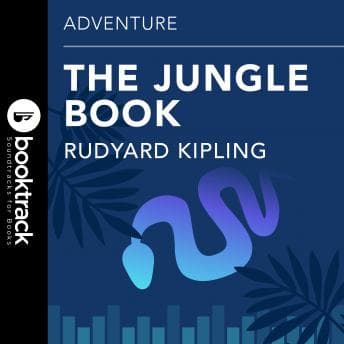
Let's talk about what this audiobook actually is, because the description promises a "movie-style soundtrack" and I want to be honest — I didn't pick up on any significant cinematic scoring. Phil Chenevert's narration is clean and straightforward, the kind of reading that trusts Kipling's prose to do its own heavy lifting. And at two hours and thirty-two minutes, this is a lean experience. We're not getting the full Jungle Books collection here. This is essentially the Mowgli stories stripped to their essentials — the boy raised by wolves, the uneasy council at the Pack Rock, Shere Khan's menace threading through the undergrowth.
And that brevity surprised me. I'd forgotten how compact these stories actually are before Disney inflated them into feature-length adventures. The confrontation between Mowgli and Shere Khan doesn't unspool over chapters of buildup. It arrives with the swiftness of actual jungle violence. Kipling understood something my students struggle with in their own writing: economy is power. Say it once. Say it right.
Phil Chenevert — Steady Hands on Old Material
Here's where I have to be straight with you. I don't have a ton of specific detail on Chenevert's vocal choices for individual characters — whether Bagheera gets a different register than Baloo, whether Shere Khan sounds properly imperial and dangerous. What I can tell you is that the narration is clear, unhurried, and carries a genuine sense of atmosphere. You feel the density of the jungle. The humidity of it.
But "clear and atmospheric" at this price point and duration is a bit like getting a solid B+ essay from a student who you know is capable of A work. Chenevert reads competently. He doesn't interpret the way I wish he would. The Law of the Jungle passages — those chanted, almost liturgical refrains that Kipling embedded in the stories — they deserve a narrator who leans into the ceremonial cadence of them. Who treats them like what they are: oral tradition. Poetry dressed in prose clothing. I wanted more performance there, more ritual in the delivery, and I'm not sure I got it.
The narrator understands that pause is punctuation — I'll give him that. He doesn't rush through Kipling's longer descriptive passages, which is critical because Kipling's syntax can be genuinely strange to modern ears. Those inversions, that colonial-era formality layered over what's essentially animal fable. A rushed read would flatten all of that.
The Colonialism in the Room
I can't review Kipling in 2024 without acknowledging the elephant — or rather, the Hathi — in the room. My students always want to know: can we still enjoy this? And my answer is always yes, but with your eyes open. Kipling's India is a British construction, filtered through empire. The "Law of the Jungle" is, depending on your reading, either a beautiful articulation of natural order or a rather convenient justification for rigid hierarchy. Probably both.
This audiobook doesn't provide any contextual framing for that, which is fine — it's a narration, not a lecture. But if you're coming to this fresh, or sharing it with younger listeners, know that the conversation doesn't end when the audio stops. (My students would hate this. I love it.)
Who Gets the Most Out of Two and a Half Hours
If you loved the Disney versions and never went back to the source, this is worth your time just for the disorientation. Kipling's Mowgli is harder, stranger, more feral than any animated version. The Pack dynamics are genuinely tense — there's real menace in the way Shere Khan manipulates the younger wolves against Akela. It reads less like a children's story and more like political thriller set in the underbrush. That tension between surface-level adventure and something darker underneath is something I kept thinking about when I reviewed Hellfire Club — different era, different stakes, but the same sense that the real danger is always political.
But if you want a definitive audio Jungle Book — full cast, rich character differentiation, the works — this probably isn't it. This is a clean, no-frills reading at a compact runtime. Good for a focused afternoon listen or a couple of lakefront walks.
For my 47 podcast listeners: yes, I'm doing a Kipling episode now. Mom, try to stay awake for this one.
Worth Pausing the Faculty Meeting For?
Almost. It's a solid way to revisit Kipling's prose without committing to a ten-hour production, and Chenevert's steady narration won't steer you wrong. But the brevity and the lack of interpretive flair in the performance keep it from being the version I'd press into someone's hands and say this one, right now. The prose deserves to be savored — and it mostly gets that here. Mostly.