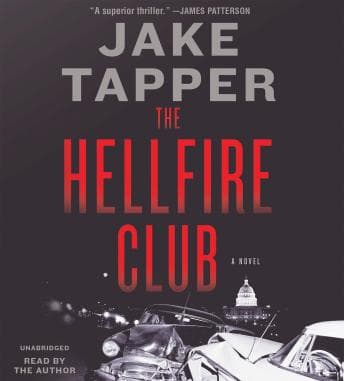

Jake Tapper wrote himself a thriller set in McCarthy-era Washington, then sat down and narrated the whole thing himself. That's either tremendous confidence or tremendous ego, and after ten hours I'm still not entirely sure which.
Here's what I know: the man can write a scene. That opening drops you into 1954 D.C. with the kind of urgency that made me forget I was supposed to be grading sophomore essays on The Great Gatsby. (Sorry, period three. Your thesis statements about the green light will have to wait.) Tapper's a journalist first, and it shows—not in a bad way, but in how he builds his world through accumulation of detail. Real senators. Real scandals. The kind of historical texture that made me pause the audiobook twice to look things up, which is either a compliment or an indictment of my own knowledge gaps. That same moral weight—watching someone navigate impossible choices—is what makes Crime and Punishment still hit so hard, even if Raskolnikov's stakes are more existential than political.
When the Newsroom Meets the Novel
Charlie Marder is our reluctant congressman, and Tapper writes him with genuine affection—a good man trying not to drown in a swamp that existed long before anyone started using that word as a political slogan. His wife Margaret is the more interesting character, frankly. A zoologist with her own career ambitions in an era that didn't much care for ambitious women. Their dynamic reminded me of what Hemingway said about writing marriage: the best ones have two people who are fully formed before they ever meet.
Tapper's narration is... complicated. He's not a professional voice actor, and you can tell. He doesn't do distinct character voices so much as slight modulations—a hint of Southern drawl here, a clipped military tone there. But here's the thing: his storytelling instincts are sharp. When Charlie is navigating a backroom deal or Margaret is piecing together a conspiracy, Tapper leans into the intimacy of those moments. He understands pacing in a way that some trained narrators don't. The prose deserves to be savored, and he gives it room to breathe.
That said—and I say this with the affection of someone who watches CNN while pretending to grade papers—the descriptive passages can get heavy. There's a gunfight scene near the end involving toppling statues that I suspect was meant to be thrilling but played slightly absurd in audio form. My students would call it "extra." They wouldn't be wrong. Girl on the Train has a similar problem with its big reveal—sometimes the mechanics of thriller plotting feel a bit much when you're hearing them out loud instead of racing through them on the page.
The Ghosts of Senators Past
What works best is the historical layering. Real figures like Joseph McCarthy and Lyndon Johnson drift through these pages, and Tapper handles them with a journalist's eye for detail and a novelist's permission to speculate. The secret society stuff—the titular Hellfire Club—walks a fine line between plausible conspiracy and pulp fiction. Sometimes it tips into the latter, but honestly? At 11 PM with a stack of ungraded essays and a glass of wine, I wasn't complaining.
The conversation between Charlie and Eisenhower near the end is genuinely affecting. It's the kind of scene that reminds you Tapper has spent his career talking to powerful people, watching them justify their compromises. He knows how power sounds when it's being honest with itself.
Who Gets an A, Who Gets an Incomplete
Listen if: You loved All the President's Men or have a soft spot for mid-century political intrigue. This is its spiritual successor in audiobook form—history buffs and political junkies will eat it up.
Skip if: You need crisp character differentiation from your narrator and don't care about historical texture. Maybe wait for a sale.
The Final Grade (From a Teacher Who Doesn't Give Them Lightly)
Look, this isn't Faulkner. It's not trying to be. It's a political thriller with literary ambitions and a genuine love for its historical moment. Tapper's narration won't make you forget about Simon Vance or George Guidall, but there's something to be said for hearing an author read their own work—you get their intended rhythms, their emphasis, the pauses they meant as punctuation.
My students would hate this. Too much context, too many senators, not enough explosions. I found myself genuinely invested in whether Charlie Marder could stay decent in a city designed to corrupt decent men. That's not nothing.
This is why we still read the classics—and why sometimes, a journalist's first novel scratches the same itch.