
"The stars are wrong."
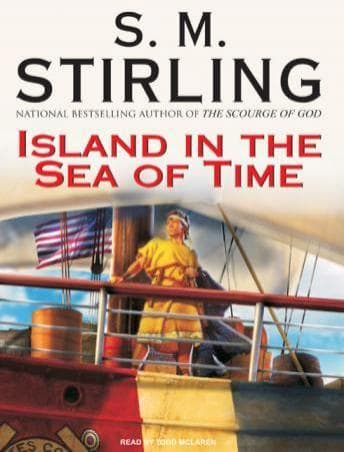
Not a quote from the book, but basically the first thing my brain registered when the premise clicked - Nantucket, the whole island, gets yanked back to 1250 BC. Not a person. Not a ship. The entire island. With its Coast Guard station, its grocery stores, its horses, its blacksmiths, its USCG training vessel Eagle, and approximately 7,000 people who were just trying to have a nice spring evening. That premise hit me like a natural 20 on a Perception check, and I was immediately in.
I was deep in a late-night board game setup - sorting meeples for a solo run of Spirit Island, which felt weirdly appropriate - when I put this on. Twenty-five hours later I had opinions.
The Premise Does The Heavy Lifting (And So Does The Scholarship)
Stirling is doing something I genuinely respect here: he's not just asking "what if time travel, lol" - he's asking what it actually takes to rebuild industrial civilization from scratch when you have the knowledge but not the supply chain. The discussions about bronze-smelting, grain storage, and how you actually train an army when your Bronze Age allies have never seen a stirrup are... okay, yes, they're info-dumps. Long ones. If you don't like info-dumps, this isn't for you (but you're wrong). This is Sanderson-level world-building in terms of internal consistency - every technological advantage the Nantucketers deploy has a logical origin and a real cost. The closest audiobook experience I've had to this kind of rigorous, consequence-driven world-building is Crown, though Stirling's scope dwarfs it considerably.
The political stuff on the island itself is where it gets genuinely interesting. Watching a 20th-century democratic community try to form a functioning government under existential survival pressure, with all the factions and egos that implies, scratches the same itch as the best D&D campaign politics. And then there's Lieutenant William Walker. Oh, Walker. The guy who looks at "we're stranded in the Bronze Age" and thinks "personal empire, actually." His arc is the kind of villain escalation that makes you put down your meeples and just stare at the ceiling for a minute.
The Battle of the Downs sequence is where the audio format really pays off - it's dense, chaotic, and McLaren's pacing through it keeps the geography legible in a way that's harder to track on the page.
Todd McLaren: Mostly Solid, One Significant Asterisk
Here's the thing about McLaren - the praise is real. His natural cadence for the Nantucket characters, particularly the Coast Guard crew, has this unhurried competence that fits the vibe perfectly. You don't notice the narration, which is genuinely the highest compliment. He's an Earphones Award winner and you can hear why across most of the runtime.
But. The Long Island accent. I've seen the complaint in multiple reviews and I can confirm: it is a choice. It's the vocal equivalent of someone dragging furniture across hardwood floors during a quiet scene. Not every chapter, not constant - but when it shows up, your brain snaps out of 1250 BC immediately. The New England accent is strained but I adjusted. The Long Island voice I never fully adjusted to. It's a real flaw in an otherwise strong performance.
The 25-hour runtime is worth flagging: this requires focus listening. I tried it as background while coding and missed about four pages of grain storage logistics that turned out to be plot-relevant. This is dedicated headphones-on territory.
Okay But Who Actually Wants This
If you mainline alternate history, if you've ever built a civilization in Civ and wondered about the actual logistics, if your D&D group has ever argued about what happens when the party accidentally destabilizes a Bronze Age economy - this is your book. The pacing is slow in places. The subplot implausibility complaints I've seen are not wrong (a couple of character decisions in the back half made me audibly go "...really?"). And the content warnings are real - there's violence and some genuinely dark material involving Walker that earns its adult content label.
But the core concept is executed with a rigor that most time-travel premises never bother with. I read this instead of writing my thesis. Well - listened. You know what I mean.
Yes, it's 25 hours. Yes, it's worth it. Start here before Dies the Fire - the timeline makes more sense that way.