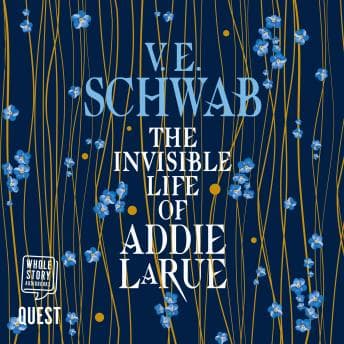

So here's the thing everyone gets wrong about The Invisible Life of Addie LaRue: they call it a fantasy. And technically, sure, there's a deal with the devil and immortality and all that. But this is really a 17-hour meditation on what it means to be remembered - and what it costs to be forgotten. I started this one during a late-night coding session where I was supposed to be debugging my procedural generation framework, and by hour three I'd stopped pretending I was going to get any work done.
Let me be upfront: I came into this expecting Sanderson-level world-building. Hard magic systems, defined rules, escalating stakes. That is not what this is. And I had to recalibrate my brain pretty hard to appreciate what Schwab is actually doing here.
The Curse That's Also a Character Sheet With One Stat
Addie's deal is deceptively simple. She can't die, but nobody can remember her. No barista writes her name on a cup. No lover recognizes her the next morning. She can't sign a lease, can't leave a note, can't even scratch her initials into a tree without the marks fading. The constraint is absolute, and Schwab plays it with the discipline of someone who actually thought through the edge cases. What happens when she steals food? When she walks into a museum? When she tries to create art? Each century peels back another layer of what that single restriction actually means in practice.
As someone who spends way too much time thinking about game mechanics and rule systems, I genuinely appreciated that Schwab doesn't cheat. The curse has consistent internal logic. It's not a hard magic system in the Cosmere sense, but it's tight. My D&D group would have a field day trying to rules-lawyer their way out of this one.
The structure alternates between Addie's past - moving through 18th-century France, revolutionary Paris, World War II Europe - and her present in modern Manhattan. The past sections are where the pacing gets divisive. Schwab will spend chapters luxuriating in a single afternoon in 1720s France, then skip forty years in a paragraph. Some people hate this. I get why. But I think it mirrors how memory actually works when you've been alive for three hundred years - some moments crystallize, and entire decades blur into background noise.
Julia Whelan's Low Frequency Magic
Here's where I have to be honest: Julia Whelan's narration is good but it's not Steven Pacey. (Steven Pacey walked so other narrators could run, but that's an unfair bar for literally everyone.) Whelan has this low, smooth cadence that works beautifully for Addie's internal world - the loneliness, the stubborn refusal to give up, the quiet fury of existing without being seen. When Addie finally meets Henry in that secondhand bookshop and he says her name - a name no one has remembered in three centuries - Whelan's voice does this thing where it cracks just slightly, and it hit me harder than I expected.
But the character differentiation is limited. Luc, the darkness-made-flesh devil figure, should sound fundamentally different from Henry, the sad-eyed bookshop boy. They don't, really. You get slight tonal shifts, and Whelan signals the time period changes with pacing adjustments, but if you zone out for a minute you might lose track of who's speaking. For a book with a relatively small cast, that shouldn't be as much of an issue as it is. I'd put her at a solid 3.5 - she nails the emotional register of the book, but I wanted more vocal range.
Who's Rolling a Persuasion Check on This One
If you need action set pieces and plot momentum, you're going to struggle here. This is a slow burn. A slow slow burn. The progression is satisfying but it's emotional progression, not power scaling or plot escalation. Think character study with fantasy trappings rather than epic fantasy with character depth.
But if you've ever sat at a D&D table and spent two hours just roleplaying a conversation in a tavern because the character work was that good? This is your book. If you love the quiet devastation of watching someone build a life knowing it'll be erased by morning? This is your book.
LitRPG fans and Sanderson completionists - you can still enjoy this, but go in knowing it's a different beast. People who loved Piranesi or The Time Traveler's Wife will feel right at home. The Once and Future Witches belongs on that list too - same slow-burn emotional devastation, women fighting to be remembered against systems designed to erase them, and I'd argue it hits even harder on audio.
I Read This Instead of Writing My Thesis (No Regrets)
Dr. Patel, if you're reading this: I was doing research on procedural narrative structures. Addie LaRue's story is basically a roguelike where you lose all your save data every session. That's... relevant. Probably.
Real talk though - this book stuck with me. I finished it at 2 AM, stared at my ceiling for a while, and then immediately started thinking about which moments in my own life I'd want someone to remember. That's not nothing. The ending is going to split people - I won't spoil it, but it's the kind of conclusion that makes thematic sense even if it's not the one you were rooting for. I respect that. Schwab committed to her premise and followed it to its logical end.
Seventeen hours is a commitment. Yes, it's worth it.