
What if the most radical thing you could do for your health is... stop trying so hard?
I started this one at 6:15 AM, squished between a guy manspreading into my seat and someone's backpack, already mentally calculating whether my overnight oats counted as "good" or "bad" breakfast. By hour three, I was genuinely questioning why I'd spent two decades of my life treating food like a debugging problem with a correct solution.
The Framework That Actually Makes Sense
Look, I'm a systems thinker. I optimize everything - my code, my commute, my audiobook queue. So when Tribole and Resch present their ten principles of intuitive eating, my brain immediately wanted to turn them into a checklist. Which is, of course, exactly what they warn you not to do.
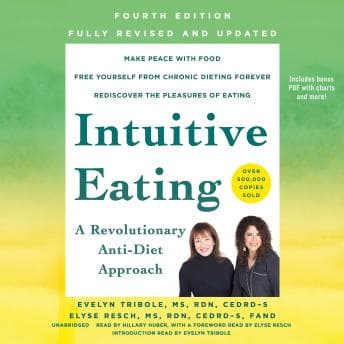
The core premise is basically: your body's internal hunger/fullness signals are a pretty sophisticated feedback system that diet culture has completely overwritten. The ROI on this audiobook is getting those signals back online. They break down concepts like "making peace with food" and "rejecting the diet mentality" with enough clinical backing to satisfy my need for evidence, but enough practical application that it doesn't feel like reading documentation.
What surprised me was how much time they spend on the psychology of restriction. That whole thing about how telling yourself you can't have something makes you want it more? They've got the research receipts. It's basically the same principle as why I always want to refactor legacy code I've been told not to touch.
Hillary Huber's Narration: The Polarizing Part
Okay, here's where I need to be honest. Hillary Huber has this warm, measured delivery that's perfect for the reflective content - she doesn't rush through the heavy emotional eating sections, which I appreciated during a particularly packed train when I needed something grounding.
But. And this is a real but. At 13+ hours, her pacing can feel a bit... slow? I bumped it to 1.5x around hour five and it hit better. Some listeners apparently couldn't stand her voice at all, which feels harsh - she's an AudioFile Golden Voice winner for a reason. But I get it. Self-help narration is weirdly personal. If her cadence doesn't click for you, that's a lot of hours to push through.
Where It Gets Frustrating
The book has a bit of an "our way or the highway" energy that started to grate on me. Look, I get that they're fighting against decades of diet culture messaging, so they need to be emphatic. But some of the dismissiveness toward any structured eating approach - even ones that might genuinely help some people - felt a little dogmatic.
And if you're dealing with emotional eating tied to depression or anxiety (hi, that's me during on-call weeks), the roadmap here is... thin. They acknowledge it exists, they validate it, but the practical tools for "I just stress-ate an entire bag of chips at my desk after a production incident" are pretty surface level. Mindbody Prescription takes a similar "your body knows what it's doing" approach but focuses on pain instead of food—and honestly has some of the same gaps when it comes to actionable next steps. I wanted more debugging steps, fewer philosophical frameworks.
That said - and I kept coming back to this - the core message is sound. The science on diet failure rates is depressing and well-documented. Their approach of treating your body like an ally instead of an enemy to be conquered? That's the kind of paradigm shift that actually sticks.
Perfect For: Focused Listening, Not Background
This is not a multitask audiobook. I tried listening while reviewing PRs once and retained absolutely nothing. The content requires you to actually sit with some uncomfortable realizations about your relationship with food. Best consumed during commutes where you can zone out and think, or during a solo walk.
Who Should Listen (And Who Should Skip)
Queue this up if you're exhausted by the optimization mindset around food and ready to stop treating eating like a problem to solve. Skip if you want a prescriptive meal plan or specific "do this, then this" instructions - this is about rewiring your entire approach, not giving you a new set of rules to follow.
The Debug Report
Bottom Line: Worth your commute if you're done with food optimization theater. The ten principles are legitimately useful, the narrator is solid if a bit slow, and the science holds up. Could've been tighter - 13 hours is a lot for what's essentially "trust your body, reject diet BS" - but the depth is there if you want it.
I finished this across five commutes and immediately sent it to my friend who's been yo-yo dieting for years. That's probably the best endorsement I can give.