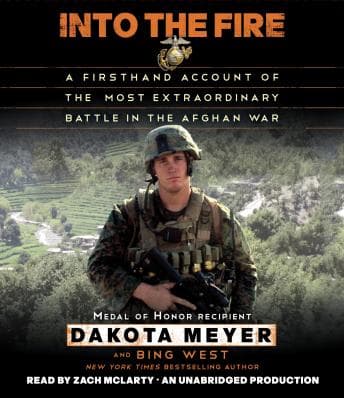

What does courage actually sound like when it's stripped of ceremony and the polish of presidential speeches?
I was up past midnight — Denise asleep, the apartment quiet except for the hum of the radiator and the scratch of my red pen across a stack of junior essays about The Things They Carried. And here I was, listening to a book about the real thing. Not Tim O'Brien's careful, recursive questioning of truth and memory, but a twenty-one-year-old Marine driving back into a kill zone over and over because his friends were dying and nobody with authority would send help. The contrast hit different at 1 AM with O'Brien's fictional weight still fresh on the papers in front of me.
When the Chain of Command Becomes the Enemy
What makes Into the Fire land harder than a lot of war memoirs is the rage underneath it. Dakota Meyer and Bing West aren't just telling you about a firefight — they're telling you about a system failure. The battle at Ganjigal in September 2009 wasn't some unforeseeable catastrophe. Meyer's team walked into a textbook ambush in a village surrounded by high ground, and when they called for artillery and air support, they were denied. Repeatedly. By officers sitting safely at a command post miles away. Meyer, a corporal — barely old enough to drink — disobeyed direct orders to stay with the vehicles and instead mounted up in a Humvee turret and drove into the valley. Five times. The book tracks each run with enough tactical specificity that you can feel the geometry of the terrain closing in: the stone walls channeling fire, the orchard where the team was pinned, the ridge lines where Taliban fighters had unobstructed shooting lanes.
What West brings as a co-author — and he's one of the best military correspondents alive — is the infrastructure of context. He lays out why the rules of engagement had become so restrictive that Marines were essentially fighting with one hand tied behind their backs. This isn't partisan ax-grinding. It's the kind of operational critique that reads like an after-action report with a pulse. I found a similar kind of institutional reckoning — angrier and more sweeping in scope — in War on the West, where the critique of Western self-sabotage operates at the civilizational level rather than the operational one. Meyer's voice provides the ground-level fury. West provides the systemic indictment. Together they make the argument that Ganjigal wasn't just a tragedy — it was an avoidable one.
The Parts That Don't Make the Medal Citation
The book is strongest when it's at its most uncomfortable. Meyer doesn't sanitize the aftermath. He talks about the guilt of surviving when four of his teammates — including his mentor, Lieutenant Michael Johnson, and Staff Sergeant Aaron Kenefick — didn't. He talks about drinking too much back home in Kentucky. About the weird purgatory of being told you're a hero when all you can think about is the friends you couldn't reach in time. There's a passage where he describes finally retrieving the bodies of his fallen brothers from the battlefield, and the prose goes flat and declarative in a way that tells you more than any emotional flourish could. West and Meyer understood that restraint is its own kind of honesty.
The weaker sections are the early chapters — Meyer's upbringing on the farm, his path to the Marines. It's not bad, but it reads like setup for a story that doesn't need much setup. You can feel the book clearing its throat for the first hour or so before it gets to Ganjigal. If you loved House to House by David Bellavia for its relentless forward momentum, this one asks for a little more patience before it pays off.
Zach McLarty Behind the Mic
Here's where I have to be honest: the research on McLarty's narration is thin, and I don't have a lot of specific technical notes to offer. What I can say is that the performance is workmanlike in the best sense — he doesn't get in the way. For a book like this, that matters. You don't want vocal theatrics when a kid is describing carrying a wounded Afghan soldier under fire. McLarty keeps a steady pace and reads with enough gravity to honor the material without tipping into melodrama. I listened at my usual 1.0x because — and I'll keep saying this until my students stop rolling their eyes — the author chose those words. At under six hours, there's no reason to rush it.
That said, I wouldn't call the narration exceptional either. It's competent. It serves the story. For a memoir co-written by a living Medal of Honor recipient, part of me wonders what it would've sounded like with Meyer himself reading it — the Kentucky cadence, the pauses where memory catches. But that's a what-if, not a criticism.
Who This Is For (And Who Should Pair It With Something Else)
If you teach war literature — or if you've ever tried to explain to a room of sixteen-year-olds why we read about conflict — this is valuable primary source material. If you loved Lone Survivor, this covers similar terrain but with a sharper institutional critique. If you're looking for literary prose in the O'Brien tradition, that's not what this is. This is blunt, factual, angry in the right places, and honest about both heroism and failure.
My students would probably connect with Meyer's age more than they'd expect. Twenty-one. Most of them are three years away from that. Worth sitting with.
The Red Pen Goes Down
I finished this one with the grading abandoned and the pen capped. Some stories make the essays on your desk feel a little smaller — not less important, but smaller. Report from Ground Zero did the same thing to me — first responders running toward the collapse while everyone else ran out, documented with the same blunt, declarative honesty that makes you put down whatever you were holding. Meyer drove into that valley five times. The least I can do is listen once, at the speed the words were meant to be heard.








![Steve Jobs [unabridged audiobook] audiobook cover](/_next/image?url=https%3A%2F%2Fcovers.audiobooks.com%2Fimages%2Fcovers%2Ffull%2F9788499923406.jpg&w=1920&q=75)