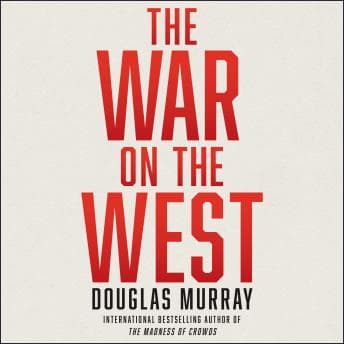

When did defending Western civilization become a controversial position?
That question kept rattling around my head during a late-night security consultation in Dallas. Client wanted to discuss cyber vulnerabilities, but I had Murray's clipped British voice in my earbuds during the drive, and honestly, I was more engaged with his argument than the PowerPoint I was about to sit through.
The Debrief on Murray's Thesis
Let me cut to the chase: Douglas Murray makes a case that Western self-flagellation has gone from healthy introspection to something approaching civilizational suicide. He's not arguing the West is perfect—nobody with half a brain would claim that. He's arguing that the standard we apply to ourselves is wildly inconsistent with how we judge everyone else.
The man's done his homework. He walks through the academic dismantling of Enlightenment thinkers—Kant, Hume, Mill—for their racial views while conveniently ignoring that Marx was peppered with slurs that would get anyone canceled today. Murray's point isn't to excuse the former but to highlight the selective outrage. If we're torching statues over historical racism, why does Che Guevara still get a pass on college dorm walls?
What I appreciated—and I've seen this scenario play out in real life—is his examination of how authoritarian regimes exploit Western guilt. China running actual concentration camps while American corporations apologize for... what exactly? I spent time in places where human rights meant nothing. The double standard Murray identifies isn't academic. It's strategic. Fire and Fury captures a different kind of strategic chaos—the kind that happens when institutional norms collapse from within. Our adversaries use our self-criticism as a weapon, and we hand them the ammunition.
Murray Behind the Mic
Murray narrates his own work, and that posh British accent carries a particular authority. But the real performance comes when he's quoting the more unhinged critics of Western civilization. He gives these passages a slightly deranged voice—not mocking exactly, but letting the absurdity speak for itself. When he reads some of the more extreme academic positions, there's this subtle theatrical edge that makes you realize, "Wait, someone actually wrote that?"
The narration is clean and measured. No stumbles, no pacing issues. At 1.25x, it's crisp without losing the argumentative flow. Murray writes like he speaks—elegant, precise, occasionally cutting. Having him read his own words means you get the exact emphasis he intended.
Where It Lost Me
Murray sometimes moves too quickly through counterarguments. He's so busy building his case that he doesn't always steel-man the opposition. I'm generally sympathetic to his position—I've seen enough of the world to know that American self-hatred looks absurd from Kabul or Baghdad. But a stronger book would spend more time with the best versions of opposing arguments, not just the easy targets.
Some critics call his analysis shallow or reactionary. I don't think that's quite fair, but I understand the complaint. Murray's writing for a general audience, not an academic journal. He's making a popular argument, not a peer-reviewed thesis. If you want 400 pages of footnotes, look elsewhere. If you want a coherent, well-articulated defense of Western values from someone who clearly cares about getting it right, this delivers.
Who This Is For (And Who Should Skip It)
If you already agree with Murray, you'll find this validating. If you're genuinely curious about the case for Western civilization, you'll find it informative. If you think the phrase "Western civilization" is itself problematic, you'll hate every minute. That's fine. Know your audience, know yourself.
The 12-hour runtime is substantial but not bloated. Murray covers race, culture, history, and philosophy without feeling like he's padding. Each section builds on the last. It's the kind of listen that works during long drives when you want something to chew on mentally.
Ranger slept through most of it—not his genre. But I found myself rewinding sections to catch arguments I wanted to think about more carefully. That's a good sign. Books that make you work are books worth your time.
Mission Assessment
Murray's not going to change minds that are already made up. But for anyone who's felt uneasy about the direction of cultural discourse—who's wondered why we're so eager to condemn our own history while giving everyone else a pass—this is a well-argued, well-narrated articulation of that unease. Worth your time? Affirmative. Just know what you're getting into.









