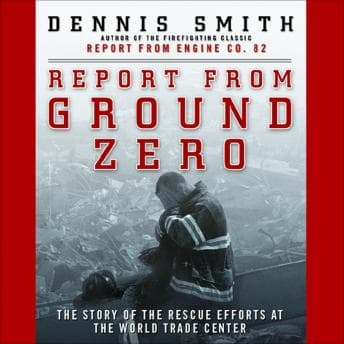

"What would make someone rush into a towering inferno and dash up stairs toward danger against a flow of human beings running in the opposite direction?"
That question hit me about twenty minutes into this audiobook, and I had to pull my truck over. Ranger looked at me like I'd lost my mind. Maybe I had, for a minute there.
Look, I've been in situations where you run toward the chaos instead of away from it. Different chaos, different continent, but the wiring is the same. Dennis Smith - himself a 30-year FDNY veteran - gets this in a way that most authors never will. He's not writing about heroes from the outside looking in. He's writing about brothers. And you can hear it in every page.
The Weight of Multiple Voices
The ensemble cast approach here is interesting. Beth McDonald, Don Leslie, Eric Conger, Jeff David - they rotate through the material, and honestly? It took me a bit to adjust. First hour or so, the transitions between narrators felt a little jarring. Like changing radio stations mid-song.
But here's where it started making sense: this isn't one story. It's dozens. Maybe hundreds. Having different voices carry different accounts actually mirrors the chaos of that day - multiple units, multiple perspectives, multiple people making split-second decisions that would define who lived and who didn't.
The narration itself is solid. Clear, measured pacing. Nobody's trying to be dramatic for drama's sake, which I appreciated. When you're dealing with material this heavy, you don't need a narrator chewing the scenery. Just tell it straight. They did.
Where the Details Hit Different
Smith did his homework. The tactical details - how companies were deployed, the communication breakdowns, the stairwell logistics - it's all there. For anyone who's ever coordinated a complex operation under pressure, you'll recognize the patterns. The fog of war isn't just a military thing. It happens in burning buildings too.
Some reviewers have complained that the book is "too somber" or that the pacing drags. I'm gonna push back on that. Hard. This isn't a thriller. It's a record. An oral history of the worst day in American firefighting history. If you're looking for action movie pacing, you're in the wrong section of the bookstore.
What I will say is that at just under seven hours, it's dense. You're not gonna breeze through this on a quick errand run. I listened over three days of client visits across central Texas, and there were moments I had to pause. Not because it was boring - because it was heavy. The accounts of guys who went up knowing they probably weren't coming down. The radio calls. The silences.
Ranger sat through all of it. He's a good boy.
The People Behind the Turnout Gear
One criticism I've seen is that the "characters" feel one-dimensional. I get where that's coming from, but I think it misses the point. These aren't characters. They're real people, and Smith is reporting what they did, not crafting backstories for narrative satisfaction. You get glimpses - a guy's sense of humor, another's quiet faith, the rookie who stepped up when the veterans fell - but this isn't about character arcs. It's about duty. About showing up.
The book works best when you stop expecting it to be something it's not. It's not "The Looming Tower" with its geopolitical sweep. It's not the 9/11 Commission Report with its bureaucratic analysis. That same ground-level perspective - ordinary people caught in extraordinary historical moments - is what makes Sapiens so compelling when it shifts from macro history to individual human experience. This is boots in the rubble. And for that specific thing, it's exactly what it should be.
SITREP
If you want to understand what happened inside those towers - not the politics, not the intelligence failures, but the actual human beings climbing those stairs - this is the book. Smith earned the right to tell this story, and the ensemble cast delivers it with appropriate gravity.
Is it perfect? No. The multiple narrator transitions can feel choppy. Some sections feel more polished than others. And yeah, it's emotionally exhausting in places.
But that's kind of the point, isn't it?
Who should listen: First responders, military folks, anyone who wants the ground-truth account of that day from someone who lived that life. Who should skip: If you need fast pacing or can't handle heavy emotional weight right now, hold off.
I've seen this scenario play out in real life - not 9/11, but the same fundamental situation. People running toward what everyone else is running from. This book captures that better than anything else I've listened to on the subject.
Ranger approved this one. So do I.






![Steve Jobs [unabridged audiobook] audiobook cover](/_next/image?url=https%3A%2F%2Fcovers.audiobooks.com%2Fimages%2Fcovers%2Ffull%2F9788499923406.jpg&w=1920&q=75)