
I was making chana masala at 10 PM on a Tuesday — the kind of elaborate cooking-for-one situation my therapist would call 'self-soothing through routine' — when I realized I'd been listening to a Christian sex manual for over two hours and hadn't flinched. That's either a commentary on me or on the surprisingly clinical delivery of Intended for Pleasure. I'm going to say it's the latter.
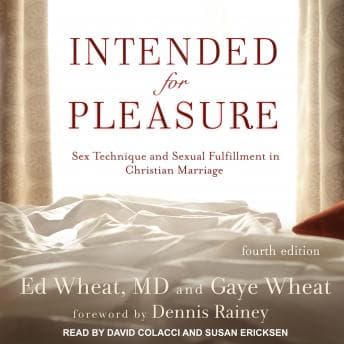
Let me be upfront: I'm not the target audience here. I'm a psychology researcher, not a pastor or a newlywed in an evangelical congregation. But I study how frameworks shape behavior, and this book is a fascinating case study in how religious authority structures attempt to give permission for something the body already wants to do. Ed Wheat, a family physician who died in 2001, wrote this with his wife Gaye, and the original text has been a fixture in conservative Christian premarital counseling for three decades. The audiobook version — narrated by David Colacci and Susan Ericksen — runs nearly eleven hours, which is... a lot of sex education.
When the Doctor and the Pastor Share a Body
The most psychologically interesting thing about this book is its dual identity crisis. One minute, Wheat is writing like an OB-GYN explaining anatomy with medical precision — labeling parts, describing physiological responses, discussing dysfunction and treatment. The next minute, he's quoting Scripture to frame sexual pleasure as divinely ordained within marriage. The research actually shows that people internalize health information more readily when it comes from a trusted authority within their existing belief system, and Wheat clearly understood that. He's not just a doctor here. He's a doctor who speaks your church's language, and that's the whole strategy.
But here's where it gets complicated. The book was first published in 1977, updated a few times, but the underlying assumptions about gender roles are... of their era. The wife's pleasure matters — Wheat is genuinely progressive for his context in insisting on that — but the framework is still one where the husband leads and the wife responds. I found myself asking: does this model of sexual partnership actually produce the fulfillment it promises, or does it just produce compliance with a more gentle face? Psychologically, the distinction matters enormously.
Two Narrators, One Very Specific Vibe
Colacci and Ericksen split the narration, which makes structural sense — he reads the more clinical and theological passages, she handles sections directed at women. Neither narrator is doing anything flashy. This isn't a performance; it's a reading. And honestly, for a book like this, that's probably the right call. You don't want dramatic flair when someone is explaining the physiology of arousal in a chapter that also references Song of Solomon.
That said, at nearly eleven hours, the steady, measured pace starts to feel like sitting in a very long doctor's appointment. There's no variation in energy. No moments where the delivery shifts to match the emotional weight of what's being discussed — and some of what's discussed (sexual trauma, dysfunction, the anxiety many religious couples carry into their wedding night) deserves more than a flat read. I didn't hate the narration. I just wished it had a pulse sometimes.
The Permission Problem
What makes this book genuinely compelling — and I say this as someone who analyzes character motivations for a living — is the psychological need it's trying to fill. The protagonist here isn't a fictional character; it's the anxious Christian newlywed who's been told their whole life that sex is dangerous and sinful, and who now needs someone with both medical credentials and theological authority to say: "Actually, God wants you to enjoy this." That's a real person with real internal conflict, and Wheat takes that person seriously. Anita Moorjani's Dying to Be Me does something structurally similar — uses a high-stakes personal crisis to give readers permission to release beliefs that were quietly suffocating them, and it works for the same psychological reason: the author has earned authority through experience, not just doctrine.
But the book is also thirty-plus years old, and some of its medical information and biblical interpretations have aged the way you'd expect. Certain claims about sexual health feel dated compared to current research. And the exclusively heterosexual, cisgender, complementarian framework means huge swaths of the Christian community are simply invisible here. If you're outside that framework, you'll feel it.
I kept thinking about what my dissertation advisor would say: "Whose story is being told, and whose isn't?" The answer here is very specific. This is for a very particular couple in a very particular church, and it serves them with genuine care. Everyone else is an afterthought. Or not a thought at all.
Who Needs This (And Who Really Doesn't)
If you're in a conservative Christian marriage — or about to be — and you grew up in purity culture with zero practical sex education, this book is trying to help you. It's kind, it's explicit without being salacious, and it treats sexual fulfillment as a legitimate spiritual goal. For that specific listener, it could be genuinely useful.
If you're looking for a modern, inclusive, psychologically informed guide to sexual health? This isn't it. The framework is too narrow, the science too dated, the assumptions too rigid.
And at 10 hours and 39 minutes, it's a significant time commitment for what is essentially a reference manual. This is a book you dip into by chapter, not one you listen to end-to-end while making dinner. Trust me on that.
My Clinical Assessment
I respect what Wheat was doing. He saw a population that was suffering in silence — people whose faith made them afraid of their own bodies — and he used his authority to give them permission to experience pleasure. That's not nothing. But the book is a product of its time and its theology, and I can't evaluate it outside of that. The narration is competent but flat. The content is helpful for its intended audience and irrelevant to most others. A niche tool, not a universal one.