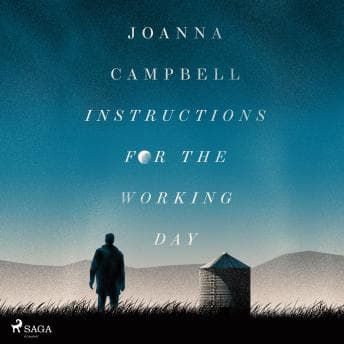

Joanna Campbell wrote a novel about inherited guilt, and I almost missed it entirely because the surface is so quiet you don't realize the ground is shifting beneath you until hour four.
I was walking the lakefront with Denise on a Saturday morning - one of those gray Chicago days where the lake looks like hammered steel - and Neil Fischer was arriving in Marschwald, this crumbling East German village he's inherited from his dead father. The cold damp of the setting matched perfectly. Too perfectly, honestly. Denise asked me why I was walking so fast and I didn't have a good answer. The book had me leaning forward.
The Ghost Town That Won't Stay Dead
Here's what Campbell does that I haven't seen done this well since maybe Sebald: she makes a physical place carry the full psychological weight of a political system. Marschwald isn't just a derelict village - it's a standing accusation. Neil arrives with his renovation plans and his English optimism and his desperate need to prove something to a father who's no longer alive to be impressed, and the village basically says: you don't get to fix this. You don't even understand what broke.
The Stasi legacy here isn't presented as history-book material. It's in the way Silke flinches at certain questions. It's in the neighbors who watch Neil from behind curtains and won't explain why. Campbell studied German at university, lived in West Germany, and you can feel that lived knowledge in the details - not the big dramatic surveillance scenes you'd get from a thriller, but the slow erosion of trust between people who used to be neighbors before one of them started filing reports. This is a novel about what happens to a community after the informers are exposed but still live next door. The dread of being watched from within your own community - I kept thinking about how differently Into the Drowning Deep handles that same slow erosion of trust among people who can't escape each other.
And then things get surreal. Not magical realism exactly, but the line between Neil's psychological state and external reality starts to blur in ways that made me rewind more than once. Is he actually experiencing these encounters, or is he cracking under the weight of whatever his father left him - not just the property, but the history attached to it? Campbell doesn't hand you the answer. She trusts you to sit with the discomfort.
John Sackville and the Art of Restraint
Sackville narrates this at exactly the right temperature. He doesn't oversell the menace - and this book has real menace running underneath it like an electrical current - but his emotional delivery during Silke's sections genuinely stopped me in my tracks. There's a particular quality to his voice when Silke starts uncovering her "shocking truth" (Campbell's phrase, and earned) where you can hear the narrator processing the weight of what he's reading. The prose deserves to be savored, and Sackville clearly agrees.
What I appreciate is what he doesn't do. No heavy German accents. No melodramatic pauses during the darker revelations. He lets Campbell's sentences - which are deceptively simple, almost spare - do their own work. At 7 hours and 19 minutes, this is a tight listen, and Sackville doesn't pad a single moment.
If I have a criticism, it's minor: some of the village characters blur together vocally. In a book where the community itself functions almost as a single organism of suspicion, maybe that's intentional. But I occasionally lost track of which neighbor was speaking during the more confrontational scenes.
Why My AP Lit Students Need This (And Would Resist It)
This reminds me of what Hemingway said about writing - the dignity of movement of an iceberg is due to only one-eighth of it being above water. Campbell's surface narrative is a man trying to renovate a village. The seven-eighths below the waterline is about inherited trauma, the impossibility of restoration (of buildings, of relationships, of trust), and whether a son can ever finish his father's unfinished business without understanding what that business actually was.
If you loved "The Reader" by Bernhard Schlink, this is its spiritual successor - though Campbell is doing something stranger and less resolved. Claire Fuller called it "mind-bending and enigmatic" and that's accurate, but it undersells the emotional precision. The funny parts are genuinely funny. The tragic parts landed hard enough that I stopped walking and just stood there on the path like a weirdo staring at the lake.
My students would hate this. I love it. It moves at the pace of someone carefully opening a door they suspect is booby-trapped, and the payoff is less an explosion than a slow dawning horror. Worth pausing the faculty meeting for - and I say that knowing full well my faculty meetings have a pretty low bar.
Who Gets an A, Who Should Transfer Out
This is for readers who love post-war European fiction, psychological ambiguity, and prose that does more with less. If you need plot momentum or clear answers, you'll be frustrated. If you want a 7-hour action sequence, obviously not. But if you've ever finished a book and immediately wanted to listen again because you suspect you missed half the architecture - this is that book.
Denise asked me what it was about when we got home. I started explaining and twenty minutes later she said, "So it's a ghost story without ghosts." And yeah. That's exactly what it is.