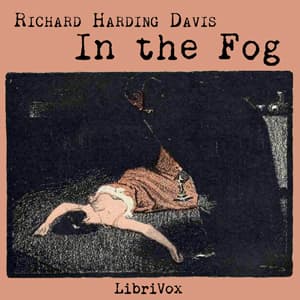

What happens when a city conspires to erase a crime?
I was up too late again—1 AM, lights off, Shirley curled on my chest like a furry weighted blanket—when I finished Richard Harding Davis's In the Fog. At just over two hours, it's barely longer than a double feature podcast episode. But that Victorian atmosphere? It clings to you like the London fog that gives this novella its name.
Gentlemen's Club Gothic
The setup is almost absurdly elegant: an American at an elite establishment called The Grill recounts stumbling through impenetrable fog and accidentally discovering a double murder. A young nobleman. A Russian princess. He reports it to Scotland Yard, and here's where it gets genuinely unsettling—they can't find the house again. The fog has swallowed it whole.
This understands that horror isn't about gore—it's about dread. And while In the Fog isn't strictly horror, it operates on nightmare logic. Being lost in a city you thought you knew. Finding a crime scene and then failing to prove it existed. Three other club members then offer their own perspectives on the incident, each peeling back another layer of what might have happened. Davis wrote this in 1901, but the Rashomon-style structure feels almost modern.
Compared to something like Wilkie Collins's sensation novels or early Conan Doyle, Davis is playing a more intimate game. There's no grand detective figure swooping in. Just men in armchairs, brandy in hand, trying to out-deduce each other while the real truth stays buried in fog.
The armchair detective energy actually reminded me of Bullet That Missed: A Thursday Murder Club Mystery—very different century, same fundamental pleasure of watching clever people talk circles around a crime they're not quite supposed to be solving.Bob Gonzalez Plays It Straight
Gonzalez approaches the material with a straightforward, no-frills reading. He's not doing theatrical vocal gymnastics to distinguish between the American narrator and the British aristocrats—the differentiation is subtle, relying more on cadence than accent work. It's a conservative choice, and honestly? For a drawing-room mystery where the atmosphere does most of the heavy lifting, it works.
The narrator commits. That's rare. He clearly respects the source material (he provides the introduction himself, which has that passion-project energy). But if you're expecting distinct character voices that immediately telegraph who's speaking, you'll need to pay closer attention. The production is clean, no audio issues, just a single voice guiding you through the fog.
For a public domain recording, it's solid. Not revelatory, but solid.
Who Should Get Lost Here (And Who Should Stay Home)
If you love the idea of Victorian London as a character—the gaslight, the cobblestones, the way the fog transforms familiar streets into alien territory—this is your jam. Perfect for a single commute or a late-night session when you want something atmospheric but not emotionally devastating.
Skip if you need action. The murder happens offstage. What we get is the aftermath: civilized men in civilized settings discussing very uncivilized violence. That tension between drawing-room manners and lurking horror is the whole point. If that sounds boring to you, fair enough. But if it sounds like a cozy evening with dread? Welcome to my world.
Also worth noting: at 2 hours and 9 minutes, this is practically an appetizer. Perfect for anyone intimidated by committing to a 40-hour epic but wanting something with more substance than background noise.
From the Stacks: A Forgotten Gem
As a librarian, I have a soft spot for forgotten gems like this. Davis was huge in his day—journalist, war correspondent, fiction writer—and then mostly faded from popular memory. In the Fog is exactly what I'd recommend to patrons who ask for "something atmospheric but not too heavy."
The mystery itself won't blow your mind if you've consumed a lot of the genre. But the execution—the nested narratives, the fog as both literal and metaphorical obscurer of truth—feels ahead of its time. Shirley Jackson walked so this author could run. Or at least, briskly stroll through a very atmospheric London evening.
My podcast listeners are going to love this. Especially the ones who think horror is only about blood. Dread, my friends. It's always been about dread.