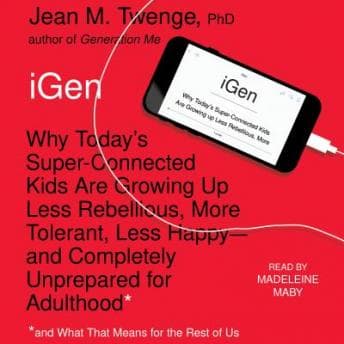

I need to talk about the subtitle of this book. "Why Today's Super-Connected Kids Are Growing Up Less Rebellious, More Tolerant, Less Happy--and Completely Unprepared for Adulthood--and What That Means for the Rest of Us." That's not a subtitle, that's a dissertation abstract. And honestly? It tells you almost everything you need to know about Jean Twenge's approach: she's going to give you ALL the data, whether you asked for it or not.
I was making my mother's rajma recipe — the one that takes two hours and requires you to stand at the stove stirring like your life depends on it — when I started this. Ten hours is a commitment. By the time the kidney beans were done, I was three hours deep and already arguing with Twenge in my head.
The Correlation Problem (And Why It Kept Me Up at Night)
Look. I study how narratives shape identity. Twenge studies how generations shape behavior. We should be natural allies. And in some ways, we are — she's drawing on massive datasets, tracking trends across the Monitoring the Future survey and the American Freshman Survey and the General Social Survey. The woman has receipts. When she shows that the percentage of teens who get together with friends nearly every day dropped by more than 40% from 2000 to 2015, that's striking. When she maps the rise of depressive symptoms in teen girls almost perfectly onto smartphone adoption curves, you sit up.
But here's where my research brain starts twitching: Twenge presents correlations with the confidence of someone announcing causation. She's careful enough to hedge in the text — she'll say "perhaps contributing" or "likely related" — but the entire architecture of the book, the way chapters are organized, the way arguments build, treats the smartphone as THE explanation for basically everything happening to post-1995 kids. Less dating? Phones. More anxiety? Phones. Less driving? Phones. Slower path to adulthood? You guessed it.
The research actually shows something messier. Economic factors, the 2008 recession's long shadow on families, rising inequality, the opioid crisis reshaping communities — these get acknowledged but never given the same weight. It's frustrating because the data she presents IS interesting. But she's constructed a narrative that's cleaner than the evidence supports. And I found myself asking: why does Twenge keep circling back to the single-variable explanation when her own training should make her allergic to it? Malcolm Gladwell does something similar in David and Goliath — the storytelling is magnetic, the pattern recognition genuinely exciting, but the single-lens explanation starts to feel like a hammer that makes every data point look like a nail.
When the Author Becomes the Case Study
Some listeners have noted that Twenge's ego shows through, and — yeah. There's a recurring pattern where she positions herself as the lone voice of reason who saw this coming. References to her earlier work pop up with the frequency of someone who really wants you to know they were right first. The protagonist of this book isn't iGen. It's Jean Twenge, data warrior.
But here's the thing — and this is what makes the book genuinely useful despite my complaints — she's not wrong about everything. The chapters on mental health are sobering. The data on teen loneliness, on sleep deprivation correlated with screen time, on the specific ways social media hits girls harder than boys — this stuff matters. When she describes the shift from "I can handle whatever comes" to "I need to feel safe first" as a generational psychological posture, that's a fascinating case study in how collective anxiety reshapes individual identity formation. That's the Twenge I want more of.
The chapter on religion and spirituality was unexpectedly good. She tracks the rise of "spiritual but not religious" and the sharper rise of "none of the above" with genuine curiosity rather than hand-wringing. And the section on attitudes toward work — how iGen wants work-life balance more than any previous generation but also expects less financial security — is the kind of paradox that makes a psychology nerd like me want to dig deeper.
Madeleine Maby Does Her Job (Quietly, Competently)
Maby's narration is steady and clear. She reads like a smart news anchor who happens to care about the material — not dramatic, not flat, just present. For a data-heavy nonfiction book, that's pretty much exactly what you want. She doesn't try to make statistics sound exciting, which I respect. The excitement should come from what the numbers mean, not from vocal theatrics. At nearly ten hours, she keeps a consistent energy that doesn't flag, which is harder than it sounds when you're reading sentences like "Figure 8.3 shows the percentage of 12th graders who..."
No complaints. No fireworks either. She's the narrator equivalent of a good research assistant — reliable, clear, doesn't insert herself where she doesn't belong.
Who Gets the Most Out of This
If you're a parent of teenagers, an educator, or someone who manages young employees and you want a data-backed (if occasionally overreaching) framework for understanding generational shifts — this is worth your time. If you already follow developmental psychology research closely, you'll find yourself nodding at the data and arguing with the interpretations. Which, honestly, is not the worst way to spend ten hours.
Skip it if you need every causal claim airtight. Or if you're an iGen member who's tired of being studied like a specimen. (Fair.)
My Professional Diagnosis
Twenge has written the equivalent of a compelling but flawed case study — strong observational data, pattern recognition that borders on brilliant, but a diagnostic conclusion that's too neat for the symptom cluster she's describing. I kept wanting her to sit with the uncertainty longer instead of reaching for the smartphone as universal explanation. The human mind has patterns, yes. But it also has complexity that resists single-factor models. Still — I learned things. I argued productively with the book in my head for days. And I burned the rajma. So there's that.