
Let's get one thing straight before we dive in: being an underdog usually sucks.
My parents ran a dry cleaning business in K-Town for thirty years. When a big chain opened three blocks away, they didn't feel like they had a "secret advantage" because they were small. They felt like they were going to lose the house. They worked 14-hour days to survive. That wasn't a strategy; that was panic.
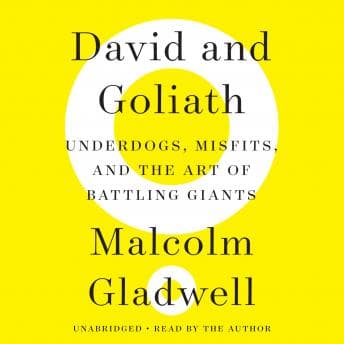
So, I went into Malcolm Gladwell's David and Goliath with my usual consultant skepticism—shields up, red pen out. I expected a lot of cherry-picked anecdotes telling me that having zero budget is actually a gift. (Try telling that to my startup clients who have two months of runway left).
And yeah, that's basically what the book is.
But here's the thing—and I hate that I'm admitting this—I couldn't stop listening.
The Gladwell Effect
Gladwell isn't really a writer anymore; he's a broadcaster. This audiobook won an Audie back in 2014, and you can hear why. The guy knows how to hold a room. Or a car. Or, in my case, a treadmill at 6 AM while I'm trying to forget I have a board meeting later.
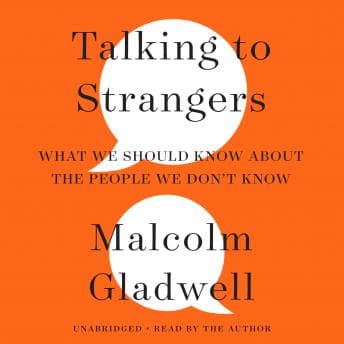
He narrates it himself. Usually, "author-narrated" is a red flag. It usually means "ego project with bad breath control." But Gladwell has that specific cadence—you know the one. It's that NPR-smooth, "I'm about to blow your mind with something incredibly obvious" tone. It's hypnotic. He pulls off the same trick in Talking to Strangers—that voice makes you believe he's revealing secrets when he's really just reframing common sense.
He takes the biblical story of David and Goliath and flips it. David wasn't an underdog; he was an artilleryman (slinger) bringing a gun to a knife fight. Okay, cool point. Then he jumps to Lawrence of Arabia, then to basketball teams, then to dyslexia.
The audio quality is pristine. No weird mouth noises, no awkward pauses. Just smooth, confident storytelling.
Where He Loses Me (But Keeps Me Listening)
Here is my issue as a guy who looks at data for a living: Gladwell loves a good story more than he loves a complete dataset.
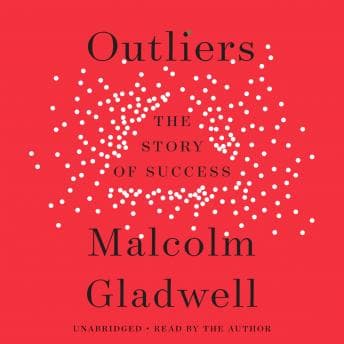
He argues that traumatic childhoods can create high achievers (the "desirable difficulty" theory). He talks about how losing a parent might make you a Prime Minister. It's the same pattern he explored in Outliers—this idea that success has hidden origins in struggle or timing.
Look. My parents struggled so I wouldn't have to have a "desirable difficulty."
But the way he weaves these case studies together? Brilliant. Even when I was shaking my head at the logic—like, literally rolling my eyes while doing deadlifts—I wanted to know where he was going. He makes business and psychology feel like a thriller.
(Jenny listened to it a few years ago and told me I'm too cynical. She said, "Just enjoy the narrative arc, David." She's probably right. She usually is.)
The ROI on Your Time
I listened at 2.0x speed. At that pace, Gladwell sounds like a very caffeinated, very enthusiastic professor.
Is this book going to save your business? No.
Is it going to give you some killer anecdotes to drop at a networking dinner to sound smart? 100%.
There's a chapter about the "inverted-U curve"—basically, the idea that more isn't always better. Too much money makes parenting hard. Too small class sizes don't actually help students. As someone who constantly tells founders to stop chasing metrics that don't matter, I actually nodded along to this part.
Who Should Listen (And Who Should Skip)
Grab this if you want 7 hours (or 3.5 hours at 2x, if you value your time) of high-quality intellectual entertainment that makes you rethink how you view obstacles. Skip it if you need rigorous data or actionable frameworks—buy a textbook instead.
Bottom Line
Just don't go telling a struggling small business owner that their lack of cash is a "secret weapon." They might throw a rock at you. And unlike Goliath, they won't miss.