
I was jogging through Cambridge—one of those gray mornings where the cold bites through your jacket—when Mia's world ended. And I just... kept running. Couldn't stop. The audiobook had me so locked in that I missed my usual turn and ended up a mile past my apartment before I realized what happened.
Look, I study how stories shape identity. It's literally my job. I've analyzed narrative structures in everything from Science of Getting Rich to contemporary fiction, and the mechanics of emotional engagement are always fascinating. So when a YA novel about a teenager in a coma makes me forget where I am in physical space? That's data. That's interesting.
The Psychology of Impossible Choices
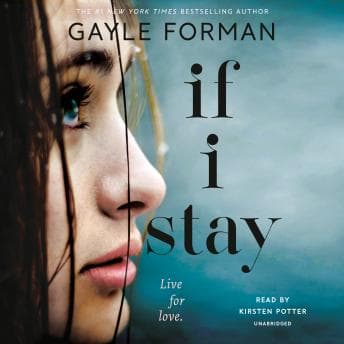
Here's the thing about If I Stay that most reviews miss: this isn't really a book about death. It's a case study in attachment theory and identity formation. Mia is watching her own life from the outside—observing her relationships, her memories, her possible futures—and trying to answer the question every psychologist secretly wants to ask: Who are we when we strip away everyone who loves us?
Gayle Forman gets something right that a lot of authors fumble. The protagonist exhibits classic ambivalent attachment patterns, and they make sense. Her pull toward Adam (the boyfriend) versus her pull toward her family isn't arbitrary teenage drama. It's developmentally accurate. Mia is seventeen, which means she's in the exact developmental stage where identity consolidation is happening. The accident doesn't just threaten her life—it threatens the person she was becoming.
(My therapist would have thoughts about this character. Specifically about how Mia processes grief while simultaneously experiencing it. A fascinating paradox.)
The research shows that near-death experiences often trigger rapid identity reevaluation. Forman captures this without making it feel clinical. The memories that flood back aren't random—they're the ones that matter for Mia's sense of self. Her cello. Her grandfather's quiet strength. The way Adam looked at her the first time he really saw her.
Kirsten Potter's Emotional Precision
Okay, so. The narrator.
Kirsten Potter does something I rarely see in YA audiobooks: she trusts the material. She doesn't oversell the emotional moments. When Mia is remembering her parents—their punk rock past, their weird beautiful marriage—Potter's voice gets this warm, almost nostalgic quality. But she doesn't push it into sentimentality.
There's a valid critique floating around that Potter sounds a bit too mature for seventeen. And yeah, I hear it. Her voice has a groundedness that most actual teenagers don't have. But here's my counterargument: Mia isn't narrating as a normal seventeen-year-old. She's narrating from a liminal space between life and death. She's been forced into a kind of wisdom she shouldn't have yet. The slight maturity in Potter's voice actually tracks, psychologically speaking.
The moments that hit hardest? The quiet ones. When Mia describes her little brother Teddy, Potter's voice catches just slightly. Not a sob. Not dramatic. Just a tiny hesitation that says everything. That's skill. That's someone who understands that grief isn't loud.
Where the Narrative Earns Its Tears
I'm going to be honest—I don't usually cry at books. (Don't tell my students, but I'm more of an "intellectually appreciate the emotional manipulation" type.) This one got me. Not the big moments you'd expect. It was the grandfather's bedside monologue. The way he gives Mia permission to leave without ever saying it directly.
What makes Mia compelling is that she's not passive, even though she's literally in a coma. Every memory she revisits is a choice. Every flashback is her weighing what's worth staying for. Forman structures the whole thing as a psychological evaluation—Mia is essentially running her own case study on herself.
The pacing works because it mirrors how memory actually functions. You don't remember your life chronologically. You remember in clusters of meaning. The audiobook leans into this, and at five hours, it doesn't overstay its welcome. I listened over two morning runs and one very long cooking session. (I made my mother's dal. Seemed appropriate for a book about family.)
Who This Is For (And Who Should Skip It)
This is for people who want to feel something. Full stop. If you're looking for plot twists or action sequences, you will be disappointed and possibly annoyed. The "action" here is internal—a girl deciding whether her life is worth living, and watching her work through that decision.
Content warning: the car accident is described. Family members die. If you're in a raw place with grief, maybe wait. Or don't—sometimes the books that hurt are the ones that help. I'm a psychologist, not a fortune teller.
Commuters, this is your jam. The emotional intensity is perfect for a morning drive when you need something to make the world feel real. Bedtime listeners, proceed with caution. You might not sleep.
The Case File Closes
I kept asking myself: why does Mia's choice feel so earned when it could easily feel manipulative? And I think the answer is Forman's refusal to make it simple. There's no right answer. There's just Mia, and her memories, and a decision that belongs only to her.
The audiobook sticks with you. It's been three days and I'm still thinking about it.