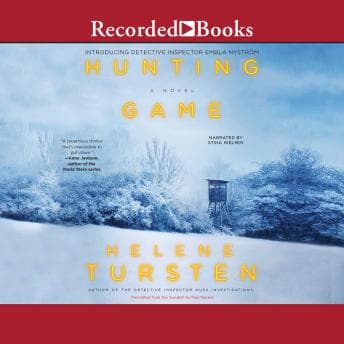

Embla Nyström should be a character I root for. On paper, she's got everything: chronic nightmares, anxious energy she channels into boxing and police work, a complicated psychology that practically begs for analysis. But somewhere between Helene Tursten's concept and the execution, Embla flatlines. And the audiobook narration doesn't do her any favors.
I was halfway through making dal makhani on a Sunday evening — the kind of elaborate, slow-simmering project that demands something in my ears — when I put this on. Swedish moose hunting mystery. Rural setting. Closed circle of suspects. Thirteen hunters, a bad omen. This is literally my comfort zone. Agatha Christie with elk and aquavit. I wanted to love it.
The Protagonist Who Wouldn't Let Me In
Here's the thing about writing a detective with anxiety, racing thoughts, and a tendency toward "unhealthy fixations" — you have to actually let us inside that head. The research actually shows that what makes fictional characters with mental health struggles compelling is specificity. Not just telling us someone has chronic nightmares, but showing us how those nightmares bleed into their waking decisions. Embla is described as rash and fixation-prone, but she mostly just... investigates things normally? She's a 28-year-old detective inspector who hunts moose and boxes at welterweight. Cool résumé. But where's the interiority?
I found myself asking: why does Embla really do what she does? And the book never quite answered. Compare her to Tursten's Irene Huss, who felt like a lived-in person with a family and contradictions. Embla feels like a character sheet that hasn't been fleshed out into a human being yet. The psychological interiority I kept waiting for here — the kind that makes you feel genuinely trapped inside a damaged mind — is exactly what Quiet Tenant delivers with such suffocating precision. This is a first-in-series problem sometimes — the author is still finding the character — but it's frustrating when the psychological setup promises so much.
The romantic subplot with Peter, the "enigmatic young divorcé" who joins the hunting party, is particularly weak. The protagonist exhibits classic patterns of attraction-as-plot-device rather than attraction-as-character-revelation. It reads distasteful rather than organic, like Tursten needed a love interest and picked the most convenient body in the room. My therapist would have thoughts about this character's relationship choices, and none of them would be kind.
Swedish Woods, Monotone Delivery
The atmosphere of the hunting camp is genuinely the best part. I'll give credit where it's earned. The details of Swedish rural hunting culture — the rituals, the group dynamics, the territorial tension when an outsider joins a longtime circle — that felt real and specific. Someone who knows this world wrote those scenes. The discovery of the missing hunter floating facedown in the lake, arm wedged between rocks, is a strong image. Visceral. The kind of detail that should land like a punch.
But Stina Nielsen's narration flattens nearly everything. Her delivery is monotone in a way that works against the material at every turn. She attempts emotional variation here and there — you can hear her trying — but it doesn't land. During moments when characters should be panicking or grieving or suspicious, the vocal register barely shifts. For a 7.5-hour listen, that's a problem. Nordic noir already tends toward restraint; when the narrator adds another layer of flatness on top, you get scenes that should crackle with tension just... sitting there. I bumped it to 1.25x around hour three, which helped the pacing but couldn't fix the emotional gap.
This is a fascinating case study in how narration can undermine an already struggling text. A more dynamic narrator might have compensated for Embla's underdevelopment by giving her voice some spark, some edge. Instead, the audiobook compounds the book's weaknesses.
Who Gets Invited to This Hunt
If you're a completist for Scandinavian crime fiction and you've burned through everything else — sure, this will fill a Sunday. If you loved Tursten's Irene Huss books and want to follow her into a new series, temper your expectations significantly. The slow-burn pacing suits the moose-hunting setting in theory, but the payoff doesn't justify the patience required.
Skip this if flat protagonists frustrate you, if you need your narrators to bring some vocal range, or if you're looking for psychological depth in your detective fiction. The bones of something interesting are here — the closed-circle hunting party, the superstition of thirteen, the rural Swedish landscape — but bones aren't enough.
Case File: Promising Setup, Insufficient Data
Psychologically, this doesn't track. You can't give a character anxiety, nightmares, and compulsive tendencies and then not let those traits meaningfully shape how she solves a murder. Embla Nyström deserved better writing and a better audiobook performance. I'll probably check in on book two — sometimes first installments are just rough drafts for the series a writer really wants to tell. But I won't be using a credit on it.