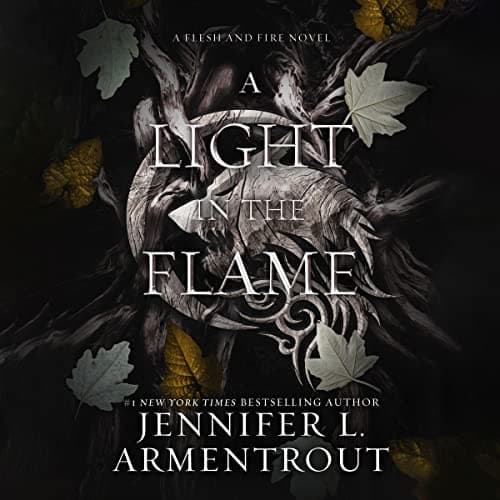

What happens when a romance literally cannot work—when the love interest is physically incapable of the one emotion that would save the heroine's life? That's the central tension driving A Light in the Flame, and it's the reason I kept my earbuds in during a three-day road trip instead of switching to my usual podcast rotation.
I listened to this one almost entirely on highway stretches through rural Pennsylvania, and I'll tell you exactly when the book grabbed me by the throat: somewhere around hour eighteen, when Sera and Nyktos arrive at Kolis's Court. Up until that point, I'd been enjoying the ride but occasionally zoning out during the mid-book push-pull cycles. Then the atmosphere shifted into something closer to a horror novel than a romance, and I missed my rest stop exit because I didn't want to pause.
Let me back up. A Light in the Flame picks up after Sera's assassination plot has been exposed, which means her fragile relationship with Nyktos is basically rubble. The book asks her—and you—to rebuild trust across 26 hours while Primal power grows inside her like a ticking bomb, a false god-king closes in, and attacks on the Shadowlands escalate. Armentrout is running multiple plotlines at full speed, and the mythology she's building around Iliseeum and the Primals feels genuinely lived-in here in a way the first book only hinted at.
But here's the honest truth about those 26 hours: not all of them earn their place. The middle stretch repeats a cycle—scorching intimacy, then retreat into mistrust, then tentative reconnection—that I clocked at least four times. Each individual scene works. Sera's internal conflict is real, Nyktos's emotional walls make sense given what we know about him. But the pattern becomes visible, and by the third round, I caught myself thinking "okay, I know how this one ends" before the scene played out. If repeated emotional stalemates frustrate you, you'll feel the length.
When the plot finally accelerates in the last third, though, it becomes relentless. The Court scenes with Kolis carry genuine dread—not cartoon villain energy, but something that made my skin crawl during a late-night listening session. And that ending? It's a cliffhanger that left me sitting in a dark parking lot staring at my phone. No resolution. No comfort. Just a gut-punch and silence.
Now—Stina Nielsen. This is where I have to be straight with you because listener opinions are wildly split and both sides have a point.
What she does well: Sera's emotional life. The vulnerability, the determination, the moments where duty and desire collide—Nielsen captures all of that with a delivery that made Sera feel like someone I was rooting for rather than just listening to. Her pacing across a 26-hour book is steady and confident, and at 1.5x speed (which I switched to around hour four and never switched back), the narration flows naturally.
What didn't work as well: the character differentiation blurs in places. Nyktos's voice shifted from the first book in a way that pulled me out of scenes—he started sounding like a character from a completely different series, and once I noticed it, I couldn't un-notice it. Nielsen's vocal distinctions actually land with more precision in A Shadow in the Ember, where the cast is smaller and her range isn't stretched as thin. The intimate scenes are the bigger issue. There are quite a few of them, and Nielsen's tonal choices during those moments create a disconnect. The words on the page are clearly running hot, but the delivery stays at a cooler temperature. It's not terrible narration—it's a mismatch, and whether that bothers you depends entirely on how central the spice is to your experience.
The monotonous intonation criticism I kept seeing in other reviews? It's overstated but not invented. Nielsen has a default cadence she gravitates toward, and across this runtime, you will notice it. I did. It didn't ruin the experience for me, but I can absolutely see why some listeners wished for a different narrator.
Sera herself remains one of the strongest things Armentrout has written. She's not just defiant for the sake of being defiant—she's strategic, she's exhausted, and she's slowly realizing that what she wants and what her duty demands might actually be the same thing. That character arc kept me invested even through the repetitive middle sections.
Buy this if you love romantasy that lives in emotional tension and you're willing to sit through 26 hours of push-pull before a devastating payoff. The Court of Silver Flames crowd will probably feel right at home here—Court of Silver Flames runs a similar emotional gauntlet with Nielsen behind the mic, and the listener overlap between those two books is real. The world-building rewards your patience, and the final act delivers. Skip this if repeated mistrust cycles or a narrator with limited vocal variation across a long runtime will drive you to distraction. This book needs your full attention—it's not one you can half-listen to while doing dishes and expect to track the Primal politics.
The 4.78 source rating tracks for existing fans of the series. For newcomers, I'd shave a bit off for the narration divide and the middle-book pacing. But the story Armentrout is building here is ambitious, emotionally punishing in ways that feel earned, and ends on a note that will have you immediately searching for book three.