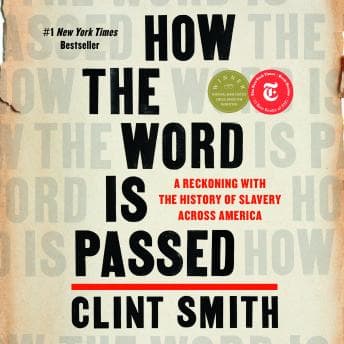

This book broke something in me. And I don't mean that in the hyperbolic way people throw around on social media. I mean I had to pull over during my morning commute because I was crying too hard to see the road.
Clint Smith doesn't just write history. He writes case studies of collective trauma, of how a nation builds identity through selective memory. As someone who spends her days analyzing why humans do what they do, watching Smith methodically visit these sites of American slavery felt like watching a colleague conduct field research I'd been too afraid to do myself.
The Psychology of Monuments and Memory
Here's what got me: Smith understands something fundamental about human cognition that most historians miss. We don't just remember history—we construct it. Every monument, every tour guide script, every plaque that says "workers" instead of "enslaved people" is a choice. A psychological defense mechanism writ large across the American landscape.
The Monticello section hit particularly hard. Thomas Jefferson writing about liberty while enslaving over four hundred people isn't just hypocrisy—it's a case study in cognitive dissonance so profound it became our national inheritance. Jefferson's own Autobiography of Benjamin Franklin shows a similar pattern—the Founding Fathers constructing their legacies while conveniently editing out the parts that don't fit the narrative they wanted to leave behind. Smith interviews tour guides who are actively wrestling with how to present this contradiction, and you can hear in his voice that he's not judging them. He's documenting the messy, uncomfortable process of a country trying to look at itself honestly.
And then there's Angola. A former plantation that became a maximum-security prison where Black men work the same land for virtually no pay. Trauma echoes across generations. Place holds memory in ways we're only beginning to understand. Smith doesn't need to spell out the psychological implications. He just describes what he sees, and your brain does the rest.
Why Author-Narration Changes Everything
I've listened to plenty of audiobooks where the author narrates and it's... fine. Competent. Sometimes actively bad (academics, I love you, but please hire professionals). Smith is different. He's a poet, and you can hear it in his pacing, in the way he lets certain sentences breathe.
When he reads his own reflections—standing in Blandford Cemetery surrounded by Confederate graves, or walking through the streets of lower Manhattan where enslaved people were once sold—there's a quality to his voice that a hired narrator couldn't replicate. It's not performance. It's presence. The warmth and compassion in his delivery never tips into sentimentality, which is honestly remarkable given the subject matter.
My therapist would have thoughts about how Smith processes his own emotional responses to these places. He doesn't hide them, but he doesn't wallow either. There's this psychological groundedness that makes the whole experience feel safe, even when the content is devastating.
What This Does to Your Brain
I finished this three weeks ago and I'm still thinking about it. Specifically, I'm thinking about how I drive past historical markers without stopping. How I've walked through cities without wondering what happened on the ground beneath my feet.
Smith—and yes, he's the protagonist here, not just the narrator—exhibits classic patterns of someone doing genuine integration work. He's not seeking closure. He's seeking understanding. And that's psychologically so much healthier than the American tendency to want history wrapped up with a bow.
The book runs ten hours, which sounds long, but it didn't feel it. I listened over two weeks of morning runs and cooking sessions, and I found myself deliberately slowing down so I wouldn't finish too quickly. That's rare for me. Usually I'm hitting 1.5x speed by chapter three.
One thing I appreciated: Smith doesn't tell you how to feel. He presents what he learns, shares his own reactions, and trusts you to do your own psychological work. It's a fascinating study in how to write about trauma without retraumatizing—or worse, without making the reader feel like they're being lectured.
Who Needs This (And Who Doesn't)
If you're interested in how stories shape identity—and I mean really interested, not just cocktail-party interested—this is essential. Educators, obviously. Anyone who's ever wondered why American conversations about race feel so stuck. Skip it if you need your history to have heroes, or if you're looking for something light. This isn't light. But it's not hopeless either. Smith ends with Juneteenth, with celebration, with the possibility that memory can be reclaimed rather than just inherited.
Final Assessment
I don't give out high ratings easily. My dissertation committee can confirm I'm a tough grader. But this? This is the rare book that changed how I think about my field. About place. About what it means to reckon with something instead of just learning about it.
My mother would ask why I need another book about sad things. Maa, sometimes the sad things are the most important ones.