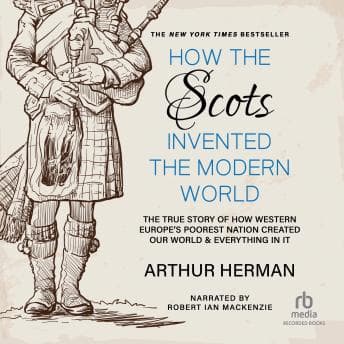

Arthur Herman's thesis is audacious, maybe even a little ridiculous, and I'm completely here for it.
The claim is right there in the title - the Scots invented the modern world. Not contributed to. Not influenced. Invented. And over eighteen hours, Herman makes a case that's far more convincing than it has any right to be. I started this one skeptical and finished it genuinely re-evaluating how I teach the Enlightenment.
The Scottish Enlightenment Deserves Its Own Semester
Here's what gets me. I've spent twenty years teaching American literature, touching on the Enlightenment as this vaguely French-and-English thing that happened before the Revolution, and Herman basically grabbed me by the collar and said you're missing half the story. David Hume, Adam Smith, Francis Hutcheson, Adam Ferguson - these names show up in footnotes of the texts I assign, but Herman puts them center stage and traces how their ideas about human nature, moral philosophy, and free markets became the operating system for Western democracy.
The structure works like a slow burn through centuries. Herman starts with the Act of Union in 1707 and Scotland's transformation from - and this is his framing - Europe's poorest nation into an intellectual powerhouse within a single generation. He tracks the Scottish contribution through the American founding (the number of Scottish-born or Scottish-educated signers of the Declaration is genuinely startling), through the Industrial Revolution, through the British Empire, all the way to Andrew Carnegie and the modern corporation.
This reminds me of what Hemingway said about writing - the dignity of an iceberg is that seven-eighths of it is underwater. Herman's doing that with historiography. The visible argument is about Scotland, but underneath he's really making a case about how ideas move through cultures, how poverty can breed intellectual ambition, and how education systems shape nations. If you loved James Burke's Connections - that sense of pulling threads between seemingly unrelated historical moments - this is its spiritual successor in book form.
Robert Ian Mackenzie Knows That Pause Is Punctuation
I'll be honest: the research on Mackenzie's specific performance here is thin. What I can tell you is that over eighteen-plus hours of dense historical narrative, the man never lost me. And I was listening during faculty meetings, during late-night grading sessions, during one very long Saturday walk along the lakefront where Denise finally asked why I kept stopping to mutter "I didn't know that" at the lake.
Mackenzie is an Earphones Award winner, and you can hear why. He reads with the energy of a history professor who actually likes teaching - not the monotone drone my students assume all professors sound like. There's an upbeat quality to his delivery that keeps the intellectual density from becoming a slog. At eighteen hours, that's not a small thing. A lesser narrator and this becomes homework. Mackenzie makes it feel like a conversation with someone who's genuinely excited about what they're telling you.
I don't have specifics on accent work or character differentiation because this isn't really that kind of book - it's narrative history, not dramatized fiction. But his pacing through Herman's longer analytical passages is patient without being plodding. The prose deserves to be savored, and he lets it breathe.
Where It Gets a Little Drunk on Its Own Thesis
Look, I love an ambitious argument. But Herman occasionally oversells. The subtitle - "everything in it" - is doing a lot of heavy lifting. There are moments where the causal chain from Scottish thinker to modern institution feels stretched thin, where correlation is doing the work of causation. And the book's enthusiasm for Scottish contributions sometimes means other influences get minimized in ways that made the historian in me squint.
At eighteen hours, there are also stretches in the middle - particularly around the colonial expansion sections - where the narrative gets bogged down in detail that serves completeness more than storytelling. I'd be lying if I said I didn't zone out during a budget presentation AND during a few of these passages. (Principal Martinez, I was definitely paying attention to both.)
But these are the complaints of someone who's engaged enough to argue back. That's a good sign. Bill Bryson pulls off something similar in A Short History of Nearly Everything - sweeping ambition, occasional overreach, and you end up arguing with the book instead of putting it down, which is exactly where you want to be.
Who Needs This in Their Ears
Anyone who teaches Western history or literature and wants their assumptions productively challenged. Anyone who thinks the Enlightenment was exclusively French and English. Anyone who wants to understand why the American university system, the free market, and modern medicine look the way they do. My students would probably groan at the length. I loved every contentious hour of it.
Skip it if you want narrative history that reads like a novel - this is closer to a well-argued lecture series. Also skip if sweeping civilizational claims make you twitchy. Herman's reach sometimes exceeds his grasp, but the reach is half the fun.
Worth Pausing the Faculty Meeting For
I'm adding this to my personal curriculum. Not because I agree with every argument Herman makes, but because it forced me to rethink connections I'd been lazy about. And Mackenzie's narration carried me through eighteen hours without ever making me wish I'd grabbed the print version instead. That's the test for nonfiction audiobooks, and this one passes. At 1.0x speed, naturally. The ideas deserve the time.






![Steve Jobs [unabridged audiobook] audiobook cover](/_next/image?url=https%3A%2F%2Fcovers.audiobooks.com%2Fimages%2Fcovers%2Ffull%2F9788499923406.jpg&w=1920&q=75)